Have you ever asked yourself, “What is my biggest fear in diving?” My fear has always been getting lost at sea. I am a technical diving instructor with almost 4,000 dives, and I’ve done plenty of boating, drift diving, and dealing with current. None of my training or experience prepared me for being lost at sea for six hours.
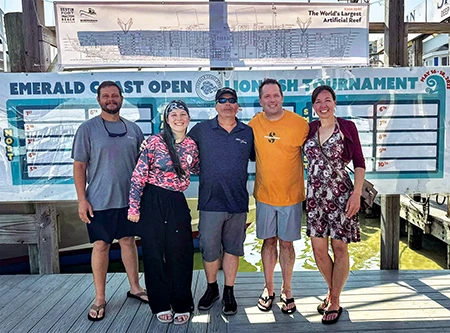
On the first day of the annual Emerald Coast Open Lionfish Tournament, my team and I left Pensacola, Florida, early in the morning. Our boat headed offshore to some positions approximately 11 miles off Navarre Beach in the Florida Panhandle.
I was the first to dive and had noticed on my four dives that morning that the current was nonexistent at the bottom but rapid for 20 feet (6 meters) from the surface. I paused for my safety stops at 25 feet (7.6 m) to avoid drifting.
While I was underwater on my fifth dive, the next two divers were preparing their gear. We already had about 50 lionfish in the cooler, and I had told the team it would be my final dive based on my remaining air. We were fishing at about 70 feet (21 m), so I would have 20 to 30 minutes of dive time based on my calculations.
When I surfaced I could hear the guys talking about the large pod of dolphins all around the boat. I watched two of the team members continue to look at the dolphins when I heard the boat going into gear to follow the other divers’ bubbles. I yelled, but they didn’t hear me. I blew the whistle on my BCD and then removed my glove and whistled with my fingers but got no response.
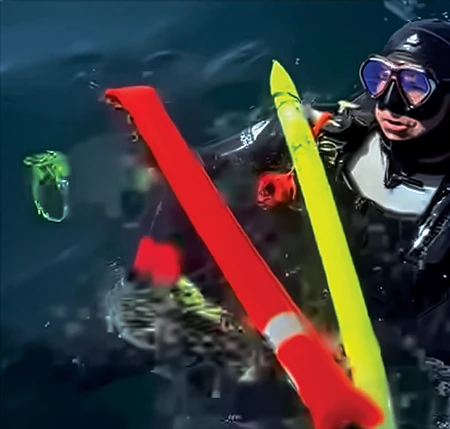
The boat was heading to the coordinates where I had gone under, and the gap between us grew rapidly. I found out later that the Coast Guard measured the current at 100 to 120 feet (30 to 37 m) per minute. I deployed my surface marker buoy (SMB) and waved it back and forth, but my team never saw me, even after I deployed my second signaling SMB. The only thing I could see for half an hour was the stern as they moved to the dive site and looked for bubbles they would never find.
The crew sent a diver to check on me, thinking I was trapped or dead on the bottom. I knew this team of highly qualified technical divers and professionals would search, so I would have to wait for them to confirm I was not on the bottom before looking elsewhere for me.
With the boat no longer in sight after an hour, I decided I would self-rescue and started swimming for shore. The shoreline 11 miles (18 kilometers) away seemed so close.
The dolphin pod feverishly circled me every five or 10 minutes when the boat first left and then spy-hopped in the direction of the boat. The boat crew later confirmed they saw the pod spy-hopping to the boat, and then the dolphins would disappear for 15 minutes before hopping back to the boat. Had the crew followed the dolphins’ bearing, they would have found me quickly.
I tried everything to get the dolphins to help me — holding out my open hand, talking to them, and pointing — but to no avail. They seemed to know that I needed help and wanted to do something, but we couldn’t make that happen.
When it was time to start swimming, I flipped onto my back and kicked hard for shore. As I went I inventoried everything I had, deciding what I could get rid of to lighten my load and make me more streamlined. I had two lionfish containment units (ZooKeepers), one with a medium-sized lionfish inside.
I’m embarrassed to say that I held onto things for too long, thinking the boat would arrive any minute. After about two hours of swimming, I used the line from one of my finger spools to tie the ZooKeepers together and onto my 4-foot (1.2-m) pole spear. With more than 10 feet (3 m) of SMB above my head, I thought I had plenty of signaling.
My hand was starting to get sunburned, so I had to lower the ZooKeepers underwater to get the lionfish out from next to my glove, which I had stored there to whistle with my fingers. I didn’t want to get poked by the lionfish spines, but I managed to dump it safely and get my glove.
I held onto the second ZooKeeper for an additional 20 minutes because its original owner, Allie Elhage, had signed and personalized it with a quirky nickname for me. I eventually realized that despite my emotional attachment to this piece of gear, I needed to drop it. Sorry, Allie.
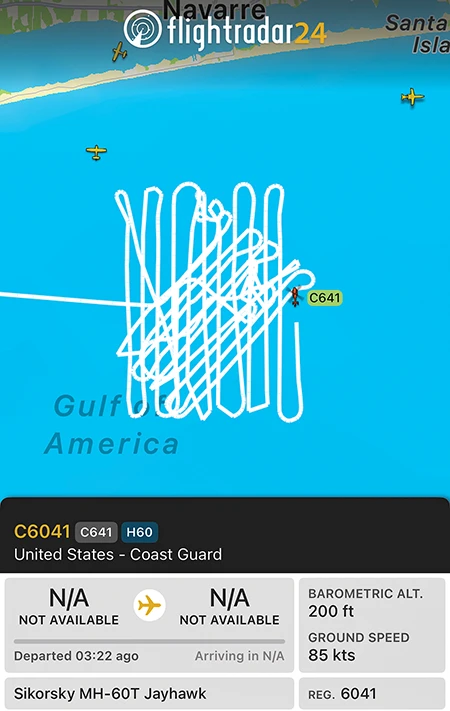
About three hours into being lost, I saw a Coast Guard helicopter. It made several close passes but never saw me or my SMBs. Four hours into swimming for shore, I could start to see balconies on the condos and hear kids screaming as they played on the beach. I guessed I was about a quarter of the way based on my pace, but a shore current swept me down the coast for the next hour.
The wind changed after that hour, and I was moving back offshore. I had wanted to keep my tank to help get through the surf, but I finally dropped it and used my SMBs like a pool noodle, which allowed me to rest and swim face down.
Finally, after six hours, a boat was coming straight toward me. A friend who heard I was missing had gone to the dive site, took drift calculations, factored in that I’d be swimming for shore, and drew a bearing right to me. A true friend indeed.
Throughout the ordeal I never panicked or had any doubt that I would make it to shore or that someone would find me. I believe that remaining calm and continuously working to solve the problem helped achieve the goal of rescue.
I didn’t have more than the basic two SMBs to make myself more findable, but based on my experience the basics are insufficient.
After seeing the amount of worry my disappearance caused my loved ones, I got a Garmin inReach Mini 2, which would allow me to send a text with my coordinates to the boat, my family, and the Coast Guard. It’s now as essential to my kit as my regulators. Having one could have potentially saved me from six hours adrift. What could it save you?
© Alert Diver – Q4 2025