DAN Medics and Researchers Answer Your Dive Medicine Questions
Q: Is breast pain a symptom of decompression sickness (DCS)?
A: Yes, breast pain can be a clinical manifestation of type 1 DCS, particularly in its cutaneous and lymphatic forms. It is essential to distinguish whether the discomfort is localized to the soft tissues of the breast or indicative of cardiac or musculoskeletal issues.
Joint pain, skin changes, and lymphatic involvement typically indicate mild type 1 DCS. Cutaneous (skin) DCS tends to present in areas overlying adipose tissue, a specialized form of connective tissue that primarily provides energy storage and insulation. The abdomen, back, thighs, and breasts are the commonly affected regions.
Lymphatic DCS arises in anatomical regions containing lymphatic tissue, which primarily influences immune function and fluid regulation. The breast contains an extensive network of lymphatic vessels and lymph nodes, making it susceptible to obstruction and inflammation from DCS. Lymphatic DCS can lead to swelling and discomfort involving the lymph nodes in the axillae (under the shoulder joint), groin, or behind the ears.
Breast pain may be misinterpreted or overlooked, particularly if it is the diver’s sole complaint. Reports of breast pain describe symptoms ranging from localized tenderness and itching to sensations of engorgement resembling lactation. People may attribute these presentations to inflammatory changes and impaired lymphatic drainage.
Responders should conduct a complete neurological exam and administer high-flow oxygen. Anyone experiencing symptoms should seek medical attention and may require hyperbaric oxygen treatment. They should avoid diving for at least one to two weeks and only resume after their symptoms have completely resolved and they have received clearance from their physician.
— Jevon Monaghan, EMT-P
Q: I was just diagnosed with postural orthostatic tachycardia syndrome (POTS). How can this disorder affect my ability to dive?
A: POTS is a form of dysautonomia characterized by autonomic nervous system dysfunction — specifically the body’s ability to regulate vascular tone and cardiac output in response to postural changes. Standing usually initiates compensatory mechanisms, such as vasoconstriction and increased heart rate, to counteract the gravitational pooling of blood in the lower extremities and maintain cerebral perfusion (blood flow processes).
The body accommodates this rapid fluid shift by activating several nervous system responses, including releasing hormones to help constrict blood vessels and increase heart rate. This response maintains adequate blood pressure, and our bodies continually adjust to maintain adequate perfusion, especially to the brain.
Vasoconstriction does not happen effectively in people with POTS, leading to more blood pooling in the lower half of the body and less circulation to the brain. Lightheadedness and fatigue are common symptoms, and heart rate increases as the body continues to release more epinephrine and norepinephrine. This response can produce chest pain, shakiness, and irregular heartbeats. Prolonged periods of standing can cause hypertension or hypotension, dizziness, and fainting.
An individual with POTS may not be symptomatic while in the water, but standing up to enter or exit the water can cause the pathological response at either critical period, possibly causing a fall and resulting in trauma.
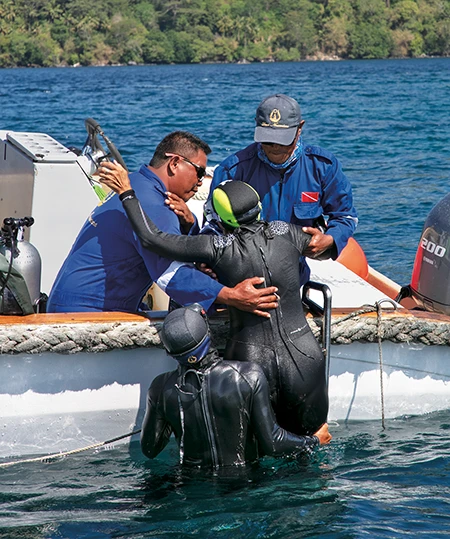
Even if someone avoids a traumatic injury, it can be difficult to differentiate POTS from decompression illness as the cause for fainting after a dive. The diver’s physician team, including a cardiologist and dive medicine physician, should confirm or rule out POTS. If they confirm POTS, that individual should not dive.
— Leandra Lynn, NREMT
© Alert Diver – Q4 2025