A Diver and Forensic Pathologist – MEMBER PROFILE
Hometown: Winston-Salem, NC
Age: 52
Years Diving: 38
Why I’m a DAN Member: No other organization exists solely to benefit recreational divers’ health and safety worldwide. I benefit from the protection of insurance for dive-related injuries and the research that helps the global community of divers safely pursue our shared passion.
As someone who loves, teaches, and works in the world of scuba diving while also focusing on community service and improving safety, I am often surrounded by amazing people, such as Craig Nelson, MD. An associate chief medical examiner and the forensic pathology fellowship program director for the N.C. Office of the Chief Medical Examiner, Nelson has dedicated his life to solving the mysteries surrounding the occasional tragedies in our sport while supporting community service and participating in public safety education.
For Nelson, diving is not just a hobby; it is the backbone of everything he does. At 52, he has logged nearly four decades beneath the water’s surface. Whether standing by a pool, walking a shoreline, or gearing up on a boat, he feels compelled to immerse himself.
“Water has a gravitational pull on my being,” he explained. That pull began when he was a teenager growing up in Winston-Salem, North Carolina, and he got scuba certified with his father and brother. The confined pool sessions were enough to capture him for life, and his first quarry dives in murky Carolina waters felt as exotic as another planet.
Memorable Encounters
Nelson is grateful for his wife, Kelly, his family, the Our World-Underwater Scholarship Society, and the people who opened doors for him along the way. That path includes many unforgettable encounters, such as when he found himself face-to-face with a leopard seal off the Antarctic Peninsula this past spring.
“Meeting an apex predator in subfreezing waters off the world’s least accessible continent changed Antarctica for me,” he said. “It’s no longer just a place from books or films; it’s somewhere I can always return to in my mind.”
Other memories are rooted in service. During Nelson’s years with the San Diego, California, Lifeguard and Police Dive Team and as San Diego deputy medical examiner, he worked alongside professionals to recover bodies, bring closure to grieving families, and assist forensic investigations.
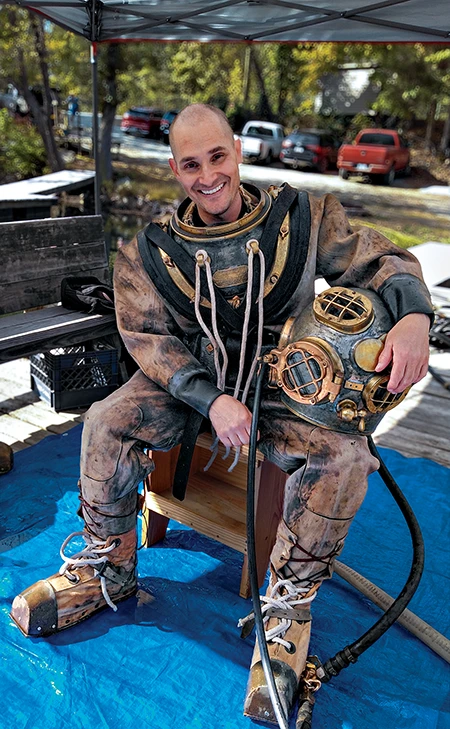
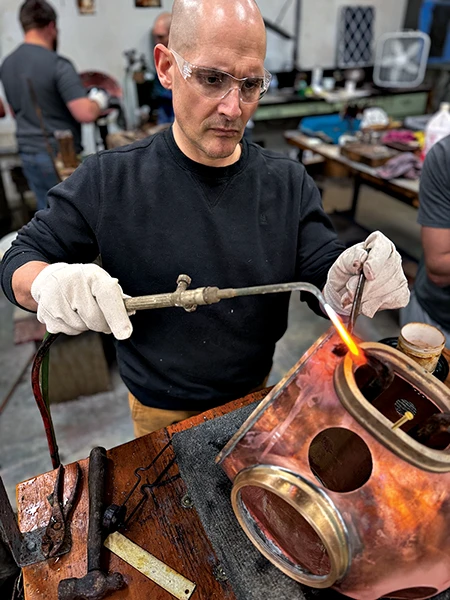
When dive opportunities aren’t always close at hand, like at home in Raleigh, North Carolina, he stays active by restoring and diving with antique gear, including his prized U.S. Navy Mark V helmet.
“No matter what I’m doing underwater,” Nelson said, “I just love being there.”
From Diving to Pathology
When deciding on a medical path, Nelson said that no specialty initially grabbed his attention. Receiving the Our World-Underwater Scholarship in 1996 let him explore marine biology, hyperbaric medicine, public safety diving, underwater photography, and more. During that time, working with Walter “Butch” Hendrick and Andrea Zaferes of Lifeguard Systems got him thinking about what happens to bodies in the water and divers who suffer fatal incidents, which then led him to forensic pathology.
From medical school at Wake Forest University in North Carolina to residency in Tucson, Arizona, and a fellowship in San Diego, he followed the thread of water-related deaths while training in the wider field. He helped reestablish the Diver Death Review Committee in San Diego to strengthen interagency cooperation to improve local diver safety. He eventually returned to North Carolina, where he got involved in safety and research programs at the nearby Divers Alert Network headquarters in Durham.
“If I have to sum up my career,” he said, “I’m not a forensic pathologist who dives. I’m a diver who practices forensic pathology.”
Bridging Two Worlds
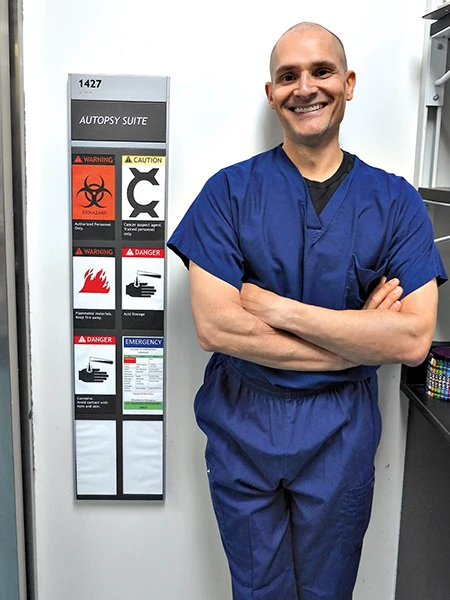
Nelson’s work is like that of any other forensic pathologist: conducting autopsies for homicides, accidents, and other deaths. But water always finds a way back into his cases. He often encounters drownings and water-related deaths, applying his dive expertise to accurately interpret them. When dive fatalities occur in North Carolina, Nelson may be directly examining the case or consulting with colleagues.
His knowledge has also takes him to the courtroom, where he provides expert testimony in diving and drowning cases. He closely collaborates with DAN on diver fatality reviews to analyze causes and strengthen the culture of diver safety.
Nelson continues to mentor through the Our World-Underwater Scholarship Society, where he now serves as medical advisor. He and Kelly often welcome young scholars to join them on dive adventures using some of their unique and interesting equipment.
Quiet Victories
When considering diver safety, Nelson grew thoughtful. “The most important contributions in diving aren’t the high-profile rescues or the dramatic research findings,” he said. “They’re the silent, invisible victories: the diver who remembers a safety lesson, uses it, and prevents a tragedy. Those unseen moments are the most rewarding contributions any of us in the dive community can make.”
Nelson does not see diving as just a passion. He sees it as a responsibility that bridges science, service, and safety. As both a diver and a pathologist, he is always an advocate for every diver’s safe return home.
© Alert Diver – Q4 2025