Capturer de belles images de baleines est l’une des expériences photographiques les plus gratifiantes pour un photographe sous-marin. Ces créatures majestueuses et charismatiques suscitent l’émerveillement, et le temps passé avec elles reste inoubliable. Cependant, leur environnement, leur taille impressionnante et leur nature fuyante présentent certains défis.
Les deux éléments clés pour réussir à photographier les cétacés sont la recherche et la préparation. Vous pouvez être un excellent photographe, mais si vous ne pouvez pas vous approcher d'une baleine ou si vous n’êtes pas prêt une fois le moment venu, vous ne prendrez aucune bonne photo. Pour maximiser vos chances de réussite, tenez compte des éléments suivants : où, quand, avec qui, et comment.
Où
Il est possible de nager avec les baleines dans plusieurs régions du monde, mais les réglementations et les conditions varient selon l’endroit. La Dominique est réputée pour ses groupes résidents de cachalots, et sa réglementation est en constante évolution.
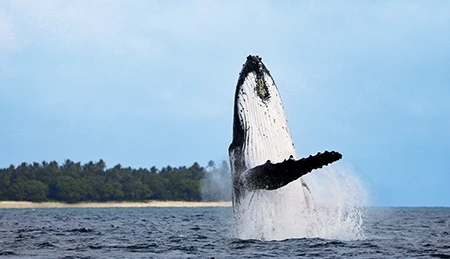
Plusieurs pays proposent des rencontres avec les baleines à bosse. À Tonga, quatre personnes et un guide peuvent entrer dans l’eau avec une baleine. Il est possible de s’approcher jusqu’à 5 mètres, avec de très bonnes opportunités de photos lorsque les baleines coopèrent. Le Silver Bank, en République dominicaine, et Moʻorea, en Polynésie française, autorisent plus de nageurs en même temps, mais cela peut signifier plus de nageoires, de bras et de bulles sur vos photos et plus de pression sur la rencontre avec les baleines. D'autres endroits, comme les îles Revillagigedo, peuvent offrir des rencontres opportunistes, mais cela dépend souvent de la saison.
Lorsque vous vous renseignez sur les destinations possibles pour observer les baleines, demandez combien de bateaux opèrent dans la même zone, combien de temps est accordé pour observer les animaux et combien de personnes sont autorisées dans l'eau.
Quand
Nager avec les baleines est souvent une activité saisonnière, car de nombreuses espèces de migrent. Le moment varie en fonction du lieu et de l'espèce. Il est généralement plus fiable de prévoir de nager au milieu de la haute saison.
Les baleines arrivent généralement à Tonga entre la mi-juin et la fin juin, et la plupart y restent pendant trois à quatre mois. Les baleines à bosse arrivent généralement à Moʻorea en juillet et y restent jusqu’en novembre, tandis que la période de janvier à mai est la plus productive sur le Silver Bank. La population de cachalots en Dominique augmente pour l’accouplement et la mise bas de novembre à mars.
Avec qui
Il est essentiel de réserver vos excursions pour nager avec les baleines auprès d'opérateurs agréés. Leurs équipages sont formés aux réglementations et aux meilleures pratiques et savent comment approcher les baleines. Vous pouvez également réserver auprès d'un photographe qui a de l'expérience avec l'espèce de baleine que vous souhaitez observer, car cette personne sera capable de lire le comportement de l'animal et d'anticiper ses mouvements probables, ce qui sera inestimable pour la rencontre.
Informez le photographe si vous avez une photo rêvée en tête. S’il voit que les animaux se déplacent d’une manière qui correspond à votre vision, il pourra vous en informer et vous aider à vous positionner.
Malheureusement, il n’est pas rare de rencontrer des personnes qui refusent de suivre les directives du guide concernant une approche respectueuse de la baleine, ce qui peut nuire à l’harmonie générale de l’expérience. De même, il est important que le guide dans l’eau ne soit pas en concurrence avec les invités pour obtenir la meilleure photo, ce qui peut aussi créer des tensions. L'organisateur de l'excursion vous expliquera soigneusement comment vous êtes autorisé à nager vers une baleine, si tant est que ce soit le cas, et une approche trop agressive de la part de quiconque peut gâcher la rencontre pour tout le monde.
Il est essentiel de comprendre qu'il n'y a aucun moyen de savoir à quelle heure vous verrez les baleines, combien vous en verrez et pendant combien de temps. Il n'y a aucune garantie que vous nagerez avec elles. Tout opérateur affirmant le contraire ne suit probablement pas des pratiques éthiques.
Certains endroits comptent des opérateurs non formés qui proposent des nages illégales avec les baleines, ce qui conduit souvent à des situations où les baleines sont acculées et harcelées. Les bateaux de ces opérateurs peuvent ne pas être adaptés aux activités en haute mer et ne pas disposer de l’équipement de sécurité approprié, ce qui est potentiellement dangereux en mer. Il existe aussi un risque d’arrestation si vous travaillez avec des opérateurs non licenciés.
L’essentiel est qu’aucune image ne justifie de compromettre le bien-être des baleines. Assurez-vous de travailler avec une entreprise agréée et expérimentée et que tous les permis requis sont en règle.

Comment
Comme mentionné précédemment, le nombre de personnes autorisées dans l’eau est un point crucial à considérer. En outre, essayez de réserver plusieurs jours en mer afin de maximiser vos chances de bonnes nages et d’opportunités d’observer différents comportements. Chaque jour et chaque rencontre seront probablement différents, même avec le même animal. Les activités de nage avec les baleines ont souvent lieu pendant les mois d’hiver, lorsque les vents dominants sont plus forts ; disposer de quelques jours supplémentaires comme tampon en cas de mauvais temps est donc utile. Cela vous donnera également l’occasion de vous entraîner et de vous habituer à la présence des baleines. Réservez autant de jours que votre budget et votre emploi du temps le permettent.
La plupart des activités de nage avec les baleines se font en apnée, il est donc essentiel d’être à l’aise en pleine mer, où il y a souvent de la houle et où vous ne voyez pas le fond. L’un des principaux défis pour photographier les baleines sous l’eau est de se positionner correctement pour la prise de vue. Je recommande à toute personne qui m’accompagne d’être en assez bonne forme pour commencer son approche dans l’eau à une certaine distance, afin que les animaux s’habituent à sa présence.
Être à l’aise et physiquement prêt vous permettra d’aller là où vous devez être et de profiter plus longtemps de l’expérience. Être en forme est également utile si vous avez la chance de rencontrer un jeune curieux. Certains peuvent être très intrigués par les gens et s’approcher pour observer de près. À cet âge, ils peuvent être maladroits ou insistants, donc il est utile de pouvoir se déplacer rapidement.
Il est également bon de s’entraîner à battre des jambes sans éclabousser, car l’approche dans l’eau doit être aussi silencieuse et fluide que possible. Avoir un caisson flottant réduit la traînée et facilite la nage. Cela me rassure également de savoir qu’il ne coulera pas si je le lâche accidentellement. La plupart des caissons, cependant, ont une flottabilité négative par conception.
Choisissez soigneusement votre équipement en fonction des conditions.. Demandez à votre guide la température de l’eau et évaluez ce que cela signifie pour vous. Certaines personnes porteront une combinaison légère dans une eau à 24 °C (75 °F), tandis que d’autres opteront pour une combinaison de 5 mm. La combinaison de 5 mm sera plus chaude, mais vous aurez besoin de plus de poids pour compenser la flottabilité de la combinaison. Si vous avez la chance de rencontrer une baleine détendue, vous pourrez rester dans l'eau un certain temps. Il est donc préférable d'être bien préparé avec votre équipement afin de ne pas avoir à retourner au bateau parce que vous avez froid. J'utilise toujours des couches que je peux ajouter ou enlever selon les besoins. N'oubliez pas d'avoir des vêtements de protection contre le vent, la pluie ou le soleil si vous souhaitez prendre des photos en surface depuis le bateau.
Considérations techniques
Il est essentiel de connaître son équipement. Familiarisez-vous avec votre appareil photo et son boîtier avant le voyage. Les baleines peuvent changer rapidement de position et vous ne voulez pas rater la photo parce que vous étiez occupé à modifier les réglages. Il est judicieux de régler vos paramètres avant d'entrer dans l'eau, d'autant plus que les premières fois où l'on voit une baleine peuvent être assez impressionnantes.
Réglages: je préfère généralement utiliser l'automatisme avec priorité à la vitesse d'obturation et régler l'ISO avant d'entrer dans l'eau en fonction des conditions de luminosité à la surface (les flashs sont généralement interdits avec les baleines). Une vitesse d'obturation comprise entre 1/200e de seconde et 1/400e de seconde me convient bien avec des baleines détendues. Mon ISO sera généralement de 200 ou 320 par temps clair, ou je le pousserai à 800 par temps sombre et couvert.
Je sélectionne le mode de prise de vue en rafale rapide ; si votre appareil photo dispose de cette option, utilisez le mode pour photographier des sujets en mouvement (par exemple, le mode Al Servo sur les appareils Canon ou AF-C sur les appareils Nikon). Les écrans LCD peuvent être trompeurs, alors vérifiez votre histogramme pour vous assurer que votre exposition est correcte.
J’utilise la mise au point automatique avec neuf points de focus et je les place à gauche ou à droite du centre de l’écran, selon la direction dans laquelle nagent les baleines. De cette façon, j’ai plus de chances d’être net là où se trouve la tête de la baleine.

Prenez des photos au format RAW si vous le pouvez, pour disposer de plus d’options lors de l’édition.
Préférence d’objectif: J’utilise généralement un objectif 16-35 mm sur mon appareil plein format pour plus de polyvalence. Essayez de vous approcher autant que possible tout en respectant les animaux et en maintenant une distance de sécurité. Être proche est la clé pour obtenir des images nettes et de qualité. Si je dois zoomer à plus de 20 mm, c’est probablement que je suis trop loin, et la quantité d’eau entre moi et le sujet réduira le niveau de détail.
Pour les grandes baleines, comme les baleines franches australes, ou celles vivant en groupes sociaux, comme les cachalots, un objectif fisheye zoom 8-15 mm est pratique.
Caméras d’action Il est aussi agréable d’avoir de belles vidéos de votre temps passé avec les baleines. Vous pouvez fixer une petite caméra d’action GoPro ou DJI à votre caisson. Si vous pouvez la monter de manière à ce qu’elle ait un champ de vision similaire à celui de votre objectif photo, vous pouvez la laisser tourner et ensuite monter les images plus tard. Cela vous permet de vous concentrer sur les photos tout en ayant un enregistrement vidéo de la rencontre.
Considérations écologiques
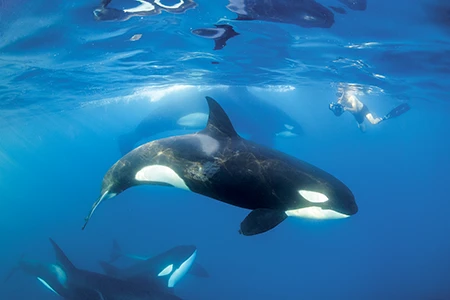
J’aime photographier de côté, car cet angle me permet de capturer l’animal entier et son œil, tout en me plaçant dans une position sécuritaire, sans croiser sa trajectoire. Les prises de vue frontales sont belles, mais ne tentez pas cela si l’animal est en mouvement.
Si l’animal est au repos et détendu, confirmez avec votre guide qu’il est acceptable de l’approcher de face. Approchez-vous lentement — être patient et prévisible dans l’eau mettra l’animal en confiance, ce qui favorisera une rencontre plus longue et de meilleure qualité.
Si vous disposez d’un second boîtier, cela vaut vraiment la peine de l’emporter avec un téléobjectif pour les photos en surface. L’activité en surface peut être phénoménale, surtout si vous croisez un jeune baleineau à bosse en train d’apprendre à sauter. Un zoom 100-400 mm fonctionne bien pour de nombreuses baleines, sauf les baleines franches australes et les baleines grises, qui peuvent être très curieuses et s’approcher du bateau. Il vous faudra une vitesse d’obturation rapide pour capturer un saut net, surtout depuis un bateau en mouvement. J’utilise souvent une vitesse entre 1/1500 seconde et 1/2000 seconde.
En ce qui concerne l’équipement et la préparation, assurez-vous que votre matériel est en bon état avant de partir. Apportez des joints toriques et des piles de rechange, car les activités de nage avec les baleines ont souvent lieu depuis des bateaux de croisière ou des régions isolées.
Veuillez garder à l’esprit que les images que vous voyez en ligne et dans les magazines font partie du meilleur travail des photographes et ont souvent été prises sur plusieurs jours, semaines, voire mois. Pour chaque superbe photo, il y en a beaucoup de moyennes.
En tant que guide, j’ai parfois des invités avec de grandes attentes à cause de ce qu’ils ont vu en ligne. Ils ne profitent pas pleinement de l’expérience parce qu’ils sont trop concentrés sur la prise de vue. Rappelez-vous d’être patient. Suivre ces conseils augmentera vos chances de belles rencontres et de bonnes images, mais il n’y a aucun moyen de garantir quoi que ce soit avec la faune, surtout avec la mégafaune.
Profitez de l’instant, et détournez parfois le regard de votre appareil. Passer du temps avec ces doux géants est une expérience merveilleuse, parfois bouleversante. Même si vous ne prenez pas de photo primée, les images gravées dans votre mémoire resteront pour toujours.
© Alert Diver – Q4 2024