Les récifs coralliens sont confrontés à de nombreux défis environnementaux, et les bateaux de croisière y contribuent largement. L'un des impacts les plus importants de ces bateaux est qu'ils commencent à remuer les fonds.
Après avoir été durement touchée par la pandémie de COVID-19, l'industrie des croisières connaît à nouveau un essor fulgurant, avec plus de 37 millions de passagers prévus pour 2025. Les navires transportent en moyenne environ 3'000 personnes, mais certains peuvent désormais accueillir plus de 6'500 passagers. Un tel nombre de personnes à bord génère une quantité massive de déchets, allant des eaux usées et des eaux grises (eaux usées provenant des douches, des éviers et des buanderies) aux eaux de cale huileuses, ce qui affecte la qualité de l'eau de mer.
La pollution atmosphérique causée par les moteurs diesel des navires et les déchets solides tels que les aliments, le plastique, les canettes et le verre aggravent les effets sur l'environnement. L'empreinte carbone d'un navire de croisière de taille moyenne est supérieure à celle de 12'000 voitures. Et l'eau de ballast, c'est-à-dire l'eau de mer introduite dans la coque d'un navire pour assurer sa stabilité, peut propager des espèces invasives et des maladies. (Pour plus d'informations, voire « Blame the Ballast » dans le numéro du quatrième trimestre 2023 de Alert Diver )
Impact sur les coraux
Les récifs coralliens fragiles sont particulièrement sensibles à ce type d'impacts environnementaux. Les Caraïbes, qui abritent près de 10 % des récifs coralliens mondiaux, sont la première destination des bateaux de croisière.
La santé des récifs coralliens dépend d'un environnement stable. La détérioration de la qualité de l'eau, due notamment aux eaux usées, aux déchets marins, aux espèces envahissantes, aux maladies et à l'augmentation du carbone atmosphérique, a des effets néfastes sur les récifs coralliens et les millions d'espèces qui y vivent.
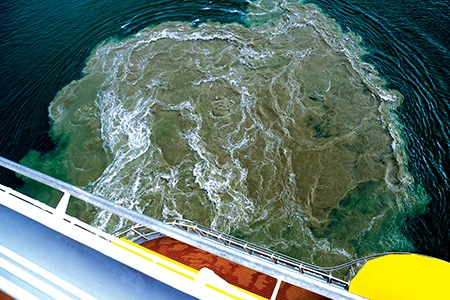
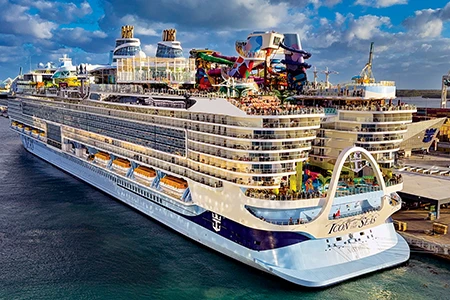
Sédiment
Les navires de croisière sont grands et ne cessent de grandir. La plupart des ports des petits pays insulaires où font escale les croisières n'ont pas été construits pour accueillir ces navires gigantesques. Par conséquent, les ports multiplient la fréquence et l'ampleur des projets de dragage. Ils creusent des chenaux et des ports plus profonds afin d'accueillir des navires plus grands qui nécessitent une plus grande profondeur. Le dragage détruit les habitats locaux et augmente la quantité de sédiments dans la colonne d'eau.
De plus, les sédiments au fond sont remués dans les eaux peu profondes chaque fois qu'un grand navire arrive au port. Une étude récente menée à Key West, en Floride, a révélé qu'il était courant que les navires de croisière entrant au port provoquent des niveaux de turbidité dépassant les limites fixées par l'Agence de protection de l'environnement, avec des niveaux parfois aussi élevés que ceux causés par les ouragans.
La turbidité est particulièrement problématique dans les habitats qui prospèrent généralement dans des eaux cristallines, comme celles que l'on trouve dans les Caraïbes, car elle affecte la pénétration de la lumière du soleil. Les coraux ne sont pas photosynthétiques, mais ils dépendent d'un symbiote algal, les zooxanthelles, pour survivre. Les zooxanthelles ont besoin de la lumière du soleil pour effectuer la photosynthèse, et elles partagent les sucres résultant de ce processus avec les coraux, leur fournissant l'énergie nécessaire à leur survie.
Les sédiments remués, qui contiennent des contaminants, des agents pathogènes et des microbes provenant des couches enfouies du fond marin, peuvent étouffer les coraux. Certaines espèces sont plus sensibles à l'accumulation de sédiments, selon leur forme.
L'augmentation de la sédimentation affecte les stades précoces du développement des coraux. Si les sédiments recouvrent le substrat, les larves de corail ont du mal à s'installer. Une étude récente a montré que les sédiments provenant spécifiquement d'un port — par opposition à un site récifal au large — avaient un impact significatif non seulement sur le succès de l'installation des larves, mais aussi sur le taux de survie global des larves de corail. Les chercheurs suggèrent que la communauté microbienne spécifique présente dans les sédiments du port, qui dans cette étude contenait des bactéries associées à des maladies du corail, est probablement un facteur contributif.
Solutions
Il n'est pas facile de changer l'industrie gigantesque des croisières, mais des ajustements pourraient être apportés afin de réduire leur impact environnemental tout en continuant à offrir de nombreuses activités divertissantes à bord.
• Les navires peuvent réduire leur vitesse à l'approche du port afin de limiter la sédimentation.
• L'industrie des croisières peut renforcer l'application des réglementations en matière de gestion des déchets.
• Les progrès technologiques peuvent améliorer la durabilité des navires de croisière grâce à l'utilisation de carburants alternatifs, d'un éclairage LED économe en énergie, de conceptions de coques plus efficaces, de programmes de recyclage et de compostage à bord, de panneaux solaires et de systèmes éoliens.
Si vous prévoyez de faire une croisière, choisissez un navire qui a moins d'impact sur l'environnement que les autres. Friends of the Earth publie chaque année un rapport sur les navires de croisière qui évalue 15 compagnies différentes selon des critères tels que le traitement des eaux usées, la conformité aux normes de qualité de l'eau et l'empreinte environnementale globale.
Si vous préférez des vacances plus durables, envisagez un séjour dans un complexe hôtelier tout compris ou une croisière en voilier. Même une croisière sur terre (visite en bus) serait plus respectueuse de l'environnement. Ces options offrent une empreinte carbone plus faible, moins de pollution et moins de dommages aux écosystèmes marins, ce qui constitue un luxe considérable.
© Alert Diver – Q3 2025