Bridging the Lab and the Abyss
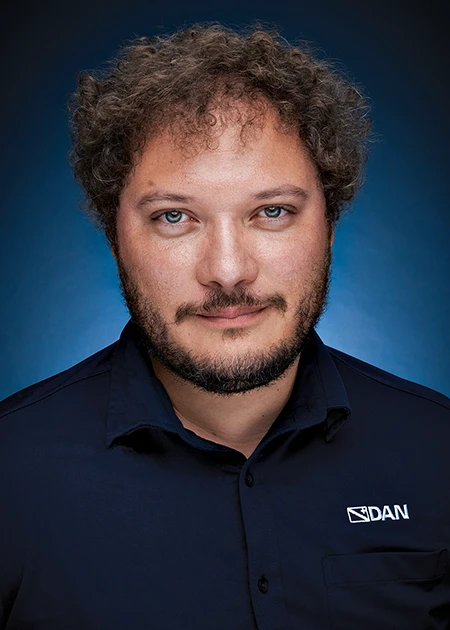
Emmanuel “Manu” Dugrenot, PhD, a senior researcher at Divers Alert Network (DAN), brings cutting-edge physiological research to the development of safety protocols for both technical and recreational diving.
His research concentrates on defining the boundaries of human performance in extreme environments, particularly the intricate mechanisms of decompression sickness (DCS) and improving the accuracy of physiological models that support safe planning and execution of deep dives. By translating complex scientific findings into practical safety recommendations and collaborating closely with training agencies and equipment manufacturers, his work benefits divers worldwide and advances DAN’s central mission of injury prevention and risk reduction.
Dugrenot maintains active academic partnerships in Europe and the United States. He is a visiting researcher at the ORPHY (Optimisation des Réponses Physiologiques) Laboratory at the University of Western Brittany (UBO) in Brest, France, where he contributes to collaborative projects on human physiological regulation and responses to stress. He is also a visiting researcher in the biomedical engineering department at the University of North Carolina at Chapel Hill, working with Virginie Papadopoulou’s group on ultrasound applications in dive medicine and other innovative medical uses.
These ongoing appointments provide access to complementary expertise in biological systems and engineering approaches, significantly reinforcing the interdisciplinary strength of DAN’s research efforts.
Dugrenot is also an accomplished dive professional who trains closed-circuit rebreather (CCR) and trimix divers and instructors. He is qualified as a scientific and public safety diver and currently serves as safety officer for the Youngsville (NC) Rescue and EMS dive team, which named him Diver of the Year in 2025.
Quel est votre parcours ?
I originally studied molecular biology but took a year off when working on my master’s degree to earn the Brevet d’État d’Éducateur Sportif — France’s state-level professional dive instructor certification. That experience provided my first in-depth exposure to the technical and scientific side of diving.
While visiting the COMEX Experimental Hyperbaric Center in Marseille, France, I met the former scientific director, Bernard Gardette, PhD. He generously spent hours walking me through the physiological principles and operational protocols his teams had developed for the world’s deepest chamber dives and open-sea record dives — many of which remain unbroken today.
Gardette directed me toward the ORPHY laboratory and Professor François Guerrero, whose work in dive physiology introduced me to the French Navy’s dive physicians and researchers — collaborators I still work with more than a decade later.
From that moment on, I combined laboratory research with active diving throughout my PhD process, later founded a company dedicated to deep-dive physiological modeling, and joined DAN in November 2022 to broaden the reach and real-world impact of my work on a global scale.
Why does this kind of research excite you, and how much of your work specifically relates to diving?
I have always been a diver first. My interest in dive research began under practical circumstances. When I was learning to dive, the training manuals seemingly promised that following decompression tables or a dive computer would keep a diver safe from DCS. The more I learned, the more I realized how oversimplified that message was.
Most decompression models in widespread use today are not truly physiology-based; they depend on theoretical tissue compartments rather than actual biological structures. Despite decades of research, we still do not fully understand the relationship between circulating bubbles, inflammatory responses, and the clinical onset of DCS. Those persistent knowledge gaps were both surprising and deeply motivating to me as a diver and scientist.
That same curiosity continues to drive my work. The vast majority of what I do now is directly related to diving: studying decompression stress, bubble dynamics, individual susceptibility factors, and practical ways to improve real-world safety protocols. I have broadened my scope to include DCS in hypobaric environments, notably astronaut exposure during extravehicular activities in space.
What makes DAN’s research department unique?
What truly sets DAN apart is its direct connection to the worldwide dive community. Unlike many purely academic or institutional settings, where research can remain theoretical for years, the results of DAN’s studies translate almost immediately into updated guidelines and tools that divers can quickly use.
DAN also provides unparalleled access to real-world data from thousands of divers to a global network of instructors and industry partners, and to rapid field-testing opportunities that would be difficult or impossible elsewhere. For me, this unique combination of rigorous science, immediate operational relevance, and cross-community collaboration creates an ideal research environment.
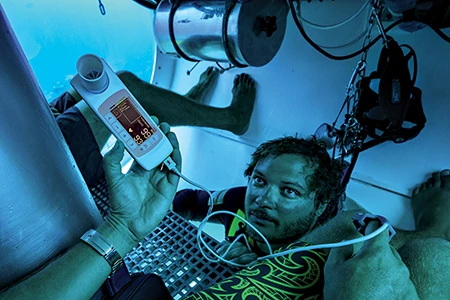
Recent examples include a study I just completed on how formal training influences adoption of the mouthpiece retaining strap among CCR divers, examining both willingness to use it and perceived safety benefits. A new project underway investigates the effect of body trim on the risk of immersion pulmonary edema when comparing chest-mounted versus back-mounted rebreathers.
It is genuinely rare to find a place where the science you conduct can have such direct and tangible effects on people’s lives while still supporting truly cutting-edge physiological research.
What are some of the most interesting or innovative research projects you’ve been involved in ?
Two projects stand out as particularly memorable and innovative. The first was the Capsule project with Under the Polein French Polynesia. Using an oxygen-exposure model I had refined for Gardette based on French Navy limits, we conducted shallow saturation dives in a lightweight underwater habitat. After three days at 66 feet (20 meters) on heliox, we safely accelerated decompression from the standard 18 hours to just four hours, including two hours of pure oxygen breathing inside the habitat.
The second project was the 2019 Gombessa saturation expedition, where I assisted the physiological monitoring team during the final decompression phase after divers had lived for weeks at depth. Both experiences offered firsthand insight into how targeted physiological modeling can dramatically improve operational efficiency while maintaining or enhancing safety margins in extreme diving scenarios.
Which of your projects could have the greatest impact on dive safety?
A project with major long-term potential is our work with artificially selected rats resistant to DCS. Within a few generations, we bred rats almost entirely protected from DCS, demonstrating that susceptibility has a strong heritable component.
Current decompression models don’t incorporate individual physiology, so identifying the mechanisms behind this resistance could be transformative. If we can pinpoint genetic or biological markers of susceptibility — and validate them with gene expression changes in human divers — we may eventually achieve personalized decompression strategies, improved screening tools, or even pharmacological protection.
I am currently working with partners at UBO and the University of Utah, supported by the Office of Naval Research (ONR) Global, to link these animal findings with gene expression in human divers. It’s early, but the potential impact is significant.
What is your vision for the future of diving?
I want diving as a sport to become easier, lighter, and more accessible while preserving —and ideally improving — safety.
At the same time, I expect steady advancement in rebreather technology that will extend the safe range of technical diving through lighter units, “safe-to-fail” design philosophies, and more intelligent real-time monitoring systems.
Overall, the future needs to balance broad accessibility and enjoyment for the majority of divers with expanded safe exploration possibilities for those who choose to push the limits.
How do you and DAN fit into that future?
My role has two primary aspects. First, it’s to continue advancing dive science by developing more accurate protocols, deepening our understanding of diver physiology, and helping shape technologies that make diving safer and more enjoyable.
Second is to mentor and inspire the next generation. I benefited enormously from key mentors who opened doors for me, so I feel a strong responsibility to not only do the work but also train safety-conscious, environmentally respectful divers and spark curiosity in young scientists who may carry forward this field.
DAN is uniquely positioned to support both dimensions through its internship programs, global data network, academic partnerships, and mission-driven structure. By offering students and early-career researchers real-world exposure to applied dive science, DAN helps ensure that tomorrow’s divers and scientists are better equipped, safer, and more inspired than ever before.
© Alert Diver – Q1 2026