The question of whether a diver should rely on a drysuit for buoyancy control or treat it primarily as thermal protection while managing buoyancy with a buoyancy compensator device (BCD) remains one of coldwater diving’s more practical and seemingly never-ending debates.
Both approaches appear in training literature and field practice, and the choice is rarely absolute. It depends on suit construction, water temperature, equipment configuration, the diver’s anatomy, and their individual experience. There are rationales for both approaches that draw on established material properties, historical development, and observed performance characteristics.
Drysuits evolved from earlier waterproof garments used in surface-supplied diving. In the 19th century, canvas suits sealed to metal helmets kept a diver dry under continuous air supply, but they offered limited mobility and no independent volume control. By the 1930s and 1940s, the military was using rubberized suits. These setups still required the diver to remain largely upright so excess gas could escape through the helmet exhaust.
A new constant-volume design in the 1940s introduced valves at the hood, wrists, and ankles, allowing inflation by exhalation under the mask skirt and venting in more positions. The modern variable-volume suit became practical only after watertight zippers were introduced and reliable low-pressure inflator and exhaust valves were available in the 1960s and 1970s.
Some manufacturers later popularized laminated membrane constructions, shifting the emphasis from inherent material insulation toward undergarment systems that could be varied with conditions.
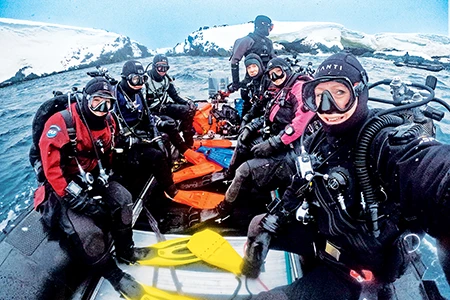
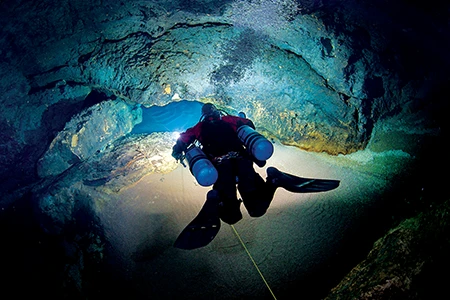
Three principal material families now dominate recreational and technical use in drysuits. Traditional foam neoprene contains closed gas cells that provide insulation and positive buoyancy at the surface. As ambient pressure increases, those cells compress, reducing thermal protection and buoyancy. A suit that requires several kilograms of additional lead at the surface may lose some of that lift at depth. How quickly this occurs depends on the neoprene type, thickness, and age.
Crushed or highly compressed neoprene undergoes controlled pressure and heat treatment that flattens the cells without rupturing them. The resulting material is denser and more abrasion-resistant, and it exhibits far smaller volume change with depth, so buoyancy remains comparatively stable.
Membrane or trilaminate suits consist of a waterproof barrier of materials, such as rubber or polyurethane, laminated between protective fabric layers. The layers contribute neither inherent buoyancy nor meaningful insulation; thermal performance depends entirely on the undergarments and the gas layer maintained in the suit. Because the shell itself does not compress, buoyancy shifts are limited to the intentional addition or venting of that gas volume.
These material differences shape recommended gas management. In any drysuit the minimum gas volume is the amount needed to eliminate squeeze and to maintain loft in the undergarments. Excess volume migrates to the highest point in the suit and can cause an uncontrolled feet-first ascent if not promptly vented. This frequently, though not exclusively, happens to less-experienced divers who are still struggling with buoyancy control or stability in the water column (trim) or to divers wearing ill-fitting suits.
Training agencies differ in emphasis when it comes to drysuit courses. Some curricula historically encouraged primary buoyancy control with the suit so that the diver manages only one air space underwater, reserving the compensator for surface flotation or emergency redundancy.
Technical and many coldwater programs advise the opposite: Add only enough gas to the suit to relieve squeeze and preserve insulation, and perform all your primary buoyancy adjustments with the BCD. The rationale is that a BCD bladder is more predictable in shape, always in the same spot, and easier to vent in any orientation, while a large, free bubble inside a loose-fitting suit may shift rapidly with changes in trim.
As with most things in diving, both approaches require deliberate practice. Once that mastery is in place, either option becomes viable.
Environment further modulates the decision. In temperate lakes or coastal waters, where undergarments are moderate and single-tank configurations may dominate, the volume of gas required for comfort often coincides closely with the volume needed for neutral buoyancy once weighting is correct.
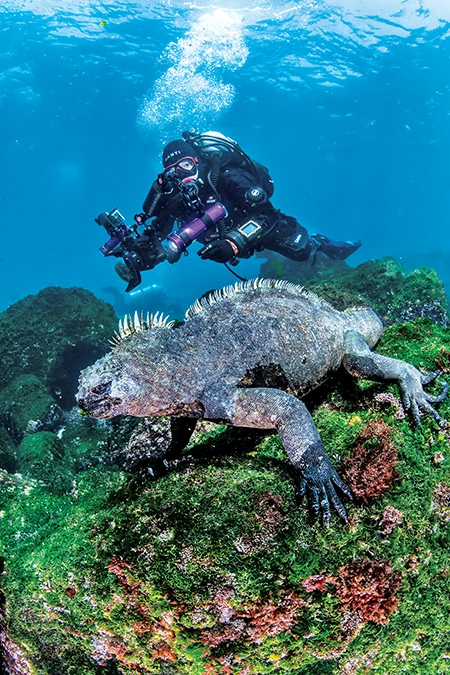
In polar or deep technical environments, thicker undergarments are often essential and demand greater loft. Argon is occasionally used for inflation because of its lower thermal conductivity relative to air. Yet the practical gain is modest once undergarment conductivity and residual air are considered, and the additional cylinder adds complexity.
In strong currents, varying flow, tight passages, or constantly changing depth profiles such as caves or wrecks, overinflating the suit may introduce larger buoyancy swings and complicate maintaining trim and holding necessary stops. The same holds when introducing additional mass through steel cylinders and multiple stages. In all these scenarios, practice of minimal suit inflation becomes more critical.
Individual fit exerts an equally strong influence. A suit cut too generously creates large internal voids that trap gas and resist rapid venting. Excess gas volume increases hydrodynamic drag and forces continuous micro-adjustments. A suit that is too tight restricts range of motion, compresses undergarments, and may prevent adequate loft even when gas is added.
Proper fit leaves sufficient room for the chosen undergarment plus a thin, continuous air layer while still allowing the diver to reach valves and adopt a horizontal trim without gas pooling in the legs or feet. Custom or carefully sized stock suits therefore improve thermal efficiency and the predictability of buoyancy.
Body composition matters as well. Muscle density and lung volume alter the baseline buoyancy that must be offset, so identical suits and undergarments produce different weighting requirements for individual divers.
One practical point worth making explicit is weighting. A diver who is overweighted must add more gas somewhere to become neutral, whether that gas goes into the suit or the BCD. That extra gas increases buoyancy changes during ascent, making both systems less forgiving. A simple buoyancy check — done with cylinder pressure close to reserve levels and minimal gas in the suit — helps confirm that the diver can hold a shallow stop without carrying unnecessary weights.
In practice, most experienced divers settle on an approach shaped by their specific dive. On shallow, recreational dives in a well-fitted crushed-neoprene suit, the gas required for comfort may suffice for neutral buoyancy, and the compensator remains essentially empty. On a deeper, mixed-gas dive with a membrane suit and heavy steel twin tanks, the suit receives only the minimum lofting volume while the wing absorbs the larger adjustments.

The critical skill is not loyalty to a single doctrine but the ability to recognize when the free bubble has grown beyond what is manageable and vent it before it migrates. Redundancy remains valuable. Either system can and will serve as backup if the other fails, provided the diver has practiced and mastered both methods.
Material science and the accumulated experience of training agencies converge on the same practical advice: Understand how gas volume will expand or contract with depth, and weight the overall system so that the remaining adjustments stay within the predictable range of the compensator, whether that is the drysuit, a jacket-style BCD, or a wing.
Buoyancy control with a drysuit is therefore less a binary choice than a continuous calibration among material behavior, environmental demand, gas volume, and personal comfort. The divers who handle it best are usually those who have practiced both methods until the responses become automatic and who then choose the combination that best matches each dive.
© Alert Diver – Q4 2026