Capturing a Majestic Scene
We recently traveled nearly halfway around the world to photograph some of the planet’s most beautiful coral reefs, and wow, did we get lucky. Our liveaboard was gloriously uncrowded, and the conditions were fantastic.
Getting incredible photos must have been simple, right? If I’m being honest, not always. And I wasn’t terribly surprised. Here’s the truth about telling a full reef destination story in images: Regardless of how epically mind-blowing the dive sites are, reefs are one of the most difficult themes to capture well.
Demonstrating the full scope of the colorful vistas and rich marine life in these areas requires patience and flexibility, but the result will be an incredible portfolio that evokes the incomparable majesty of these locations.
Geared to Win
To have the best chance for success, you must begin with the optimal gear for the job. Ultrawide lenses that feature close-focusing capability — such as a fisheye lens, a wide-angle wet lens, or an ultrawide conversion port — are critical for capturing expansive reefscapes or close-focus wide-angle images.
For fish portraits, lens choice is a bit more flexible, ranging from a fisheye all the way to a 50mm or 60mm macro lens. A conversion lens in this scenario is an incredible tool that can provide a fantastic range of widths without sacrificing close-focusing ability or (in many circumstances) corner sharpness. For those days or dives when you would like to capture a reef’s smaller denizens, a macro lens will be key.
Lighting will be a major component of your kit as well. Dual strobes or strong lights are recommended to maximize functionality, though we also tend to bring specialized lighting options, such as snoots and diopters, for macro dives.


The Big Picture
Super-wide reefscapes are one of the most challenging formats to capture, and there’s more than one reason for that. Composition is one of the main considerations, because we’re often thrust into visual overload when we first descend on a lush, busy reef.
It’s easy to fall into the mindset of “I’ll shoot this, and this, and this too!” But for these types of images, quality beats quantity every time. It’s important to patiently examine the site, looking for an arrangement that makes sense in terms of reasonable size, shape, and organization of subjects.
Ideally, you’ll identify a lovely collection of tightly grouped objects, such as a cluster of multihued soft corals or gorgonians, preferably with interesting contour and dimension. The size of the scene is also a biggie, pun intended. If the area is too large, it’s likely impossible to effectively light the entire scene; if it’s too small (more on this below), you may not achieve the super-wide vision you’re hoping for.
Just as important is ensuring that the compilation of objects you would like to include in your image can all be incorporated without items being cut off or lost in a busy background. It’s also good to check that the area you are shooting is free of adjacent items that you could accidentally include and that viewers might misconstrue as an intended part of the compilation.
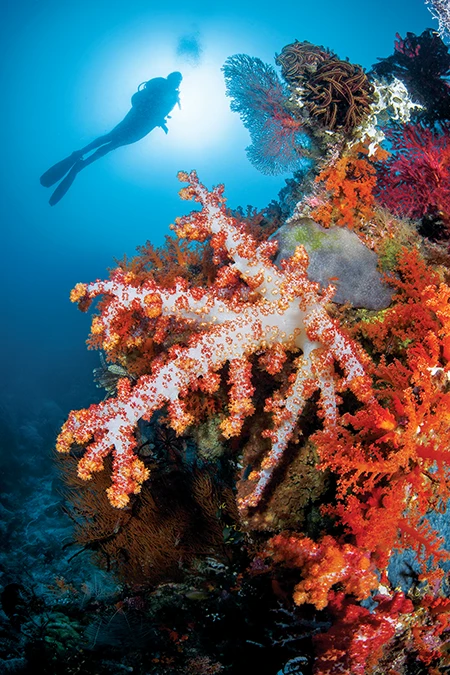
Contrast is a huge part of making these images work. For super-wide reefscapes, this generally means selecting a brightly colored foreground and then shooting upward so the blue of the ocean frames your subject. An easy way to achieve all aims is to look for an outcropping or ridge.
It’s additionally important to be cognizant of the sun’s position and brightness. When the sun is high in the sky, it may not be possible to adequately light a very large foreground while dialing back your exposure to avoid a blown-out sun ball. You’re better off looking for a way to place the sun just outside of the frame, seeking an object that blocks it altogether, or searching for scenes that allow you to shoot with your back to the sun.
Finally, the more additional interest you can add by including secondary subjects, the better. If you’re able to incorporate fish, sunrays, or a diver, it will boost your image’s story and add action and context for the viewer.
The second main reason super-wide reefscapes are so tough to photograph effectively is proper exposure. Executing even, purposeful lighting of an expansive scene is extremely challenging, even if you have the ideal camera settings dialed in. You will need to place strobes the correct distance from your port and the area you wish to capture (in many cases, these distances will be equal), use the appropriate power settings, and aim them properly.
When you’re shooting a large area, the likelihood is high that you will initially get at least one of these three components wrong. It’s critical that you review your images in real time, first fine-tuning your camera settings and then adjusting your strobes or lights to ensure optimal power and subject coverage.
Next, reposition your strobes or lights to correct any shadows, hot spots, flare, and backscatter you detect. Then confirm that your composition is captured as intended, and repeat these steps as needed. It may take some effort and patience, but for the right setup, putting in that extra time will be well worth it.

Getting Closer
Nailing a few super-wide reefscapes is most underwater shooters’ top goal when visiting a world-class reef destination. These images rarely depict the full story of most of these locations, however, so be ready to get a bit closer when the situation demands it.
Some subjects are better portrayed using a close-focus wide-angle (CFWA) technique. The impact of a fantastic subject such as a giant frogfish or gorgeously placed anemone, for example, could easily be diminished in a sprawling, busy reef image. In addition, life within small crannies and swim-throughs — think napping sharks or schools of golden sweepers — can be breathtaking, but these areas may be tiny or impossible to isolate from the seafloor or contrast against an open water background.
Using a CFWA technique or zooming in (if you’re shooting a wide or slightly narrower zoom lens behind a dome or wide conversion port) may allow you to capture such scenes in an attractive way that conveys the delicate beauty of these smaller spaces while minimizing the influence of undesirable objects or surfaces in the adjacent area on the resulting image.
Another instance where you may want to concentrate on smaller subjects is when you’re exploring a colorful vertical area with little relief, such as a sheer wall covered with flat sponges or small soft corals. In these situations I look for ways to utilize the wall as a vibrant backdrop, such as for a fish portrait.
Finally, don’t neglect an opportunity to capture kinetic marine life, such as a passing turtle, manta, or shark, if one presents itself.
All these situations will require you to think on the fly and to be prepared to adjust your camera settings and strobe position as needed, but there are ways you can optimize your probability of success in case you’re surprised by a dynamic subject.
When I’m hunting for super-wide reef scenic opportunities, for example, I tend to swim around with settings that are likely to help me grab a spontaneous shot in the given environment, especially if we know a certain type of creature has been spotted in the area.
As above, it’s important to review your images as you shoot and adjust as appropriate, even if you’re fine-tuning things following what seemed like a quick fly-by of moving marine life. Who knows? You may get a second pass and another chance to shoot the same subject.

Zooming In
Even in the richest reef destination, you’re likely to be shooting a bit of macro, either when suboptimal conditions won’t allow access to the best sites or during repositioning or night dives. For this reason it’s best to give some forethought to how you can round out your storytelling with images of the area’s small inhabitants.
Before your dive, familiarize yourself with the creatures that inhabit the colorful corals, sponges, and fans so you’ll be prepared to recognize the habitats likely to harbor equally colorful symbiotic subjects. If you wish to lean into color as a thematic element, consider using a bokeh effect by choosing a wider aperture so your subject appears to blend with the vivid background.
If you spot a subject you can photograph against open water, shoot upward or slow your shutter speed to achieve a blue-hued background. Also, consider photographing the natural patterns of the reefs themselves, which can yield stunning abstract images that enhance the portfolio you take home.


Final Thoughts
It’s important to include one last point: Lush reefs require nutrients, and nutrients require water movement. Water movement is your friend. Nothing is more disappointing than descending upon a site famous for vibrant Dendronephthya soft corals and instead encounter slack current and deflated corals.
Naturally, there’s nuance. Gentle flow is no big deal, but the intense current inherent to some locations can challenge even the most seasoned diver. It’s important to have the discipline to pause your photography when conditions are so unrelenting that you are likely to cause damage to the reefs you have traveled so far to admire.
© Alert Diver – Q3 2026