Destination Anilao, Philippines
Marine scientists have long been enthusiastic about the Philippines’ Verde Island Passage (VIP), referring to it as the “center of the center of marine biodiversity.” Kent Carpenter, PhD, and Victor Springer, PhD, authored a study published in 2005 that described the VIP as having the highest concentration of marine shorefish biodiversity on the Earth, with more than 1,736 overlapping species coexisting within a 6.2-square-mile (10-square-kilometer) area.
What makes it so special? Evolution played a part. The Philippines was historically isolated, shaped by powerful ocean currents and a winding, complex coastline. As ice ages caused periodic sea-level drops, these geographic features created isolated marine refuges. This isolation drives biodiversity; when individual species develop specialized traits to survive in distinct habitats, they eventually diverge into new species.
The strong North Equatorial Current pours into that developmental crucible and acts as a massive marine conveyor belt, carrying diverse species and their larvae across the Pacific Ocean. Once in the Philippines, they find refuge within the complex archipelago, where many eventually settle, flourish, and evolve.
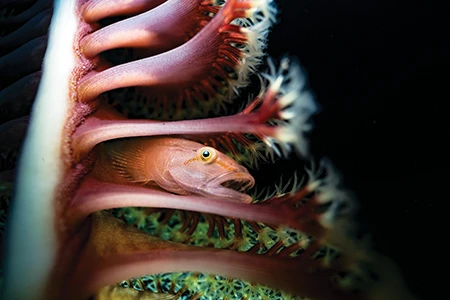
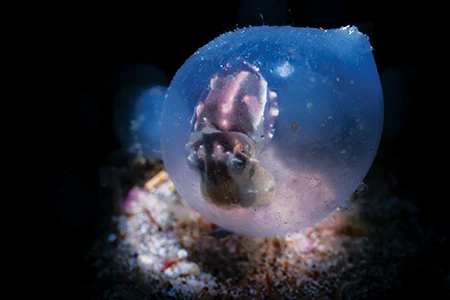
In the grand story of Anilao’s rise as a marine biodiversity hotspot, the concept of settling is crucial. Biologically, settlement is the phase where free-swimming or drifting larvae mature enough to find a permanent home on the seafloor, shifting their lifestyle from mobile plankton to stationary, bottom-dwelling benthic organisms. How the settling of marine larvae here influenced Mike Bartick’s settling in Anilao as his base of operations is a testament to the quality of diving within the VIP.
Bartick spent the first 20 years of his career as a chef trained in fine dining, but he worked the gamut from sandwich station to corporate executive chef in Orange County, California. The work was so intense and stressful, however, that he sought respite by trying scuba diving at Catalina Island. He found calm and tranquility underwater, where the muted sounds were far removed from a frenetic kitchen.
He became more drawn to diving than dining and began to record his underwater adventures with a modest Minolta Weathermatic, a 110-format film camera released in the early 1980s. Its 26mm f/3.5 Rokkor lens was better suited for small fish rather than sweeping kelp seascapes. He began to train his eye for reef minutiae, a skill he advanced rapidly after acquiring his first housing for a digital single-lens reflex camera.
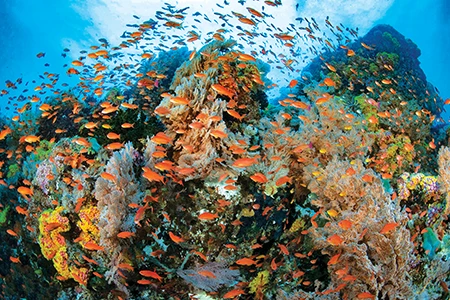
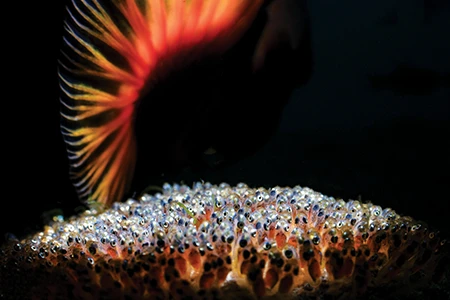
As his photography improved, he began traveling internationally to search for more compelling subjects. He first heard about Anilao during a surface interval while photographing macro life in Lembeh, Indonesia, when another guest compared diving there to Anilao.
With a dose of skepticism, Bartick began researching Anilao and booked tickets for his first trip there in 2007. He found it to be a diamond in the rough. There were no photo-specific resorts with dedicated camera rooms, and only two truly dedicated macro guides could point out the iconic but nearly invisible creatures of the muck. He made his first serious immersion into the local waters from Club Ocellaris, which was a rite of passage for divers visiting Anilao at that time.
By 2009, after searching for a place where he could bring groups, he settled into a symbiotic relationship with the owner of Crystal Blue Resort, evolving the property into a photographer-friendly resort, above and below the water. Today about 40 resorts cater specifically to divers on Anilao, ranging from small guesthouses to luxurious spaces with top-tier amenities.
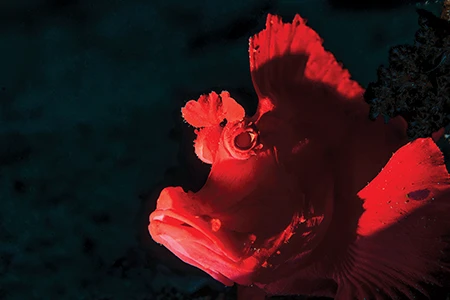
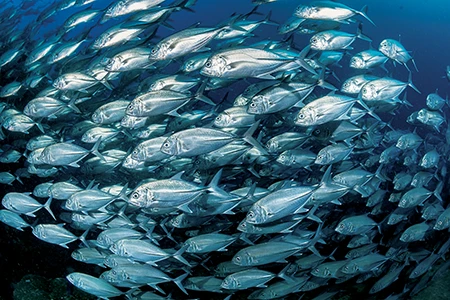
Bartick credits nudibranchs for his attraction to Anilao, saying they are “the gateway drug to macro.” But Anilao is much more than tiny reef creatures. As the marine biologist and ichthyologist Carpenter postulated, 60% of the reef fish on the planet either reside in or pass through the VIP.

Bartick describes the currents as “the firehose of nutrients pushing water up and over the shallow pan of the bays” — specifically Batangas, Balayan, and Puerto Galera bays. This convergence of tides triggers a nutrient-rich upwelling from the deep, while the calm waters at the backs of the bays provide a nursery for juveniles. In between lie sandy slopes, where local guides keep macro enthusiasts racing from one incredible setup to another.
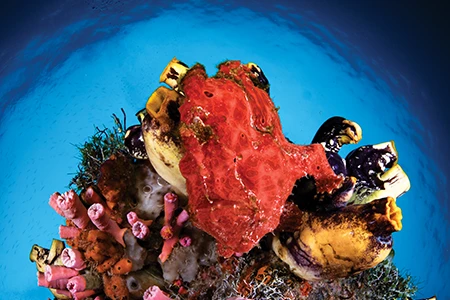
Anilao’s wide-angle opportunities would also be renowned if not for the average water visibility of only 30 to 40 feet (9 to 12 m). The nutrients suspended in those waters, however, are what keep the anthias so active and the soft corals so vibrant. Few divers complain about the water clarity when balanced with the richness of the marine life. A fisheye lens in the hands of a skilled photographer can make a wide-angle shot special even on an average day. When the occasional 100-foot (30-meter) visibility washes over the reef, the 105mm macro lens will get a well-deserved break.
After 7,000 dives — about 5,000 of which were likely at Anilao — Bartick is even more passionate today than he was when he first arrived as a tourist in 2007. He works alongside guides who have spent more than 30 years diving these waters. His friend and guide Edgar, for example, quit counting his dives after surpassing 20,000. Despite the countless hours they have spent underwater together, Mike and Edgar still reminisce about a special night excursion in 2012.
They were diving Anilao Pier, a spectacular night dive site known for the coconut octopuses and bobbit worms that dot the seafloor. Edgar is naturally animated underwater, always eager to show off a new find. On this night, however, he swam back from the edge of the deep, waving his light and frantically gesturing for Bartick to follow him.
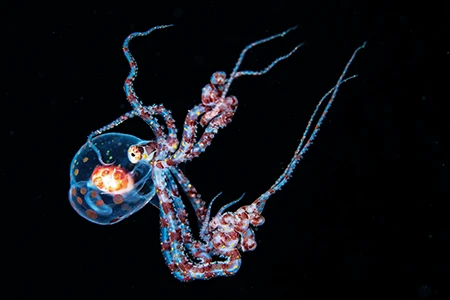
Edgar pointed out and Bartick photographed a surreal, translucent pelagic creature, whose true identity was a mystery at the time. Unable to find the animal in standard reference books, Bartick emailed the image to his trusted contacts at the California Academy of Sciences. They confirmed it was a larval Wunderpus photogenicus in its pelagic settling phase. That was the first time Bartick had heard the term “settling,” and it ignited an overwhelming passion for blackwater diving.
Around this same time, photographer Gutsy Tuason was introduced to blackwater diving in Hawaiʻi and brought the concept back to his home waters in the Philippines. While Chris Newbert originally introduced the technique in his 1984 book Dentro de un mar arco iris, his method of doing it alone and far offshore carried significant risk. Anilao, by contrast, has a geographical advantage: Its deep, abyssal waters are close to shore. Photographers like Bartick, Tuason, and others began creating images so startlingly unique and otherworldly that a new subset of underwater photography emerged. Anilao became the first mainstream blackwater destination, and it arguably remains the best.
Looking forward, Bartick hopes his life’s work will emulate the achievements of iconic photo guides such as Larry Smith, who pioneered the art of muck photography in remote regions —although Anilao is not really remote anymore.
Manila is the primary international gateway to the Philippines, and Anilao is on the same island, so traveling divers can bypass local connecting flights, along with the issues of overweight bags. Instead, a three-hour overland bus ride will land divers at any of the more than two dozen resorts that specifically cater to scuba divers.
It is rare to find a place so special in the world of dive photography that remains so effortlessly simple to reach.
Explore Más
The World of Blackwater
Under Cover of the Night
Strange Creatures of Anilao
© Alert Diver – Q4 2026