Always a Lee Shore
Spectral light dances on the water from across Puget Sound as the Seattle skyline glitters on the horizon. It’s the end of February, and a storm front is moving into Washington state, scheming to thwart our efforts to dive this evening.
Serious squalls have been rolling through all day, with light rain between, and the wind remains brisk. But the mountainous topography surrounding the greater Seattle metropolitan area has created a lee shore. The water is smooth here at Alki Cove, where we intend to dive.
We unload Nirupam Nigam’s SUV, stacking scuba tanks, fins, lead weight harnesses, and camera kits onto a picnic bench. I shake my head in disbelief that we are actually going to make a night dive off a small stretch of sandy beach across the sound from downtown Seattle.
We are here because nasty weather dashed our original plans to dive Vancouver Island’s winter Pacific herring run, which brings a mother lode of hungry sea lions to feast on the bounty. I was aware that this Seattle trip was at risk before I flew from my home in Orlando, Florida, and I would have been comfortable canceling had it not been for Nigam’s insistence that I come anyway and shore dive locally in the cold Puget Sound waters.
“It doesn’t matter if it’s windy or rainy,” he said. “We always have a lee shore to dive in Puget Sound, so you should come.” So here I am, huddling under the SUV’s rear hatch with him and his buddy, Daniel Pio, as we wrestle into our drysuits before the rain begins to fall in earnest.
Totaling about 95 miles (153 kilometers) long from northwest to southeast, Puget Sound is a large estuary connected to the Pacific Ocean via the Juan de Fuca Strait, which separates Canada and the United States. There is always a lee shore somewhere in the sound because it has more than 1,330 miles (2,140 km) of shoreline.
Many capillary-like waterways flow between numerous islands and peninsulas, which form lee shorelines regardless of wind direction. The lack of wind dampens the waves, and the weak winter sun inhibits plankton growth, often creating excellent visibility.
With the diversity and accessibility of dive sites across Puget Sound, it is not surprising that there is a large, local coldwater dive community. But weather and tides matter in the sound, so Eric Askilsrud created PNWDiving.com to provide real-time dive conditions and dive site predictions based on weather forecasts and observations from the dive community. This tool enables Nigam to steer us to diveable sites in the face of adverse conditions.
“It’s kind of late in the season, but last night a diver at Alki Cove found a Pacific lumpsucker at 60 feet” (18 meters), Nigam tells us as we don our gear. I’m shooting macro and hoping to see one of these critters, which is a prize find for Pacific Northwest photographers. Honestly, I’m thrilled to be here making my first beach night dive in Puget Sound. Any images I capture are a bonus.
We submerge into 46°F (7.8°C) water and slowly work our way down the gentle, sandy slope to around 15 feet (4.6 m), where sand gives way to a silty seafloor and a steeper drop. The visibility is good, probably 40 to 50 feet (12 to 15 m), as we split up and work our way to 60 feet (18 m) and, hopefully, a Pacific lumpsucker.
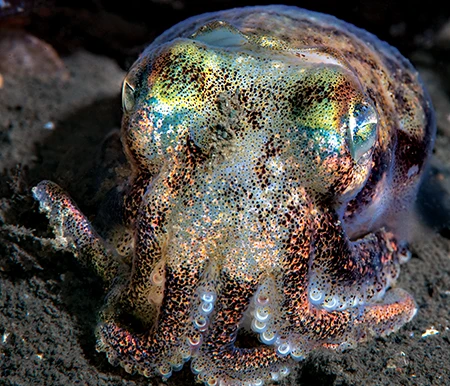
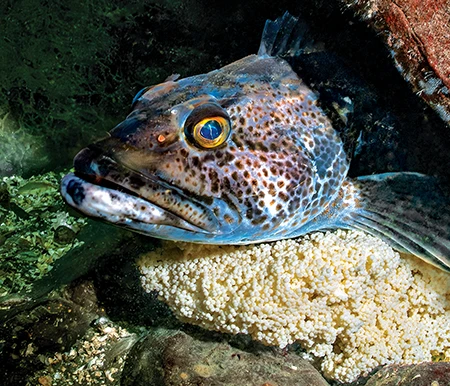
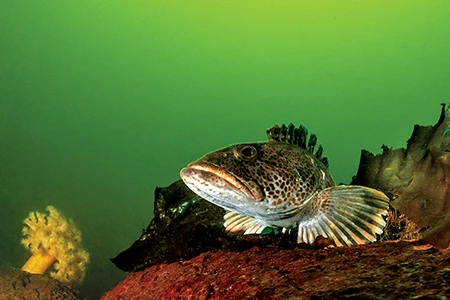
Not seeing any, we don’t invest much more time looking for them. There is much more to photograph at 40 feet (12 m) around the wooden pilings of an old, collapsed pier. The pilings are festooned with orange and white Metridium anemones and are better suited for a wide-angle lens, but I find plenty of squids, sculpins, gobies, and shrimp to shoot.
The storm winds shifted the next morning, making last night’s lee shore this morning’s windward side. Nigam determines that Sund Rock on Hood Canal is the only option for today. “With all of this rain, the visibility above 30 feet at Sund Rock is going to stink,” he tells us, “but the vis is really good below that, according to several reports.”
Sund Rock is a small, popular dive site on private property, so we quickly pay our diver fee to reserve parking and dive spots. The wind and rain seem relentless, and it feels a bit gloomy when we arrive. The site is protected in today’s lee, however, and the sound is pancake flat. We quickly gear up under the shelter provided for divers and make our way to the rocky entry point.
The visibility is 2 feet (0.6 m) at best on the surface, as Nigam predicted, and it’s spooky descending through the cold, murky layer. But at 30 feet (9 m), the visibility goes from near zero to more than 40 feet (12 m), leaving us in the ethereal, green gloaming at midday.
A school of rockfish immediately grabs my attention before Nigam points out a pair of wolf-eels in a rocky den at the base of the slope. Sund Rock is impressive, and the anemones against the rocky backdrop provide an otherworldly vertical relief to our images. The sight is magical and well worth the price of admission, even as the wind and rain make every attempt to dampen the mood.
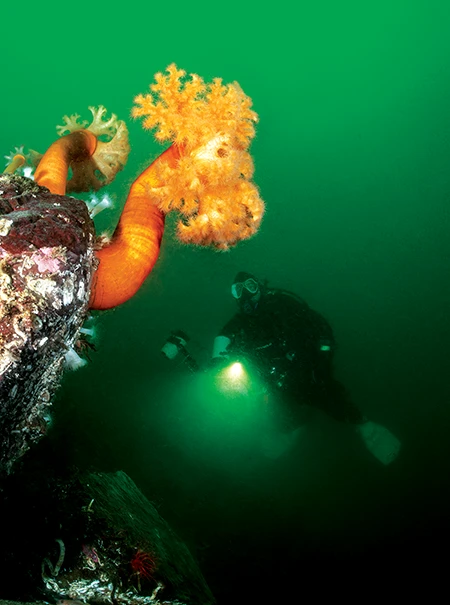
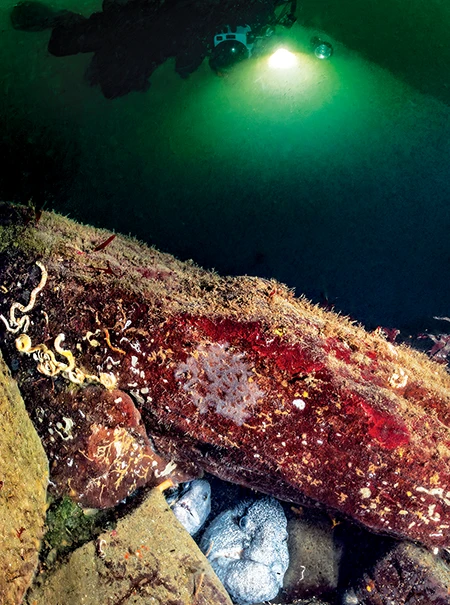
On the third day we expect fair but windy conditions everywhere except Keystone Jetty on the west side of Whidbey Island, which sits nicely in today’s lee. It’s a longer haul, including a ferry ride from Olympia, Washington, but a fleeting look at sunshine makes the trip worthwhile.
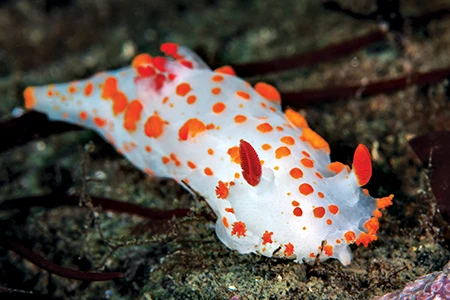
While Keystone can be an excellent wide-angle site, we opt to shoot macro along the rocks, which drop to 60 feet (18 m) at the end of the jetty. I find nudibranchs, greenlings, and even a curious, photogenic sculpin taking refuge in a large barnacle shell. The visibility is not as good as that at Alki Cove or Sund Rock, but the sloping jetty rocks provide a point of reference, allowing us to split up and pursue our own image agendas. We compare notes after the dive, and I learn that the curious sculpin I saw has been a resident in the same barnacle shell for at least seven years.
On our final diving day the weather once again changed for the worse. “It’s not usually this nasty,” Nigam says as he searches for another sheltered site. The only place we might find a lee shore is Sekiu Rocks, halfway between the Pacific Ocean and Whidbey Island, on the south shore of Juan de Fuca Strait.
The site is definitely tide-governed, and the four-hour drive might end without a dive, but Nigam tells us that the drive through Olympic National Park is beautiful, even in the rain. We will have a one-hour window at low tide. If Nigam is right, the conditions will be perfect for a single dive before the tide changes. “Since the wind is coming directly from the south, it should flatten out any swell in the strait,” he surmises.
We arrive at Sekiu Rocks in a steady rain. With no place to shelter, we scramble to put on our waterproof kits. Nigam’s prediction was spot on. The strait is smooth, the current is dead slack, and the kelp forest 120 feet (37 m) offshore beckons.
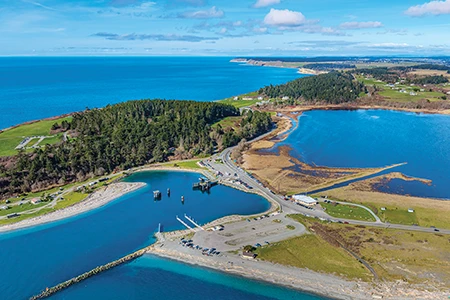
The visibility is excellent, and the vibe is more coastal, with the luxurious kelp fronds adding a different dimension to the site. This place is quintessential for wide-angle shooters, with anemones, urchins, and invertebrates covering boulders among the forestlike kelp.
The water is unusually blue compared with the inner sound’s green hue. Pio searches for the rare kelp greenling in the shallows, while Nigam and I occupy ourselves photographing each other between the rocks and kelp fronds on the deep side of the reef.
It’s a magical hour, and despite the clouds and rain, the conditions are as good as Nigam has ever witnessed at Sekiu Rocks. We wrap up our trip by scoring another victory on the final day of Puget Sound shore diving.
Explore Más
Submerged Passages of Puget Sound
© Alert Diver – Q4 2026