Seas of Surprise in the Land of the Rising Sun
Beneath the waves lapping at Tokyo’s doorstep, fish as wildly colorful as Amazonian birds glide through forests of soft corals and over bustling artificial reefs. Shoals of hammerhead sharks ride the strong currents that sweep past offshore islets. Their smaller elasmobranch brethren — more than a half dozen harmless shark and ray species — rest on a sandy seabed and swim through boulder fields.
During winter months, strange, normally deep-dwelling creatures ascend steep slopes into shallower depths. Lucky divers may catch a much-coveted glimpse of these rarely seen beasts before they return to their abyssal haunts until snow once again falls on Mount Fuji.
The variety of ocean habitats and the convergence of cool temperate and warmer subtropical waters along the rugged southern coast of Honshu — Japan’s largest, most populous island — contribute to a diverse, dynamic, and unique assemblage of sea life. The diving there is genuinely great.
Long Time Coming
I thought I had mostly seen it all in the greater Pan-Asian region, except for Japan — specifically, the seas swirling near central Japan. For decades I had wanted to dive the legendary Izu Peninsula, first introduced to me in a striking photo essay by David Doubilet in National Geographic. That seed was planted in 1984, before I had ever picked up an underwater camera.
It took eons for my action plan to germinate. I finally took the plunge in 2023 and returned to Honshu in 2025 for more. Even with a reasonably good idea of what to expect from my research and a pretrip virtual dive from following native Japanese photographers on social media, I was nevertheless blown away and pleasantly surprised by the real experience.
he diving was so delightful that I’m already daydreaming about a three-peat in the next few years. But first I’ll recap some of the many highlights, one peninsula at a time, from my two expeditions.
Bōsō Peninsula
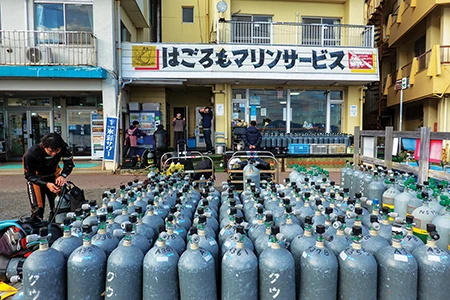
My first dives in Japan were at Ito in Tateyama, Chiba Prefecture, on the southern Bōsō Peninsula. From Tokyo, it took about two hours by car to reach the dive shop in Ito, but many people make the journey by train. It’s common practice to ride the train to scuba dive for the day here and at many other dive sites in central Japan.
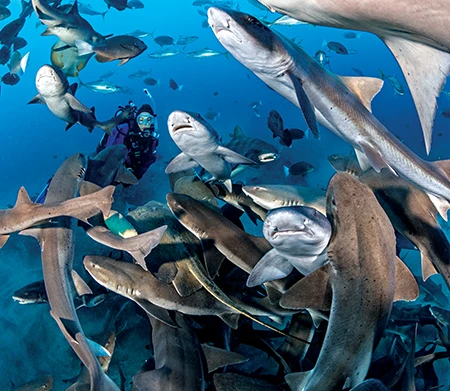
The main attraction at the popular Shark City (or Shark Scramble) site, unsurprisingly, is sharks — and lots of them. Divers often see 50 or even 100 banded houndsharks on a single dive. They are endangered throughout much of their geographic range — from Russia south to Taiwan — because of fishing pressure (targeted harvest and incidental bycatch), but the species thrives here.
Many years ago, fishers in this region were troubled by houndsharks damaging their nets and disrupting fishing operations. Some encounters ended badly for the sharks. A local dive operator had a novel idea and negotiated with the fishers to provide baitfish, and in return he would use the fish to lure the sharks away from the fishing grounds. The bait-and-switch worked.
With regularly scheduled dives during which a small amount of bait is given to the houndsharks, they have remained around the same rocky nearshore reef for years and are no longer in conflict with fishers. It’s an interesting twist on sustainable ecotourism that seems to benefit both the people and the wildlife.
Divers from all over come to Ito Tateyama for the small sharks. It was great fun to be surrounded by dozens of 3- to 4-foot (0.9- to 1.2-meter) squirming houndsharks. Sometimes even the 180-degree superwide view of my fisheye lens wasn’t wide enough to capture all the bumping, writhing action.
Banded houndsharks are by far the most abundant elasmobranch at Shark City, but many other cartilaginous cousins also live on this reef between 50 and 70 feet (15 and 21 m) deep. Red stingrays were mixed in with the horde of houndsharks. Our guide pointed out a bottlenose guitarfish and an oddly shaped Japanese butterfly ray on the sand.
My wife, Melissa, proved that her eyes are better than mine when she discovered a Japanese wobbegong hiding in plain sight. Thankfully, she was carrying our second camera, which sported a narrower 17-70mm lens, allowing us to zoom in for portraits showing the cryptic bottom dweller’s mustache and beard of nasal barbels and protruding skin flaps. One of 12 wobbegong species worldwide, this is the only one found in the Northern hemisphere and a new, exciting addition to my lifetime elasmo list.
Late into another tank we found a neko-zame, the Japanese bullhead shark, in stately repose under a boulder. Winter is the best time to stumble across wobbegongs and bullheads in Honshu since both prefer cooler ocean temperatures.
Miura Peninsula
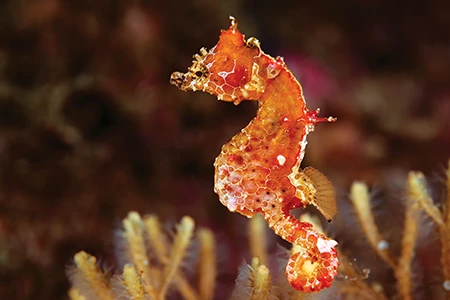
I didn’t know about Ito’s shark diving when I began researching Honshu early in my career. That unexpected bonus came later. Critters such as the koke-gimpo (moss fringehead) and hanatatsu (painted seahorse), however, have had me wrapped tightly around their fins for quite some time.
A long-term fascination with Japan’s cool little creatures put Hayama on my map long ago and ensured its inclusion in my expeditions. It is due south of Yokohama on the Miura Peninsula in Kanagawa Prefecture, its diving is a bit muck flavored. Get low, go slow, and search for diminutive treasures on a mostly soft seabed. Our indispensable bilingual Japanese guide, driver, and fixer described this site as “like tatami mat diving,” meaning our camera-heavy group of five would dive together in close quarters, jostling for pole position when we found photogenic targets.
Experts from our dive shop took us to two boat sites whose names translate to Emperor’s Villa dan White Lighthouse. Two divemasters shepherded us down to similarly muddy bottoms at about 50 feet (15 m) and traced unseen paths they knew by heart to introduce us to their undersea neighborhood’s remarkable residents.
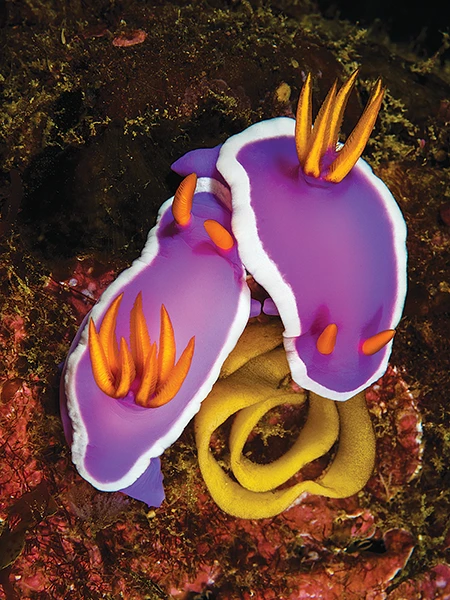
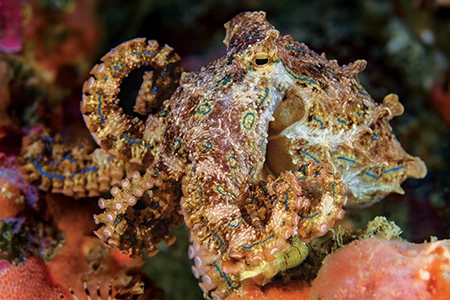
y logbook entry boasts magnificent anemone shrimp, garishly colored nudibranchs, blue-lined octopus, hard-to-believe-they’re-real pinecone fish, yellow crowned seahorses, red painted seahorses, and three koke-gimpos. These charming fellows put on quite the show, with twitchy eyes agog, repeatedly turning upside down and launching aggressively out of their wormhole lairs. They ferociously snapped their mouths open and shut as if they were the biggest, baddest predators in the sea rather than the wee fish folk they truly are. These comical characters with outlandish, spiky crewcut hairdos are barely the diameter of a pencil.
Kii Peninsula
Off the Kii Peninsula, more than 350 miles (563 kilometers) by road or rail west of Hayama, Kushimoto had a different vibe. I found reefs with more vertical relief and warmer water than earlier in the trip. There were even a few small patches of hard corals growing on the rocky ridges and pinnacles. These shores experience more of the northerly flowing, warmwater Kuroshio Current coming up from the equatorial tropics.
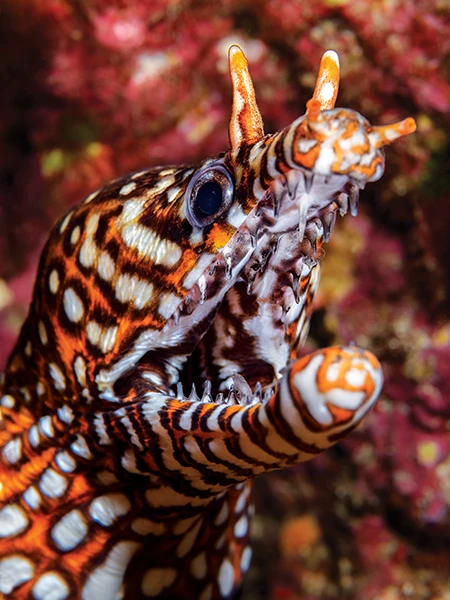
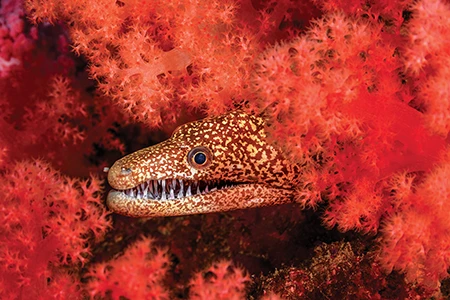
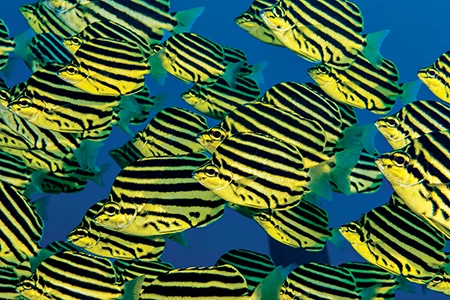
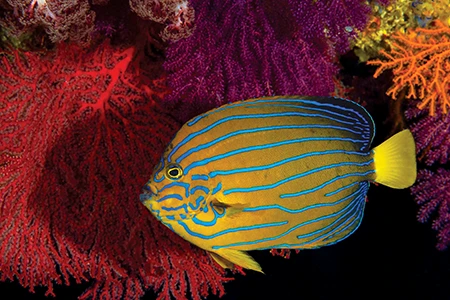
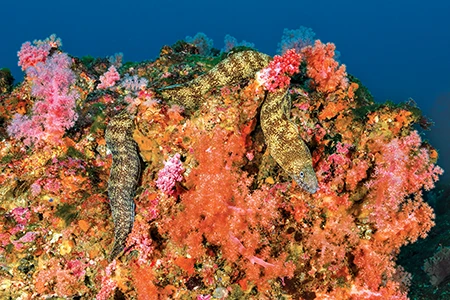
I didn’t come for corals, however, but rather the fish. Exploring four sites (Bizen, Sumisaki, Second Pinnacle, and Good Wrasse World), we spotted plentiful typical tropicals and exotic endemics alike. My favorites included frogfish, Japanese angels, stripeys, dragon morays, morwongs, and boarfish. The grand prize was the pygmy seahorse, japapigu, which lives only in Japanese waters.
We divided our four days on the Kii Peninsula in January 2023 between Wakayama Prefecture’s Kushimoto and Owase in Mie Prefecture, about two hours up the road. I was blown away, in the best way, at Owase’s Gyosho dive site, where sea life of all kinds has colonized an artificial reef on otherwise barren, muddy, flat substrate 70 feet (21 m) deep.
Built by fishers some 60 years ago to revive diminishing catches, the reef’s foundation is a pile of open concrete blocks, each one 8 feet (2.4 m) to a side. The three-dimensional structure provides shelter for fish and infinite attachment points for encrusting invertebrates. Resplendent sea fans, soft corals, sponges, and tunicates decorate the real estate on, over, and through which all manner of animals swim, slither, climb, hunt, and hide. I saw baitfish, lionfish, blueline angelfish, blue lightbulb tunicates, golden hawkfish, coral trout, wire corals, and Xeno wire coral crabs. And there was so much more. Three dives weren’t enough.
Fishers and divers take turns accessing the site. Fishers selectively work waters adjacent to the reef that now support more fish. Our group explores the living jungle gym itself. Dive operators hire fishing boats to shuttle divers from the harbor to Gyosho. The extra income helps fishers maintain boats and gear, pay mooring fees and fuel, and weather difficult seasons when their catches are down. This unusual union is an effective alliance I had not witnessed before.
Izu Peninsula
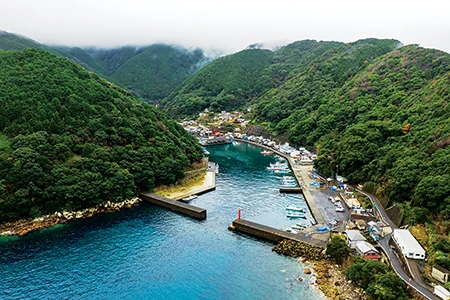
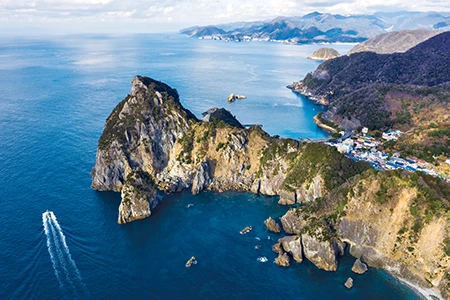
If cruel fate decreed that I could dive only one peninsula, I would choose Izu. Seen from the clouds, the Izu Peninsula in Shizuoka Prefecture resembles a morel mushroom sprouting into the sea from majestic Mount Fuji. Seen from below the waves, it looks spectacular and is full of surprises.
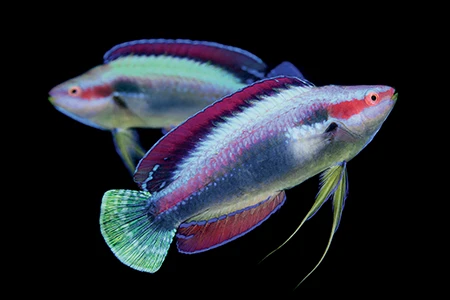
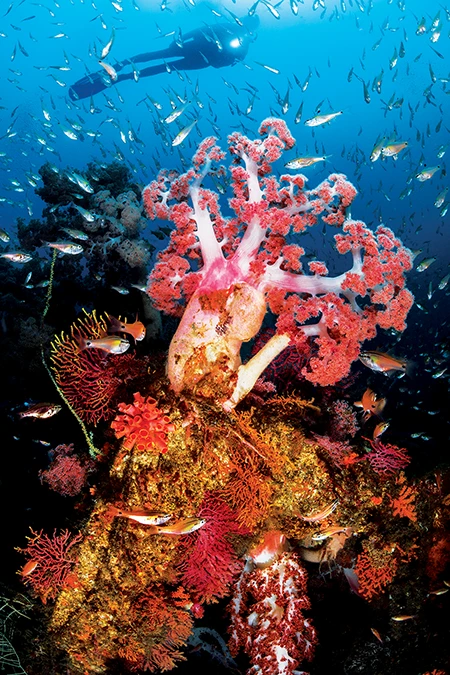
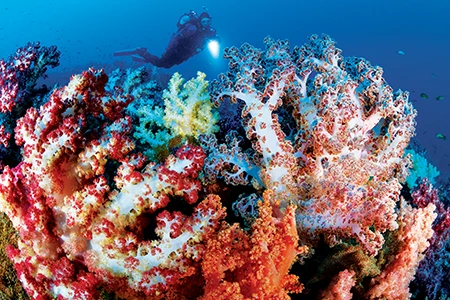
I was taken aback by the towering soft corals 100 feet (30 m) at Sentan in Osezaki Bay on Izu’s northwest corner. Gorgeous cherry and sharpfin anthias flitted through the pastel-hued coral trees as tall as me. Shallower, I watched equally stunning fairy wrasses in electric neon colors chase each other about.
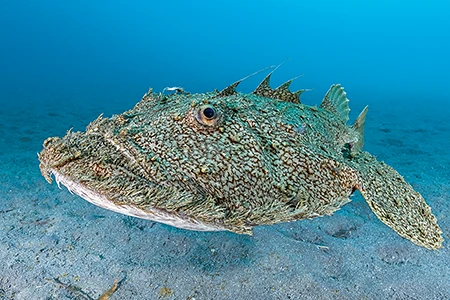
uring my January dives at Osezaki, chilly water pulsed up Sentan’s steep cobbled incline. Thankfully, I was wearing a drysuit. I was fortunate to see spiky-finned, pancake-flat John Dory fish here. Even luckier were the sightings of uber-ugly monkfish (also called goosefish) on the silty flats in the center of Ose Bay. This mega-sized anglerfish species likewise occasionally sneaks up from its much deeper, colder abode during winter.
Sea robins, gurnard lionfish, and flatfish prefer Ose’s mucky substrate too. If you come across an empty bottle on the bottom, look inside, and you may see a yellow pygmy goby staring back at you. Blackwater night dives present the opportunity to see cephalopods, crustaceans, and out-of-this-world larval and juvenile fishes, including ribbonfish.
Osezaki is busy year-round thanks to its excellent shore diving and protection from all but the worst of storms. Some Izu sites are more exposed, but depending on the direction of wind and waves, you can usually dive one side of the peninsula or the other. Shishihama, Arari, Tagodan Kumomi are more spots well worth exploring on Izu’s west side.
Divers are overly spoiled for choice on the peninsula’s eastern flank. Boat dives out of Ito in the Shizuoka Prefecture take you to pinnacles fed by nourishing (sometimes challenging) currents, reefs blanketed in apricot-colored sea fans, lemon whips, cherry soft corals, and kiwi cup corals.
Lurking among the invertebrate eye candy were hookjaw morays with needlelike teeth and the more common kidako eels. Groupers, goatfish, butterflyfish, and golden anthias streamed overtop. Ito also has critter-covered artificial concrete block reefs, like Owase, enveloped in clouds of silver cardinals and glassfish.
I included nearby Atami in my itinerary for the Asahi Maru shipwreck. Its deck is at about 65 feet (20 m), and the keel is at about 105 feet (32 m). Much of the old barge’s stern is now decorated with prettycorals, sango kirei.
Izu Oceanic Park dan Futo were on my wish list for specific elasmobranchs. With the help of our patient guides, we found and photographed angelsharks at the former and electric rays at the latter. The pedigree of these two sites stretches far into the past; I read about both more than 30 years ago. They remain popular today, frequented by both scuba newbies training and more experienced divers looking to meet the diverse marine life.
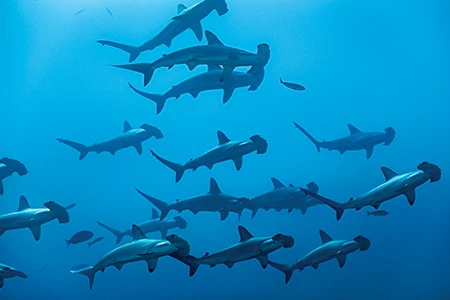
Mikomoto, a small island off Izu’s southern tip, is a more recent addition to Honshu’s dive story. In a few short years it has gained international recognition for schooling scalloped hammerheads. This lure was the prime directive for our July 2025 trip. The powerful Kuroshio Current bathes Mikomoto in warm, clear, northerly flowing waters during the summer months, apparently the secret sauce in the hammerhead equation.
Even though a typhoon and several tsunami warnings threatened to hijack my mission, we persevered through the challenging conditions in the week we dedicated to Mikomoto, and we eventually succeeded. Tightly gripping the rocks at 80 feet (24 m) to prevent being torn away in Kuroshio’s clutches, we were treated to jaw-dropping, heart-pounding views of scores of hammerheads above us; the enigmatic, fantastic beasts were weaving rhythmically into the sea wind. Their dramatic, unmistakable silhouettes are now seared into my memory.
I once would have doubted claims that central Japan boasted a world-class hammerhead dive and gardens of Fiji-esque soft corals blooming brightly in bracingly cool waters. Surely the very idea of such abundance and diversity so close to the world’s third-largest metropolis seems implausible. But no longer.
My more than 80 dives here have repeatedly impressed and thoroughly intrigued me. I eagerly look forward to the next series of surprises that I’m certain await in Honshu’s waters.
Cara Menyelam
Sampai di sana: Airlines worldwide fly to Tokyo. Travel to dive sites along Honshu’s coastline by rental car, taxi, or train. I hired a van and a driver who was also a translator and guide to transport me and assist with dive reservations, hotel bookings, and everything else.
Kondisi: Climate and sea conditions change seasonally. Winters are cool and usually drier; summers are hot and humid with more rain. You can dive year-round, but winter storms may cancel diving for a day or two. In summer and fall, there’s a chance of typhoons, which can prohibit diving for longer. For the areas mentioned in this article, ocean temperatures range from about 55°F to 80°F (13°C to 27°C) between winter and summer depending on location. Visibility varies from about 15 to 75 feet (5 to 23 m), with the best clarity in winter.
Miscellaneous: Planning and executing a multidestination dive trip in Japan can be difficult if you don’t speak Japanese. Enlist local support. Dive-in-Japan.com is an excellent English resource for researching dive sites, marine life, dive operators, and more. Plan ahead for any special gear needs. Many dive operators don’t offer large tanks or nitrox. Rental equipment for very large or tall people is limited.
Familiarize yourself with basic tourist etiquette in Japan. Courtesy and respect for Japanese culture and customs are much appreciated. A language translation smartphone app is useful. Type A electrical outlets — the same as in the U.S. — deliver 100 volts and are standard here, but many places have only two-prong outlets with no grounding pin, so a 3-prong adapter is helpful.
Jelajahi Lebih Lanjut
Diving in Osezaki
Japan Dive Sites
© Alert Diver – Q4 2026