A Magical Vibe
Cozumel, a tiny gem of an island in the Caribbean Sea, is nestled across from mainland Mexico in the state of Quintana Roo near the eastern tip of the Yucatán Peninsula. Getting there is easy, with a small on-island airport that offers regular flights to and from all over the U.S.
The seaside resort town has an active, thriving dive community, great restaurants, all-inclusive dive resorts, and private-hire lodging such as condos, apartments, and houses. Many of the oceanfront accommodations are served by private-hire dive operations, making Cozumel an even easier choice for individuals, groups, and dive clubs.
I began planning my first visit to Cozumel in 2019 to help a dive shop set up its blackwater diving program after a close friend had introduced me to the shop’s owners. As we carefully prepared for the trip, the COVID-19 pandemic’s worldwide travel hiatus temporarily threw a kink into our best-laid plans. Cozumel remained open to travelers, however, so in early 2021 we set our plans in motion. With gear in tow, I soon exited the airport to find my friend waiting for me curbside.
Admittedly, my only real knowledge of diving in Cozumel came from its reputation for large dive boats full of divers and extensive drift diving. Contrary to what I expected, I soon discovered that Cozumel has a completely different side with a magical vibe all its own.
Cozumel Diving
Diving in Cozumel isn’t difficult and mainly occurs in the channel between the island and mainland Mexico. The longshore reefs here are part of the Mesoamerican Barrier Reef System, which stretches more than 620 miles (1,000 kilometers) from the coast of Honduras through Cozumel, forming the Western Hemisphere’s largest reef system.
The unique barrier reef protects against coastal erosion while forming other important habitats along its path. Nutrient-rich waters flow from the deep ocean up and over the shallow pan, forming an aquatic chasm where it has carved an intricate labyrinth of tunnels, channels, and cathedral-like swim-throughs along the shoreline.
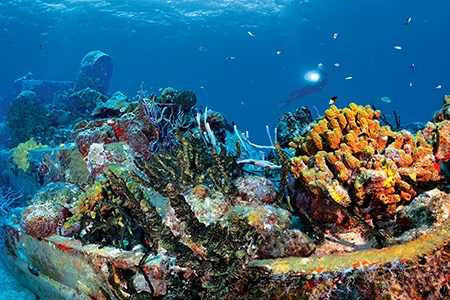
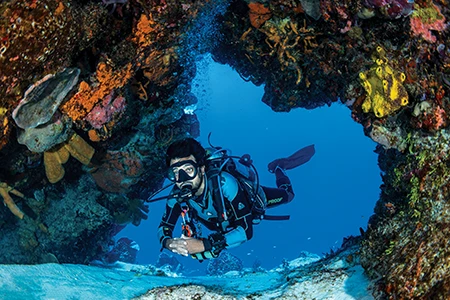
Signature dive sites such as Kolombia feature a typically shallow inner reef and a deeper reef that opens into blue water. The caverns and swim-throughs here are ablaze with wonderfully colorful, oddly shaped sponges, sea fans, stony corals, and schooling fish.
What really grabbed my attention on that first dive is the striking, vivid blue water. The white sand below reflects sunlight upward, creating a bright blue glow that nearly demands that you wear sunglasses while diving. The water’s color and clarity are delightful, especially coming from the turbid areas I am accustomed to in the Pacific. From the tip of Maracaibo dan Punta Sur, where the prevailing current first moves through the Cozumel Channel, all the way to Barracuda Reef, the magic of the moving waters is evident everywhere.
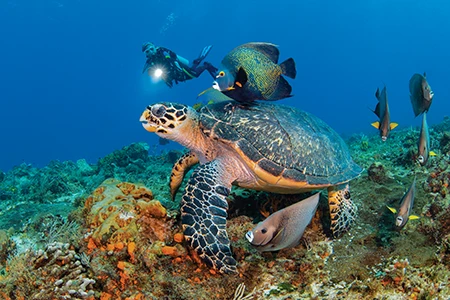
Cozumel has a surprising abundance of marine life around the island, which I credit to Mother Nature, strong park management, and the local community’s cooperation. A fee is required to enter the parks, but the money is well spent. Palancar Reef, Colombia Deep, and other sites are excellent examples of the conservation efforts other countries should adopt.
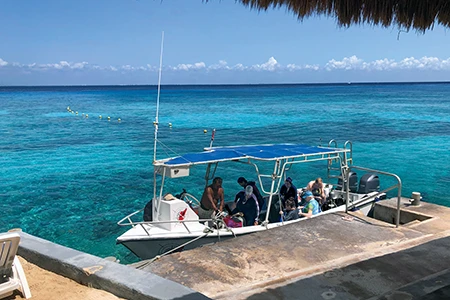
While shore diving is easy from many places, reaching the reefs and protected dive parks will require a boat due to distance and current. Our dive operator uses small speedboats that carry up to six divers. They service many of the oceanfront villas and condos by arrangement and can have you diving like a local and at your favorite dive sites in short order. The guides are well trained and knowledgeable, great with photographers, and even decent macro spotters.
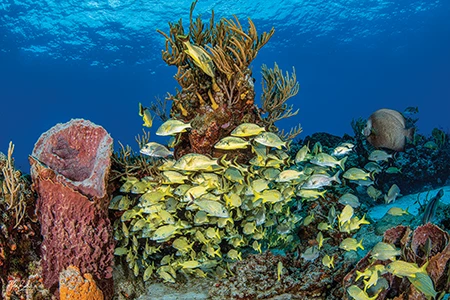
Some things I enjoy most about diving Cozumel are the mazelike cuts and cavernous topography shaped by centuries of water movement, a force still at work today. While the current flows over the reef tops, small alcoves offer calm respites where you can explore the reef system’s inner fingers. Overhangs and enclaves are often populated by snappers, grunts, eels, an occasional nurse shark, and sometimes other divers with the same ideas.
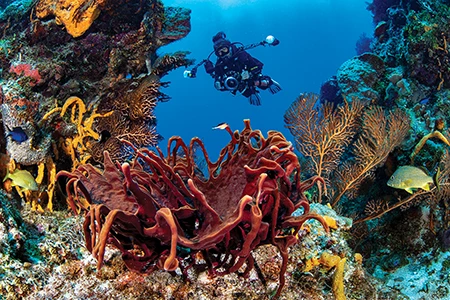
The sunlight flattens the contrast as you roll into a dive, making the reefs seem featureless and their colors dull. As the current carries you closer, however, colors emerge, and the details come into sharp focus. Jutting pinnacles, swim-throughs, massive vase sponges resembling cacti, and gorgonian sea fans in hues of green, orange, and yellow are all set against the piercing blue backdrop.
Most dives are above the 90-foot (27-meter) mark, averaging around 65 to 70 feet (20 to 21 m), so long dives are easy. Even with the extended bottom times, the dives pass by way too quickly, and I often find myself wanting more.
Critter Hunting
After a fun morning of drifting and finning around the reefs, it’s nice to wind down with a critter hunt in the afternoon. If you like blennies, you’re in for a treat. The corals, rocks, sponges, and seagrass beds are filled with these tiny, photogenic critters that are exciting and challenging to shoot.
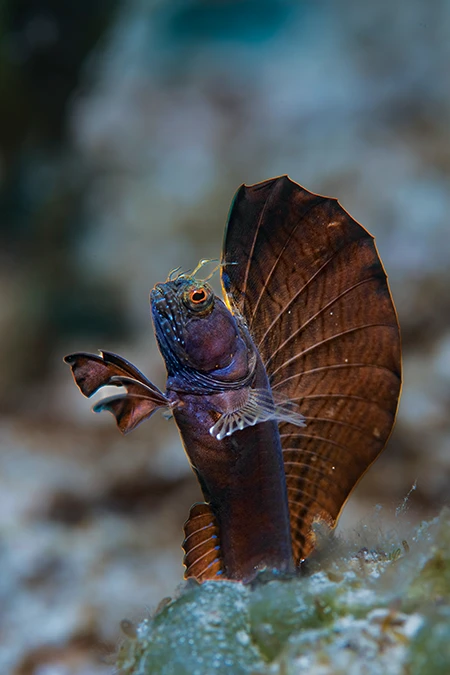
Many shore dives also offer easy access to great macro subjects, such as nudibranchs, crustaceans, and other unusual creatures. Sailfin blennies are a favorite target because they are tricky to find and fun to watch. To locate them, approach slowly, stay relaxed, and look ahead while patiently searching for small rocks with even smaller holes where a blenny could reside. With luck, you may see the head of a sailfin, which resembles a small twig, sticking out of one of these holes.
Most blennies are somewhat social and live close to one another. They are tolerant of each other but can flush with color, flare up, and become agitated in an instant after crossing some invisible line.
Sailfin blennies are perhaps the most passive-aggressive fish I have ever encountered. When you spot one, go slowly, as the situation can get tense, and any quick movements can spook the blenny back into its hidey-hole. If you remain calm, the tranquil little star may suddenly spring upward and rapidly begin bobbing up and down while extending its massive dorsal fin. The display lasts for a few seconds, and the fish may either retreat or repeat.
They are generally dark in color but can range from deep brown to green, black, blue, and red, or any variation of these colors. Their display is typically classified as a nuptial behavior, but it can also serve to warn off intruders.
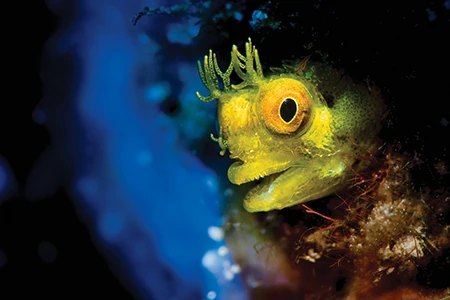
I am also easily charmed by roughhead and spinyhead blennies, which are best photographed with a diopter to reveal their tiny, expressive faces. These fish live almost anywhere in the Caribbean, and Cozumel has a large population of them.
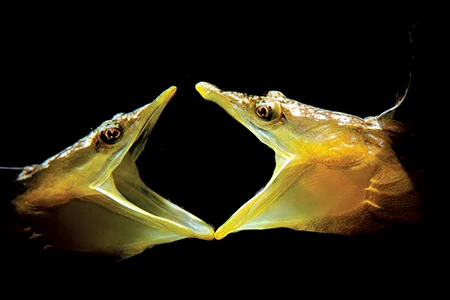
When we were nearing the end of a dive, the guide called me over, pointing ahead in the seagrass and signaling for me to get low. Ahead we spied a rare pikeblenny extending itself and bobbing its head, aggressively posturing by flaring its gills and flushing with color. Pikeblennies have a different posture than other blennies. Watching them face off with each other is quite fascinating as they curl forward, mouths agape and nose-to-nose, their throats expanded as if silently shouting at one another.
Wrecks and Artificial Reefs
Cozumel also has a few wrecks you can visit, though they are shallow and not the kind that would attract tech divers. The dive site Two Boats, which is in the bay — or “in town” as locals like to say — is well protected from strong currents. This site unsurprisingly includes two boats that rest at about 45 feet (14 m) on a flat, sandy seabed.
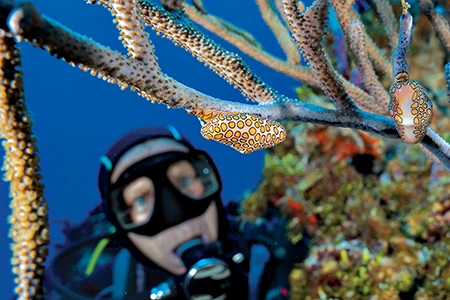
The current here is normally mild but strong enough to carry you across a sprawling field of coral- and sponge-covered blocks. The underlying structures were deposited here more than 20 years ago during construction of a cruise ship terminal. Exploring these artificial reefs reveals many small inhabitants that can be difficult to find, such as the colorful flamingo tongue snail. These predatory gastropods, which resemble cowries, are quite large and feed on the soft corals on which they live.
In addition to the great macro life here, it is fun to shoot the wrecks with a wide-angle lens. The sand around the boats offers some of the best night diving on the island.
Blackwater Diving
Exploring the channel for potential blackwater diving sites was one of the main goals of that first trip. Thanks to generally calm seas and mild weather, Cozumel is ideal for multiple consecutive nights of blackwater diving.
After consulting my trusty charts and the local boat captains, we decided to head north, away from the ferry port. We knew the current would carry us, but we were unsure how far or how fast. The objective was to complete two dives per night, drift toward town, and avoid major vessels crossing there.
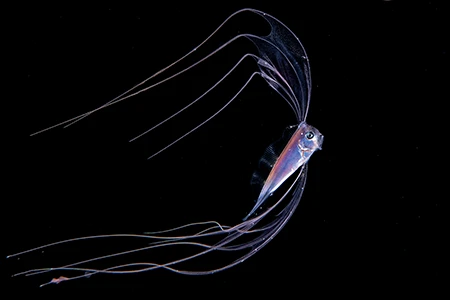
The nearly clear, blue water glittered as we launched our lights and a glowing surface buoy from the boat, and then geared up for that first jump. I was immediately struck by the visibility as we drifted down along the column of lights. Squids were already active, jetting ink splotches everywhere. Small jellyfish pulsated, and we saw light-refracting ctenophores in rainbow colors, salps and salp chains, and lovely filamented larval fish.
The scene was exactly what we came for — we had hit paydirt on the first run. We managed two dives that first night and every night that week. Cozumel turned out to be a very rich blackwater destination with some unique finds. Two shops now run blackwater trips each week, so it’s easy to get out and enjoy the other side of the nightlife Cozumel is famous for.
Cenotes and Caverns
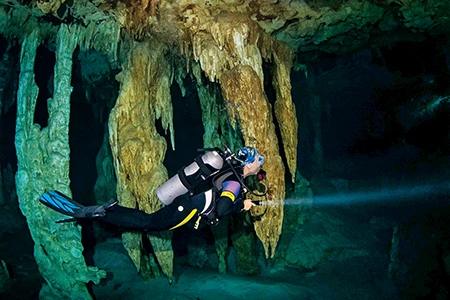
In addition to diving in Cozumel, you can also take a day trip to Tulum to dive in the cenotes. Our group didn’t have any cave-diving experience, but we learned we could enjoy a similar experience by diving in a cavern.
On a recent trip we decided to hop on the ferry, cross the channel to Playa del Carmen, and meet with a recommended cave-diving instructor. Tulum is about 36 miles (58 km) south of Playa del Carmen and is well known for its extensive cave systems that stretch for miles beneath the jungles of Yucatán. Because we aren’t cave-certified, we couldn’t dive the more advanced locations.
Our instructor selected a cavern system and route known as the Barbie Line, and the diving was easy and enjoyable. As a cavern, it provided vertical access to air at all times. The caverns were wide and expansive, and the entire experience was relaxing and different from the type of diving I’m used to. The Barbie Line allows anyone who is open water certified to experience this type of diving without the cumbersome gear or the inherent risks of dedicated cave diving.
We managed two dives that day: Barbie Line and Bat Cave. Both sites were accessed via the same crystal-clear pool at the mouth of the system, each heading in a different direction. The guide was great and, after a quick lunch, had us back at the ferry port before 4 p.m.
There is so much more to Cozumel than meets the eye — including Mayan ruins, wild crocodiles, and the historic Celarain Lighthouse at Punta Sur Eco Beach Park. The dive parks are well managed.
Whether you prefer enjoying an all-inclusive getaway or diving like a local, the Cozumel vibe is easy to slip into.
Cara Menyelam
Sampai di sana: You can fly directly to Cozumel from the U.S. and Canada. Dallas, Denver, Miami, Montreal, and Toronto have daily nonstop flights. Several all-inclusive resorts on the island provide dive packages. Airbnb and Vrbo also offer vacation rentals with self-hire dive operations.
Kondisi: Cozumel offers year-round diving. August is hurricane season, but the diving is still good. Water temperatures range from about 78°F to 86°F (26°C to 30°C). The wind can make it cool on a boat deck, so bring a light jacket.
Customs information: Mexico has a two-camera (stills or video) limit. Customs agents can charge an import sales tax of 16% to 19% of the estimated value of any items over the limit, regardless of whether the cameras return home with you. Enforcement varies. As of press time, discussions with government officials are underway to improve this issue. Meanwhile, prudent travel strategies include:
- Travel light.Leave backups at home.
- Split photo gear into a non-photographer buddy’s bags.
- Keep receipts, especially for older, preowned gear.
- Professional photographers may consider getting an ATA Carnet to protect them from import duties, but they are expensive and time-consuming upon entry and exit.
- Learn more about what you can pack for Mexico at anam.gob.mx/equipaje-y-franquicia-ing
Jelajahi Lebih Lanjut
Dive onto Palancar Reef in this video.
© Alert Diver – Q3 2026