From picking the perfect destination to packing the right gear, planning a major dive trip requires thoughtful preparation. Yet many divers and operators overlook a crucial part: knowing what emergency assistance options will be available if a dive accident occurs.
Manfaat DAN membership provides valuable protection. However, some divers may assume DAN membership covers everything “from the water to the hospital.” The reality is more nuanced — especially when diving in remote areas like Raja Ampat, Galapagos, Cocos, or Socorro, where local rescue and medical resources are limited.
A critical distinction exists between the terms emergency medical transportation dan rescue. Understanding this difference and what your DAN membership covers will help prevent unwelcome surprises during emergencies.
Emergency Medical Transportation: What DAN Membership Includes
When you need us, DAN will be here to help. We arrange emergency medical transportation for members, including medical evacuations (medevacs), and up to the benefit limit will be paid for covered expenses incurred for such emergency medical transportation. Emergency medical transportation is transport by land, water, or air conveyance and en route medical care of a member by medical personnel to an appropriate medical facility. In cases of emergency medical transportation such as medevac, the person being transported has already been medically assessed.
DAN’s emergency medical transportation benefits fall into three categories:
- Emergency Medical Evacuation (Medevac): When there is no local medical care available and the medical condition of the member and medical necessity warrant it, the immediate transportation to the nearest hospital or medical facility where appropriate medical care, treatment or evaluation can be obtained. Important limitations: Emergency medical evacuation coverage does not include efforts to search for a member whose location is unknown, or efforts to rescue a member from a dangerous situation or a location inaccessible by emergency medical services (EMS) personnel.
- Medically Necessary Transfer: The transportation of a member to a different hospital or medical facility for further care, treatment, or evaluation, following treatment or evaluation at the nearest hospital or medical facility, and absent suitable local care.
- Medical Transportation Home (only available with DAN Enhanced Membership in Canada and the US only): The transportation of a member to the hospital of their choosing located in the vicinity of their home if they have suffered a medical emergency and such condition is expected to require inpatient hospitalization for more than 7 days. The member’s condition must be sufficiently serious to warrant a Medical Transportation Home, and the member’s condition must be sufficiently stable to allow Medical Transportation Home without exposing them to additional injury or an exasperation of their condition.
Key elements of emergency medical transportation include:
- Medically supervised transport of a member after professional medical assessment to a hospital or medical facility
- Transportation by any land, water, or air conveyance (e.g., air ambulance, land ambulance, watercraft, commercial airliner) during medical transfer or evacuation
- Arranged by DAN TravelAssist
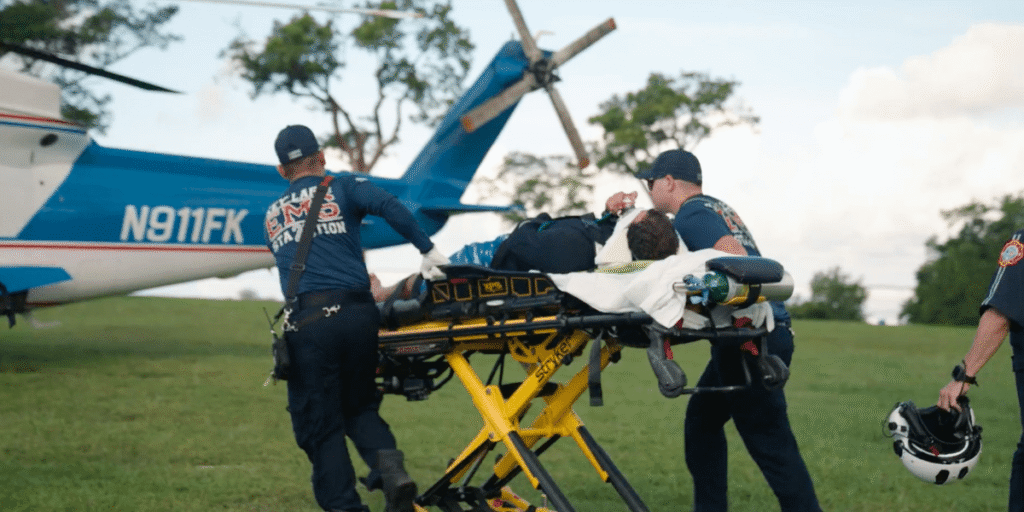
Rescue: A Different Category
Rescue is the immediate response to remove someone from a dangerous situation in the field. This typically occurs at a dive site or location of an accident and involves initial transportation to bring an injured person, who is not yet under the care of a medical professional, to a medical facility (or to a place where local EMS can take over). The rescue takes place before any formal medical assessment by a locally licensed medical authority having jurisdiction.
DAN’s ability to help with the early stages of a member’s rescue in a remote area or far out at sea may be very limited.Due to its nature and circumstances, rescue differs from emergency medical transportation. Rescue is not organized by DAN nor covered under DAN membership and differs from Search and Rescue, which is an effort to find and save the life of a missing person.
Common characteristics of rescue include:
- Occurring in areas inaccessible to local EMS
- Organized ad-hoc, usually by the dive operator rather than a medical provider
- Triggered by suspected but not yet assessed medical emergencies
- Often involves non-medical transport assets (e.g., fishing boats, tenders, trucks, non-medical helicopters) that may add risk or logistical complexity, especially in remote settings
Planning Ahead
Always know what you’re getting into when diving in an unfamiliar or remote area, especially concerning the accessibility of rescue services and emergency medical transportation. When planning a dive trip, consider these questions:
- How comprehensive are your dive operator’s emergency action plans (EAPs), medical equipment, and emergency response training?
- Where is the nearest medical facility, and is it equipped to handle dive emergencies?
- Is there a rescue or emergency response service that can transport an injured diver from the water to the nearest medical facility?
- What time and what resources would be needed to evacuate a diver to the first level of care and any subsequent advanced care, considering factors such as distance, border crossings, and any other operational restrictions (i.e., an ad-hoc air evacuation from a challenging location at night or in inclement weather)?
By understanding the scope of your DAN membership coverage and knowing what assistance will be available should an emergency occur, you can dive with greater confidence.

For a life-threatening emergency, first contact local EMS or get the injured person to the nearest medical facility. It is critical to ensure the person is stable and a medical professional assesses their condition. Once local EMS have been contacted, call the DAN Emergency Hotline at +1-919-684-9111 for additional emergency assistance or for a consultation with the local medical provider.
Members can access their coverage documents by going to Members.DAN.org and logging into the member portal. If you have an questions please do not hesitate to contact us.
DAN Membership includes automatic enrollment in DAN TravelAssist®. Emergency Medical Transportation and Travel Assistance Benefits are available for both diving and non-diving emergencies. For aggregate benefit limits, review the benefits table for your region.
DAN TravelAssist® benefits are provided by DAN, Travel Guard, and other service providers depending on the benefit. To access these benefits or to request emergency medical transportation or a severe infectious disease evacuation, you must contact DAN TravelAssist for assistance. Emergency medical transportation and severe infectious disease evacuation transportation arranged directly by you may not be reimbursed.
Coverage may vary by country. View the Policy Handbook/Certificate of Insurance for complete membership and policy details.