REEF’s Immersive New Ocean Exploration Center
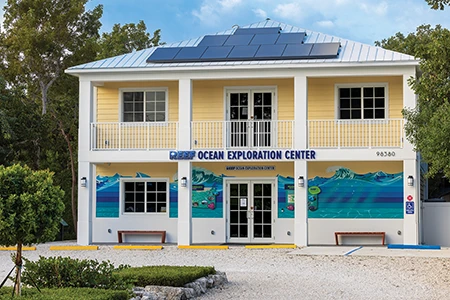
You are invited to make your first dive in one of the world’s major dive spots. One twist, however: This dive is on land at the new Ocean Exploration Center (OEC) in Key Largo, Florida.
Located between the north- and southbound lanes of U.S. Highway 1, the OEC sits directly in the flow of visitors heading into the Florida Keys. Some arrive intentionally, looking for something to do on a rainy or blown-out dive day. Others bike or walk by and wander in.
“Lots of people swim by us, and we have the chance to reel them in,” OEC Campus Director Jill Kuehnert said. “Explore. Discover. Make a difference — that’s kind of the journey here.”
A Gateway to Citizen Science
The center was designed to do something deceptively simple: help people connect with the ocean before they enter it. It transforms ocean education into something tactile, approachable, and participatory.
For more than three decades, the Reef Environmental Education Foundation (REEF), whose mission comes to life through the OEC, has evolved around a related idea: Ordinary people can meaningfully contribute to understanding and protecting the ocean.
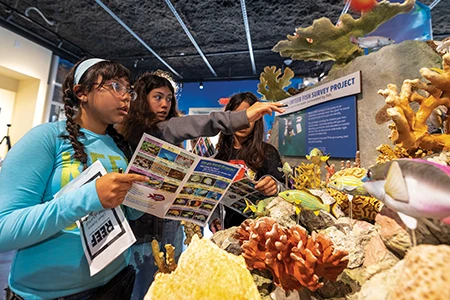
REEF has been facilitating citizen science long before the term became a buzzword. Through the nonprofit’s flagship Volunteer Fish Survey Project, divers and snorkelers collect fish population and species data during ordinary dives, helping scientists track changes in reef ecosystems over time. REEF’s global database now includes more than 300,000 surveys, with observations contributing to marine protected area management, invasive species response, and fisheries research around the world.
REEF hosts a myriad of other trips, activities, and ways to get involved, and the OEC building acts as a physical entry point to these citizen science missions and more.
“The big idea is that the ocean and its conservation are for everyone,” said Shelby Thomas, REEF’s engagement coordinator. “With the OEC, we want people to leave inspired to learn more and take action, whether by joining REEF’s programs or finding their own role in conservation.”
Diving In — On Land
Immersion is the proper word for what an hour or two feels like in this building, which opened in June 2025. The effect is immediate. Swirling blue-and-white epoxy floors mimic water, and special lighting effects create dappled sunlight, just as you would experience beneath the waves in the afternoon sun.
Walking upstairs, you find yourself amid one of the ocean’s great phenomena: a Nassau grouper spawning aggregation. This replica includes true-to-life fish suspended overhead that you can survey, just like on REEF’s field expeditions. A life-sized reef crest in the entryway teems with sponges, gorgonians, corals, and so many fish.
More than 100 hand-painted, scientifically accurate fish models and pictures are scattered throughout the building. And thus begins your Century Dive, OEC style.
A traditional REEF Century Dive, which was formalized in the late 1990s, involves identifying and recording 100 or more distinct fish species on a single scuba dive. This surveying achievement highlights extensive biodiversity and expert-level observation skills.
At the OEC, visitors-turned-explorers attempt a dry version, using REEF survey techniques to identify fish hidden throughout the exhibits, hallways, and even the bathrooms. The species are the same as those that divers might encounter in the Florida Keys and on Caribbean reefs.
Thomas recalled her favorite story from opening week. A 2-year-old grabbed her hand and pointed at every fish in the building, asking what each one was. The two spent nearly half an hour exploring together. “He was engrossed,” she said. “He was having the best time, and he learned a lot of cool fish!”
Real Skills for Real Reefs
For anyone who wants to help the ocean but doesn’t quite know how, this center offers tangible starting points.
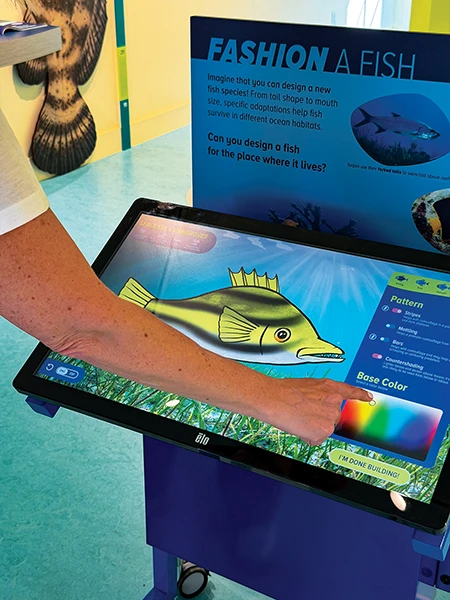
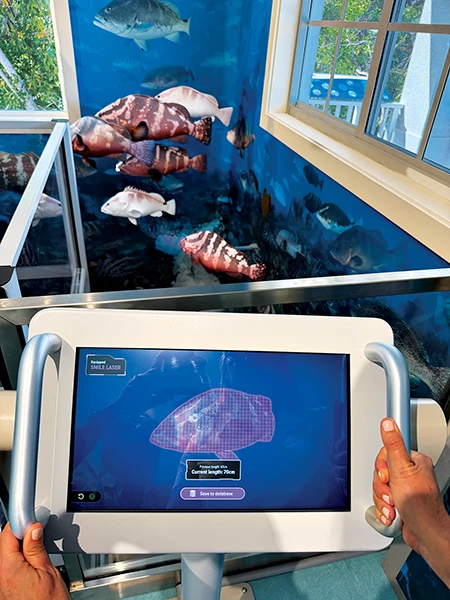
Many exhibits connect directly to REEF’s field programs and research, and all build ocean literacy through experiential learning. Beyond the dry dive, visitors can inspect the stomach contents of invasive lionfish, build fish adapted to different habitats in the popular “Fashion a Fish” game, or practice with new SMILE (Size Matters: Innovative Length Estimates) technology that estimates fish sizes underwater without handling the animal.
“People are learning without realizing they’re learning,” Kuehnert said with a grin. “We’re sneaky that way.”
Visitors gain competence and confidence in using the same skills and tools researchers need in the field every day.
Choose Your Own Adventure
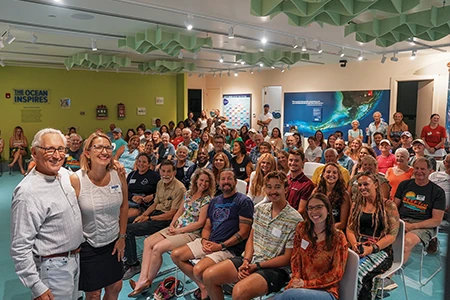
The center was also intentionally designed to meet visitors as they are. Each visit is personalized and curated to that individual. Kuehnert, Thomas, and REEF docents ask where visitors are from, whether they dive, and what interests them before guiding them through the exhibits.
“People can pick out what excites them and spend their time there,” Thomas said. “It is very much choose your own adventure.”
This flexibility is part of what keeps the OEC from feeling like a traditional museum. REEF works with exhibit designers and interpretation specialists to create discovery-based experiences that encourage participation rather than passive observation.
Enhancing the Keys Experience
For curious locals and visitors to the Keys, the OEC also provides something practical: context. Exhibits recreate specific habitats — such as sea fan meadows, low-profile reefs, and spur-and-groove reefs — while explaining how currents and habitat shape marine communities. Divers and snorkelers can familiarize themselves with species and environments they are likely to encounter before hitting the water.
“It helps people orient themselves for what they’ll be doing for a week,” Thomas said. “Even if you’ve been diving a lot, it’s great to see what you already recognize and learn some new species.”
For Kuehnert, fish identification completely changed her dive experience. “I used to be that diver thinking it was just a yellow or blue fish,” she said. “I didn’t pay attention. But knowing one fish and really appreciating it unlocks the door to a much richer dive experience. You get to learn the neighborhood when you’re diving.”
That perspective is particularly relevant in the Keys at this moment, where conversations about coral loss can overshadow what remains. “Our coral doesn’t look like it used to,” Kuehnert explained. “People who were here 20 years ago see the difference, and many get discouraged. But have you seen the fish? There’s still a lot to protect here.”
Oceans for All
The OEC is completely free to the public, thanks in part to donors and significant support from the Monroe County Tourist Development Council. REEF considered this essential from the beginning.
“We don’t want financial means to be a barrier for people to learn about the ocean and care for it,” Kuehnert said. “People coming to the Keys spend a lot to get here. We don’t want them to have to pay more to learn how to help.”
Accessibility also extends beyond admission. The building includes sensory kits, elevator access, exhibits and games in multiple languages, and activities designed for a wide range of ages and learning styles.
Most important, there is no requirement or expectation that visitors become surveyors or divers themselves.
“Getting on a boat isn’t always accessible, and it depends on the weather,” Thomas said. “This center gives people the opportunity to see something and be involved in a really important part of the Florida Keys.”
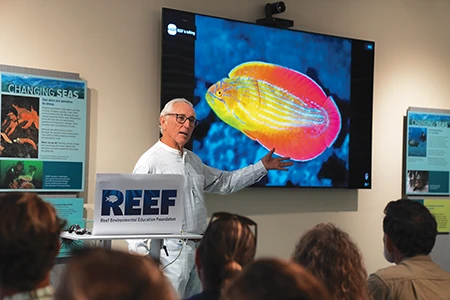
The building has also quickly become a gathering place for the larger Keys community. More than 1,000 students have already participated in educational programs ranging from classroom visits to multiday snorkeling expeditions. Weekly Ocean After Hours events bring in “Fish and Friends” lectures, trivia nights, movie screenings, and ocean yoga, among other things, all for free.
The flex spaces and meeting rooms are available for rent and have hosted teacher training, luncheons, and community events. The rental income also helps support the OEC’s commitment to free programming.
The OEC as a Living Legacy
While the building is new, the philosophy that guides the OEC is decades old.
REEF cofounders Ned DeLoach and the late Paul Humann transformed fish identification for recreational divers through their photography, pioneering field guides, and educational work. They believed everyday people could contribute valuable information “simply by paying closer attention to what they saw underwater,” said Martha Klitzkie, REEF’s co-executive director. DeLoach and Humann created an organization and the systems to leverage that impact.
Over time, they envisioned a larger, public-facing conservation center to help people really connect to our oceans. Humann became one of the strongest advocates for expanding REEF’s campus; he attended the groundbreaking during Reef Fest 2023 before he died the following year.
Their vision now exists in physical form. The OEC brings the reef onto land — not to replace the experience of getting underwater, but to deepen it. Visitors leave knowing a few more fish, asking more questions, and understanding that we all play an important role in the ocean’s future.
Jelajahi Lebih Lanjut
Watch students enjoy the Ocean Exploration Center in this video.
© Alert Diver – Q3 2026