MEMBER PROFILE – Education and Innovation
Kampung halaman: Los Angeles, California
Usia: 67
Bertahun-tahun Menyelam: 33
Mengapa saya menjadi Anggota DAN: I rely on DAN when making critical decisions. I know I can count on DAN’s expertise to provide guidance, support, and clarity, even in the most challenging situations. Whether responding to an emergency or advancing dive safety through research and education, DAN’s contributions are truly unparalleled.
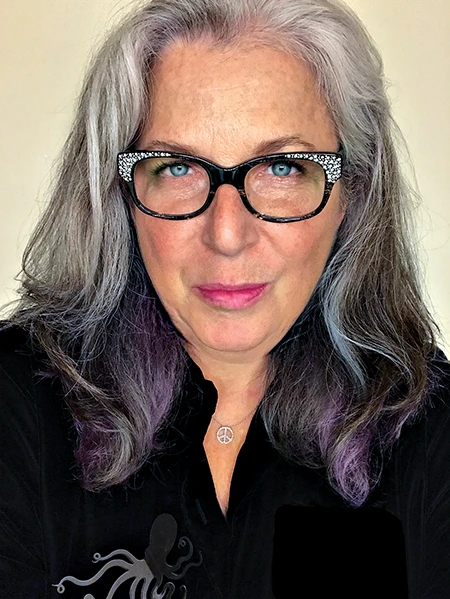
DURING our interview, Erin Quigley was immersed in another tropical dive destination. This time it was Little Cayman, where she was teaching seminars on Adobe Lightroom and digital photo workflow. Finding her there was hardly surprising. How she arrived at that point in her career, however, was far less predictable.
Quigley’s life might have taken a very different path were it not for her father, a jazz musician whose record deal prompted the family’s move from Providence, Rhode Island, to Los Angeles, California. Growing up in Southern California during the early 1960s shaped her in unexpected ways. She lived near the Alamitos Bay Yacht Club in Long Beach, but she was never a beach bum; she was a “brainiac bookworm kid” with a fascination for microbiology.
She enrolled at California State University, Long Beach, where her science curriculum required a liberal arts elective. Quigley chose theater on a whim, only to discover a passion that changed the course of her life. She auditioned for the Huron Theatre in Chicago, Illinois, where she landed the lead role in a play about the fictional detective Nancy Drew.
When the costume designer for a subsequent musical became ill, Quigley was asked to step in. She knew how to sew and had an artistic eye, but the assignment was anything but simple. Midway through the production, the entire stage had to transition from black-and-white to color, requiring elaborate set and costume changes.
The production earned rave reviews, and Quigley went on to enjoy an 11-year run as the resident costume designer with the renowned Steppenwolf Theatre Company. She eventually moved into TV wardrobe production, but the pace of racing from assignment to assignment had her craving something off the grid. Scuba diving provided exactly that.
Her first hundred dives were shore dives at Leo Carrillo, Point Dume, and other Southern California sites. She often accompanied an instructor friend who was occupied with students, leaving Quigley to pass the time in cold water with limited visibility. Yearning for something to occupy herself underwater, she picked up a Nikonos RS camera, which she still owns.
A trip to a friend’s destination wedding in West Palm Beach, Florida, got her hooked on warm, clear water teeming with marine life. She developed an insatiable appetite for dive travel and a growing fascination with emerging digital technologies.
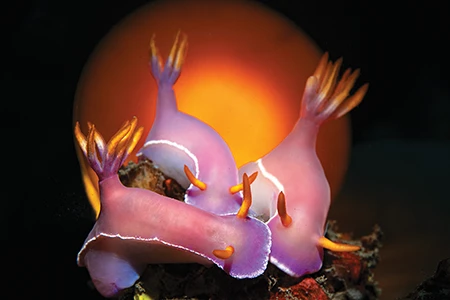
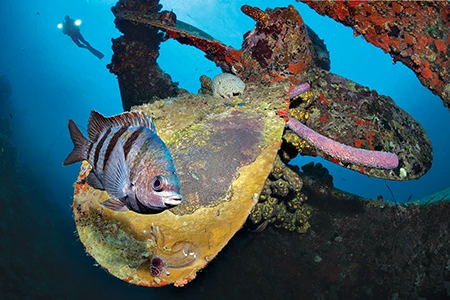
By 1989 she was working with early versions of Photoshop, processing scanned slides and eventually digital files from her Nikon D100. She became one of the most respected educators in the underwater photography community.
During a liveaboard trip to California’s Channel Islands, Quigley met Berkley White of Backscatter Underwater Video and Photo. She became a regular participant in their destination photo trips; as her images began winning competitions, White recognized that she would make an ideal instructor. Whenever Backscatter’s Digital Shootout participants ran into workflow or Photoshop problems that stumped other instructors, the answer became predictable: “Go ask Erin.”
Quigley was diving with underwater photographer Alex Mustard in Cuba’s Gardens of the Queen in 2020 when they learned the world was shutting down for the pandemic. She saw an opportunity to keep photographers learning and connected, so she worked with multimedia experts Jennifer and Joel Penner to transform her dormant domain, GoAskErin.com, into an online educational platform.
She taught Photoshop and Lightroom multiple times a week, building an international audience that regularly drew hundreds of live participants and more than 10,000 unique visitors. The classes became more than software tutorials. Participants forged genuine friendships through the chat sessions, creating a community as valuable as the technical instruction.
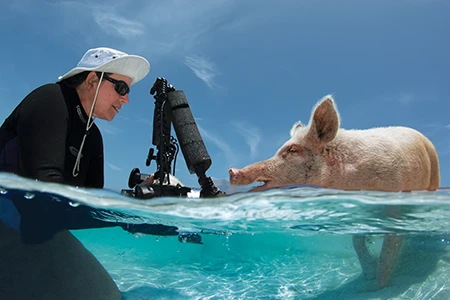
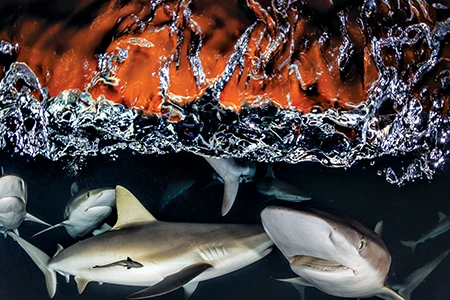
When travel resumed, Quigley expanded the concept into destination-based educational experiences in photo editing. She now spends more than half the year traveling to teach a range of programs tailored to different learning styles. Her workshops combine daily instruction with substantial time underwater. Smaller expeditions emphasize individualized coaching.
Quigley may be best known for helping solve one of the discipline’s oldest frustrations: backscatter. Every diver with a camera has experienced tiny suspended particles that appear as distracting white specks scattered across an otherwise compelling image. Manual removal requires painstaking cloning and healing, often consuming more time than the rest of the editing process combined.
She discussed the problem with Bruce Warner, an accomplished astrophotographer and underwater shooter. Astrophotographers face a similar challenge when imaging distant celestial objects through dust clouds and other visual artifacts. Warner wondered if technology developed for the night sky could work with underwater images.
They collaborated with software engineer Russell Croman to retrain the underlying model of his StarXTerminator tool, which is designed to isolate and remove unwanted stellar artifacts. The result of analyzing thousands of underwater images was BackscatterXTerminator (BSXT), a tool that recognizes and suppresses suspended particles with remarkable precision with a single click.
The software is not generative artificial intelligence; it does not invent content or require an internet connection. Instead, it identifies and attenuates unwanted artifacts while preserving the original image’s integrity. What once required hours of meticulous retouching, photographers can now accomplish almost instantly.
Quigley embraces AI with her characteristic pragmatism. She argues that imaging professionals must adapt to rapidly evolving technology rather than resist it. As she puts it, “AI is the tsunami that will drown us if we don’t know how to surf.”
It is an apt metaphor for someone whose career has been defined by reinvention. From aspiring microbiologist to actress, from costume designer to underwater photographer, and from Photoshop pioneer to educator and software innovator, Quigley has repeatedly recognized opportunities.
Her willingness to evolve — and bring others along for the journey — may ultimately be her greatest contribution to underwater photography.
Jelajahi Lebih Lanjut
Learn how to edit underwater photos with Erin Quigley in this video.
© Alert Diver – Q3 2026