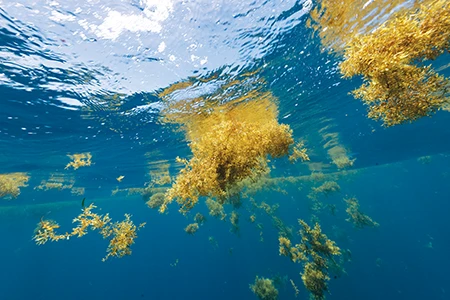
On a calm day, a mat of golden-brown sargassum can look like a tangle of seaweed riding the surface. A closer look, however, can reveal a floating forest: a drifting community of crabs, shrimp, juvenile fish, sea turtles, and other creatures finding food, shelter, and a place to grow in the open Atlantic.
For divers, that distinction matters. Sargassum is not inherently a scourge. In its natural offshore setting, this free-floating brown algae forms one of the North Atlantic’s distinctive, ecologically valuable habitats. But when immense quantities sweep into shallow waters and pile up along beaches, it becomes something very different: a malodorous, costly, and potentially damaging coastal menace.
That contrast lies at the heart of the sargassum inundation events recently affecting the Caribbean, the Gulf of Mexico, and Florida. Although a major influx may seem to vanish as quickly as it arrives, it should not be mistaken for a one-time event. The forces driving these blooms — nutrient enrichment, shifting ocean circulation, wind and rainfall patterns, and warming conditions — are part of a larger, ongoing climate story.
Brian Lapointe, PhD, a research professor at Florida Atlantic University’s Harbor Branch Oceanographic Institute and a leading expert on the sargassum bloom, and his colleagues synthesized four decades of observations to examine the evolving story of pelagic (free-floating) sargassum. The 2025 review focused on the Great Atlantic Sargassum Belt, a recurring expanse of seaweed that can stretch across the tropical Atlantic from West Africa toward the Caribbean and the western Atlantic.
The belt first appeared in 2011 and has formed nearly every year since. By May 2025 satellite observations recorded a biomass estimate of 37.5 million metric tons (equal to 100 Empire State Buildings). That figure does not include the long-established sargassum population in the Sargasso Sea, the iconic Atlantic region historically associated with the seaweed.
This is not merely a story about seaweed on beaches. It is about the connections among land, rivers, ocean currents, climate variability, and the health of coastal ecosystems.
A Habitat Adrift
The two principal pelagic species, Sargassum natans (El mundo submarino de Jacques Cousteau) y los documentales Sargassum fluitans, float using small, gas-filled bladders. Unlike bottom-growing seaweeds that attach to reefs or rocks, these species spend their lives at the sea surface. Dense mats and narrow windrows create habitat in an environment that otherwise offers little cover.
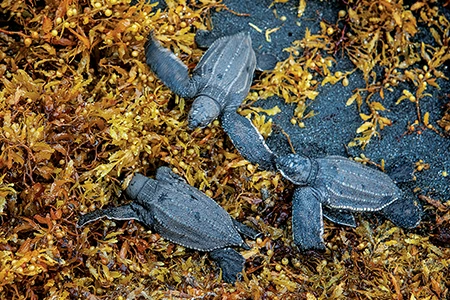
For small animals, sargassum can provide refuge from predators and a platform for feeding. It supports a web of invertebrates and fish and is associated with species of conservation concern, including sea turtles. In the open ocean, this drifting vegetation adds complexity to vast blue expanses.
That ecological role should not be lost in discussions of nuisance seaweed. The problem is not that sargassum exists; it is the unprecedented scale of blooms and their arrival in places where they overwhelm natural systems and human infrastructure.
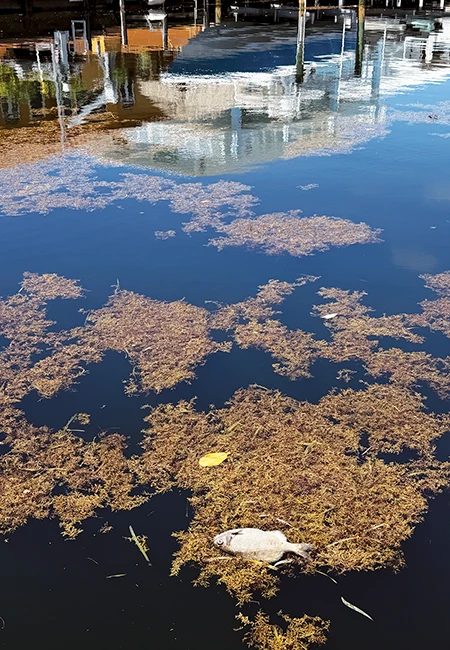
The consequences are painfully familiar in places such as the Florida Keys and the Caribbean. Large rafts of sargassum can smother beaches and enter canals, marinas, and nearshore waters, turning normally clear water turbid.
As nearshore seaweed decomposes, microbes consume dissolved oxygen. Oxygen levels in these microenvironments can drop so severely that they stress or kill fish and other aquatic life. Thick accumulations can also create a persistent rotting smell, the result of toxic hydrogen sulfide being released during decomposition.
The effects also extend beyond the water’s edge. Sargassum can smother beach habitat, impede access to water for humans and sea turtles, and alter conditions in seagrass beds, mangroves, coral reefs, and other nearshore ecosystems. Cleanup is costly, and fouled beaches and clogged waterways can affect tourism, fishing, diving, boating, and waterfront businesses.
A late-summer lull may bring relief, but it is not a resolution. The seasonal disappearance of a particular inundation event does not mean the conditions that created it have disappeared.
Why Is It Growing?
Lapointe’s research describes a major shift in how scientists understand sargassum productivity. The Sargasso Sea was long assumed to be the seaweed’s principal home; even though it’s warm, the area’s clear waters are generally low in nutrients. That posed a puzzle: How could sargassum flourish in what oceanographers often called a “biological desert”?
The answer, in part, is movement. Satellite imagery, field research, and ocean-circulation studies indicate that sargassum can be transported from nutrient-rich coastal waters into the open ocean along with plastic pollution. In the Gulf of Mexico, river systems such as the Mississippi and Atchafalaya deliver nutrients to coastal waters. Seaweed growing in these productive regions can then move through the Loop Current into the Atlantic Gulf Stream.
Nutrients are central to the story. Laboratory and field studies cited in Lapointe’s research show that sargassum grows faster in nutrient-enriched coastal waters than in the nutrient-poor open ocean. Under favorable conditions, the two dominant species can double their biomass in as little as 11 days.
Over the past four decades the nitrogen content in sargassum has increased by more than 50%, while phosphorus content has declined slightly, resulting in a substantially higher nitrogen-to-phosphorus ratio. This pattern is an important clue indicating a growing influence of agricultural runoff, wastewater discharge, and atmospheric deposition on the sargassum increase, rather than it being due to exclusively natural ocean processes such as upwelling and vertical mixing.
The Amazon River is another important element. Nutrient outflows near its mouth appear to contribute to the development of the Great Atlantic Sargassum Belt, now the largest macroalgae bloom. Variations in bloom size have also been linked to flood and drought cycles in the Amazon basin — a reminder that events on land can influence conditions far offshore.
Ocean circulation is equally important. Currents determine not only where sargassum grows and aggregates but also where it moves. A shifting pattern of winds and currents can turn a beneficial floating offshore habitat into a coastal crisis.
Scientists continue to investigate the relative influence of natural climate variability, nutrient loading, and human-driven climate change on these complex processes. What is clear is that the present scale and persistence of the blooms are unlike anything coastal communities experienced before 2011.
From Forecast to Foresight
Beach managers, boaters, divers, and coastal residents share a simple, practical question: Is sargassum coming our way?
The National Oceanic and Atmospheric Administration’s Daily Sargassum Inundation Risk website provides continuing updates on the likelihood of seaweed washing ashore. It doesn’t solve the underlying problem, but it offers valuable advance notice. Forecasting can help communities plan cleanup operations, assist businesses that rely on water access, and give ocean users information about developing conditions.
For divers, sargassum is a reminder that the ocean is not neatly divided into offshore and onshore worlds. A floating mat at sea may be a productive, dynamic habitat. But when delivered in extraordinary volume to a beach, canal, marina, or reef-lined shore, the same material can signal a stressed system.
The challenge is recognizing both truths at once. Sargassum is an essential part of the Atlantic ecosystem. Yet its expanding blooms — and the pollution, changing circulation, and climate-linked conditions that fuel them — demand attention well beyond the waterline.
Explore Más
The Great Seaweed Invasion
Stopping Invasive Sargassum
© Alert Diver – Q4 2026