Recreational divers learn about the need for a hyperbaric chamber in case they develop decompression sickness (DCS). The term hyperbaric chamber, however, is quite broad.
In practical terms, it is a machine or pressure vessel capable of holding a person at a pressure above or below normal atmospheric pressure. A recompression chamber is a hyperbaric chamber used for treatment or for returning to pressure, while a decompression chamber is used for controlled ascent and offgassing, often as part of planned dive operations.
When someone is in a chamber where the internal pressure is higher than the outside environment, this is referred to as hyperbaric exposure and is much like being underwater. When the internal pressure is lower than the outside, the environment becomes hypobaric, with some exceptions. Collectively, we refer to these systems as pressure vessels for human occupancy (PVHOs).
Let’s dive a little deeper into what we might encounter at depth, whether wet or dry, in a workplace setting, on an aircraft, or in outer space. Exposure to pressure, even when not in the water, has some interesting applications.
Recompression Chambers
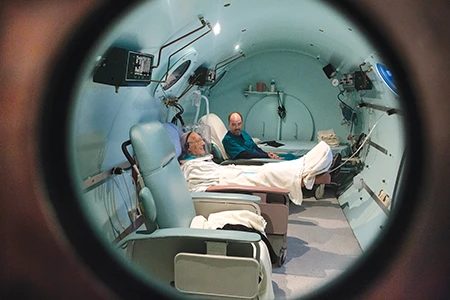
Divers are usually familiar with recompression chambers. To counter the effects of the bends, a gas embolism, or other forms of decompression illness, the injured diver must return to pressure (depth) and receive oxygen. The time and depth of these treatments determine how much oxygen is needed, which is where therapeutic treatment tables — such as U.S. Navy Tables 5, 6, and 9, or other specialized tables — come into play.
Decompression Chambers
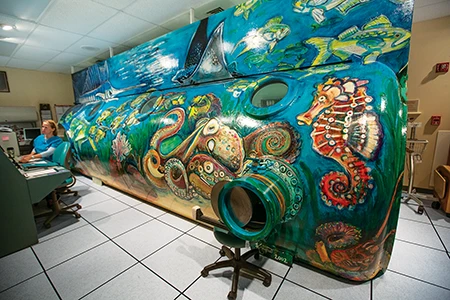
A decompression chamber is used in commercial, military, or scientific diving to provide an alternative to in-water decompression after long or deep dives. It is more comfortable to complete decompression in a dry, warm environment while the body flushes residual inert gas. This practice is called surface decompression (SurD).
Compressed-Gas Work and Saturation Systems
Compressed-gas workers who must remain under pressure for extended periods — such as during long commercial dive operations, tunnel boring, caisson construction, or other industrial activities — may require extensive decompression or may be kept under pressure for days or weeks.
When workers are intentionally saturated with inert gas to allow longer working hours, specialized dry compressed-gas environments must be used. A saturation diving complex houses these workers, transports them to and from the worksite, allows them to decompress safely, and provides for emergency evacuation. A hyperbaric lifeboat or emergency transfer capsule is ready if they need to vacate their living space or decompression facility while at sea.
Oxygénothérapie hyperbare
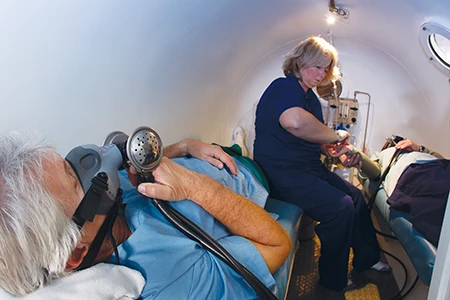
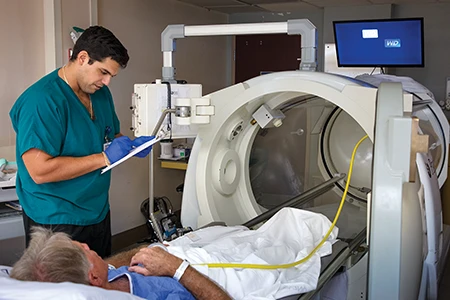
The most widely used category of chambers are for hyperbaric oxygen therapy (HBOT). A combination of oxygen and pressure is used to treat DCS along with a broad range of other medical conditions, such as wound healing, carbon monoxide poisoning, or severe infections. There are tens of thousands of HBOT chambers worldwide.
Almost any of the above hyperbaric chamber types can provide recompression therapy. While the best and most appropriate option is a chamber in a medical hyperbaric oxygen therapy facility, any PVHO capable of reaching pressures equivalent to 45 to 60 feet (14 to 18 meters) deep (1.4 to 1.8 atmospheres above ambient) is suitable regardless of their category.
Submarines, Submersibles, and Habitats
Submarines and submersibles keep occupants dry and at sea-level pressure while underwater, even when external water pressure is extreme. A subsea habitat, however, provides a dry environment but is maintained at the same pressure as the surrounding water. Because there is no pressure differential, it is not a PVHO.
Spacecraft and Aircraft
A space capsule keeps astronauts at near sea-level pressure while the outside environment is a vacuum. The pressure differential is typically a full atmosphere — 14.7 pounds per square inch (psi), which is seven times the minimum differential (2 psi) required for PVHO classification.
Pressurized aircraft cabins experience a pressure difference between sea level and the external atmosphere of 2.7 to 3.7 psi up to an altitude of 40,000 feet (12 kilometers). A fighter jet may operate at a cabin pressure as low as 4 psi below sea level, which is equivalent to one atmosphere at 15,000 feet (4.8 km), to conserve the energy required to pressurize the cabin. These are PVHOs by definition, although they are not commonly regarded as such.
Hypobaric Chambers
Hypobaric (or altitude) chambers, the final category of PVHOs, place people under low or subatmospheric pressures. These are used in aerospace training and research, where the pressure difference relative to sea level is reversed. A structural failure in such environments could result in crushing forces. Their primary use is for aircraft pilot or astronaut training, where sudden depressurization to near-vacuum conditions may result in hypoxia or DCS.
While these PVHO applications have unique characteristics, they have enough in common that we can refer to activities in these environments as dry dives.
Operating Principles of All Chambers
Despite their differences, all chambers operate on the following same basic principles:
- the ability to add air or breathing gas to increase pressure
- the ability to remove gas to decrease pressure (to simulate returning to the surface or going to altitude)
- the ability to manage the internal environment (communications, pressure monitoring, breathing-gas purity checks, temperature control)
- maintaining comfortable living conditions
- incorporating appropriate safety mechanisms
- the ability to contain and suppress a fire in the chamber
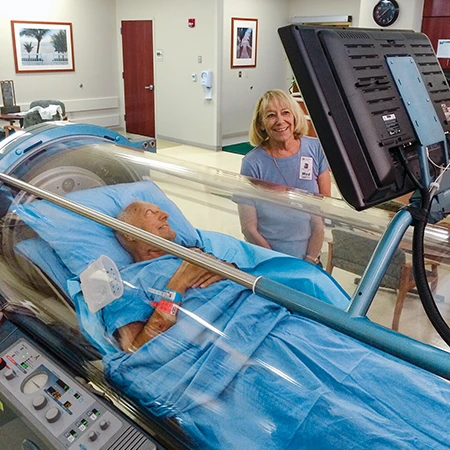
Chambers constructed and intended for a single occupant are called monoplace chambers, which are useful for transferring someone from one pressurized environment to another, serving as an emergency hyperbaric stretcher without returning to the surface, and providing hyperbaric medical treatments.
Most occupational chambers, used for diving or compressed-gas work, are intended for multiple occupancy and are known as multiplace chambers. Saturation, decompression, recompression, and larger hyperbaric medical chambers would typically fall into this category.
Monolock and multilock describe the number of pressurized compartments, or locks, that occupants can access in a chamber. Service, equipment, or medical locks are smaller compartments for transferring equipment, food, and medications into the chamber or for locking waste and other materials out of the chamber. This locking in and locking out is called transfer under pressure.
Multiplace chambers often have larger locks that allow personnel, medical staff, and other occupants to enter and exit the chamber without bringing the entire chamber to surface pressure.
Safety Considerations
When a PVHO is professionally designed and built, operated in accordance with established rules, and staffed by trained personnel, the risks associated with pressurized habitats can be managed, ensuring occupants’ safety.
When a chamber’s design or construction is noncompliant, however, or its operation is done by inadequately trained operators or using unsafe practices, chamber occupants are at risk of harm. We have seen tragic events that have led to the death of occupants, operators, or members of the public on the outside.
The primary categories of risk in PVHO operations include fire and explosion, mechanical failures, and physiological impacts on people. Fire is the greatest risk, as the number of chamber fires and the number of victims demonstrate. The fire triangle comprises the essential elements required for any conventional fire: oxygen, fuel, and a source of ignition.
If elevated oxygen levels are present in breathing gases or in a chamber environment, any sources of ignition must be closely monitored. Potential hazards may include warming devices, electronic equipment, unsafe electrical wiring, and even static electricity. The fire risk becomes increasingly significant the deeper we dive the chamber, where the amount of oxygen, not the percentage (concentration), increases.
The increased amount of oxygen results in materials igniting at lower temperatures, fires being hotter and faster, and the production of toxic gases, especially the highly harmful carbon monoxide. A fire in a chamber with inherent design flaws or that does not account for the significant pressure rise caused by heat may result in an explosion. These occurrences are very rare, but historical cases confirm the possibility.
Equipment exposed to elevated pressures or pressure differentials can fail, resulting in loss of essential functioning or the release of great volumes of gas. When inert gases build up, patients and attending staff can experience physical harm, exposure to inappropriate levels of oxygen, dangerous operations such as rapid increases or decreases in chamber pressure, PVHO rupture, or contamination of the breathing gas.
While the purpose of hyperbaric chambers is to protect people, allow for lengthy excursions at pressure, and support healing, failure to follow rules and safety protocols can lead to dangerous and harmful situations. Fortunately, following well-developed and internationally recognized codes, standards, operational practices, and thorough and appropriate training courses can mitigate most risks.
Hyperbaric Staffing
Hyperbaric operations — whether occupational, military, or medical in nature — require comprehensive technical and practical training. Staff competence is essential as PVHOs are classified as life-support habitats. Once the occupant is locked into the chamber and under pressure, there are limitations on ready access and the time required to return the chamber to the surface.
Chamber staff includes life-support technicians for all nonmedical applications and clinically qualified technicians for medical treatments. These staff members operate the PVHO from the outside.
Internal occupants who operate the chamber or tend to other occupants are called attendants or tenders. All medical operations need to have a hyperbaric-trained physician directing treatments.
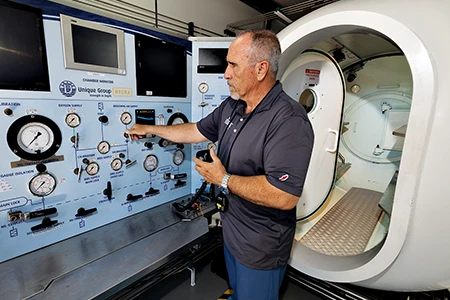
DAN’s Role in Global Recompression Support
DAN is often expected to help identify recompression options for injured divers worldwide, including in remote locations such as Antarctica. This requires knowing the locations, capabilities, and availability of these facilities so we can ensure divers receive safe and effective assistance. Our information includes decompression chambers, commercial chambers, medical monoplace chambers, and evacuation or rescue chambers.
While almost any chamber capable of achieving a suitable pressure above ambient may be technically suitable, not every facility will be available at the time of need, appropriately staffed, medically prepared, or willing to treat an injured diver. The DAN Recompression Chamber Network addresses this need by maintaining a database of chambers around the world that can assist in dive emergencies.
In some locations, even within the U.S., we may locate a suitable facility, but scheduling constraints, insufficient medical training, or liability concerns may prevent them from accepting an injured diver. We advise injured divers to consult emergency medical services and medical professionals to determine the best options and chamber facilities for treatment.
In some remote regions, where long-range evacuation may be necessary, local medical or dive communities often struggle to maintain readiness. In the interest of diver safety, DAN maintains an outreach program offering technical assistance and on-site training in recompression operations. Many of these chambers were originally intended for applications unrelated to recompression, such as for surface decompression.
We now have more than 250 participating facilities in some of the world’s most remote but spectacular dive locations. Our members and donations to DAN fund this program.
PVHOs share the same essential purpose: enabling people to operate or be treated safely when pressure becomes part of the environment. For divers, the key takeaways are simple: Not every hyperbaric chamber is the same, and not every chamber is ready or appropriate for emergency recompression.
With complex chamber technology for dry diving, a facility works best when operators have advanced training and respect all safety requirements and systems. When properly designed, operated, and staffed, these sophisticated life-support systems allow people to work, explore, recover, and survive in places the human body could not otherwise tolerate.
En savoir plus
Learn more about recompression chambers in this video.
© Alert Diver – Q3 2026