Flottant à la surface, je suis suspendu au-dessus des eaux bleues et limpides du Little Bahama Bank. Je respire par mon tuba, le regard rivé vers le fond, fasciné par les jeux de lumière qui dansent sur la crête de sable blanc, à 24 mètres sous mes pieds. Le Gulf Stream m'emporte, ainsi que mon fidèle binôme de plongée, au-dessus des tortues de mer, des requins-nourrices endormis et des parcelles de corail qui apparaissent comme des oasis sur le vaste fond marin ondulé.
Après avoir pris suffisamment d'air, je descends, me blottissant derrière mon appareil photo pour rester aussi profilé que possible, et je nage tout droit vers le fond. Pendant la descente, mes poumons se compriment jusqu'à ce que je devienne en flottabilité négative, ce qui me permet de couler sans effort. Cette chute libre est un abandon total récompensé par la sensation de voler.
Alors que j'approche du fond, j'effectue un saut périlleux allongé au ralenti : je me retourne d'abord pour voir mon binôme à la surface, puis je continue ma rotation pour observer la vie benthique. Une colonie d'anguilles de jardin brunes se réfugie dans le sable, disparaissant d'un seul coup. Le poids de l'eau à cette profondeur est, d'une certaine manière, réconfortant.
Une cacophonie de sons s'élève d'un récif tout proche : le claquement des crevettes-claquettes, le grognement sourd d'un mérou et le grattement des poissons-perroquets qui nettoient les coraux de leurs algues. Des sons saisissants envahissent mes oreilles tandis que j'assiste à cette communication interespèces sous-marine.

Une crevette nettoyeuse claque ses pinces pour signaler aux poissons qu’elle est prête à les accueillir. Je me demande : « Si je restais en suspension, en apesanteur et la tête en bas au-dessus de la station de nettoyage, est-ce que la crevette nettoyeuse et les labres m’accepteraient dans la communauté du récif ? » Un peu par jeu, je me retourne et j’essaie, mais j’entends alors un sifflement aigu résonner dans mes oreilles.
Je fais passer un peu d'air dans mes trompes d'Eustache pour équilibrer la pression. Mes oreilles vont bien, mais les grincements persistent. Les grincements se transforment en sifflements et en cliquetis qui s'amplifient, couvrant les sons du récif. Sentant les impulsions caractéristiques de l'écholocation des dauphins balayer mon corps, j'imagine que les dauphins scrutent mes os et écoutent les battements de mon cœur.
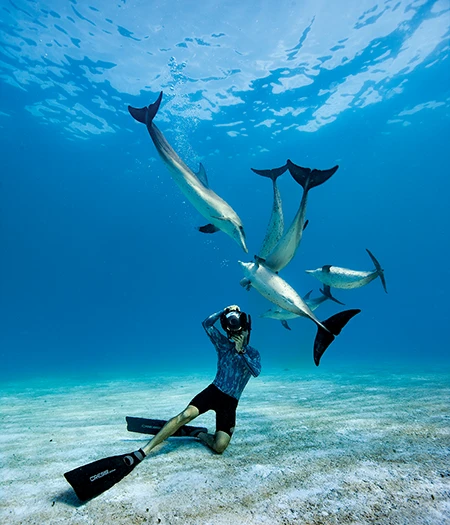
À la limite du champ de vision, un groupe de dauphins tachetés de l'Atlantique apparaît, et j'ai l'impression que leurs cris s'adressent directement à moi. Un petit dauphin fonce vers moi, puis un adulte le rattrape pour le dépasser et le ramener vers le groupe.
Je cadre le groupe de dauphins dans le viseur de mon appareil photo, je capture l'instant, puis je commence à remonter, entouré de dauphins. Mon binôme, qui observe toute la plongée depuis la surface, descend pour me rejoindre à environ 5 mètres. Nous échangeons un regard et remontons ensemble. À la surface, nous nous faisons un signe de la main pour nous dire que tout va bien tout en reprenant notre souffle.
Mon tout premier souvenir de plongée en apnée remonte à mon enfance, lorsque je faisais des loopings verticaux. Une fois que j'ai appris à équilibrer correctement mes oreilles, j'ai pris plaisir à me déplacer dans l'eau en défiant quelque peu les lois de la gravité. J'ai fini par découvrir que la plongée en apnée était un excellent moyen d'approcher et d'observer de près la vie marine sous l'eau.
Un apnéiste peut se déplacer de manière fluide et silencieuse, sans produire de bulles. Dans certaines situations, la faune sauvage peut être perturbée par le bruit des bulles d'échappement des scaphandres autonomes, et le gargouillement des bulles qui passe près de nos oreilles nous empêche de percevoir les incroyables et parfois subtiles nuances sonores sous l'eau.
Lorsqu'ils tentent d'observer des phénomènes marins éphémères tels que les bancs de poissons, les apnéistes peuvent monter et descendre du bateau avec aisance. Ils peuvent se glisser dans et hors du bateau comme des phoques et se repositionner rapidement pour un nouveau plongeon.
Quand on me charge de filmer des mammifères marins, il y a certains types de prises de vue que je trouve plus faciles à réaliser en apnée. Lorsque je nage avec ma caméra en retenant mon souffle, j’ai l’impression que les dauphins et les baleines semblent comprendre mes limites. J'imagine qu'ils voient à quel point je suis lent et qu'ils comprennent que je ne peux descendre qu'à une certaine profondeur. Ils savent que, comparé à eux, je suis presque chétif et inoffensif. Ils évaluent mon apparence et vaquent à leurs occupations, me laissant découvrir leur monde.
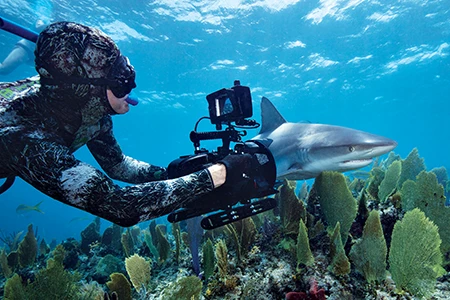
Même si j'ai l'air maladroit à côté d'un dauphin, je suis nettement plus hydrodynamique en apnée qu'avec mon équipement de plongée sous-marine. En apnée, j'ai pu me faufiler parmi les gorgones et les gorgones-éventails avec mon appareil photo pour immortaliser la façon dont les requins de récif des Caraïbes chassent au sein de cette topographie dense.
Il y a quelques années, je me suis rendu à Long Island, aux Bahamas, pour tourner une publicité mettant en scène William Trubridge pratiquant la plongée en apnée dans le Dean’s Blue Hole, un gouffre de 202 mètres de profondeur. À l’époque, Trubridge était le seul homme à avoir nagé à plus de 100 mètres de profondeur sans équipement, sans palmes, avec une seule inspiration et une nage d’une grande finesse et d’une efficacité redoutable.
À travers mon objectif, je l'ai vu effectuer cinq mouvements de bras et de jambes, puis plonger en chute libre dans l'obscurité. Je me suis rendu compte que toutes ces années passées à nager avec des appareils photo m'avaient appris à bien retenir mon souffle, mais rien de comparable à ce dont j'ai été témoin en regardant Trubridge nager. Je lui ai ensuite demandé quelques conseils pour améliorer mes compétences en apnée.
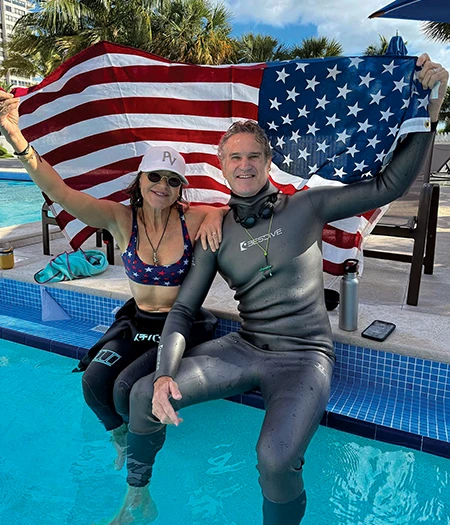
La première étape consiste à trouver des partenaires d'entraînement. La règle numéro un en apnée est de ne jamais plonger seul, même pour s'entraîner. Trubridge m'a suggéré de contacter Ricardo et Claire Paris, titulaire d'un doctorat, qui vivaient eux aussi dans le sud de la Floride. Claire détient des records du monde dans plusieurs disciplines, et Ricardo était à l'époque président de USA Freediving (Team USA). Heureusement, ils m'ont permis de me joindre à eux et de m'entraîner régulièrement entre deux missions.
L'entraînement avec des athlètes consiste à travailler la technique et à préparer le corps afin d'améliorer les performances et les capacités de manière quantifiable. La préparation physique en apnée consiste à développer une tolérance à des niveaux élevés de dioxyde de carbone (CO2) dans l'organisme et à travailler à l'amélioration de la technique, de la souplesse et de la force, dans le but de se déplacer plus efficacement dans l'eau.
Après avoir amélioré ma tolérance au CO2 , j'ai commencé à m'intéresser davantage à la détection de l'hypoxie et à l'amélioration de mon réflexe de plongée mammifère (MDR). L'eau froide sur le visage peut déclencher le MDR, mais la réponse la plus marquée se produit lorsque les niveaux de CO2 dans l'organisme augmentent et que le sang est redirigé des extrémités vers les organes vitaux.
Les apnéistes expérimentés savent apprécier cette sensation et la reconnaissent lorsqu'elle se manifeste. Lors d'une longue nage, vous pourriez ressentir de la fatigue ou une accumulation d'acide lactique, alors qu'il s'agit en réalité d'un déplacement sanguin provoqué par le MDR. Des moniteurs et des mentors expérimentés peuvent vous aider à vous familiariser avec ces sensations inhabituelles.
Au fil du temps, chaque domaine d'amélioration permet d'améliorer considérablement les capacités globales en apnée. À l'époque où je pratiquais la plongée spéléo et où je nageais avec de gros appareils photo en plongée sous-marine, j'avais pour habitude de garder les genoux fléchis et les palmes éloignées du fond ; c'est une tendance que je m'efforce de corriger lorsque je m'entraîne à l'apnée dynamique avec des palmes doubles (DYNB).
On dirait qu’on se parle à soi-même pendant les exercices. Mon mantra pourrait être : « Tends les jambes, pousse à partir des hanches et pointe les orteils. » Un autre jour, ce serait peut-être : « Je sens le sang circuler, mes jambes sont en forme, détends la nuque et laisse le sang de mon torse affluer vers mon cerveau. »
Un jour, à la piscine, mes partenaires d'entraînement m'ont dit que, vu la distance que je parcourais lors de nos séances d'entraînement par intervalles, je pourrais envisager de tenter de battre les records de plongée en apnée Masters de la Fédération américaine de plongée en apnée (USFF). En juin 2024, j'ai nagé 554 pieds (169 m) en DYNB et 390 pieds (119 m) en DNF, établissant ainsi des records américains pour les hommes de plus de 50 ans. Ces performances m'ont permis de me qualifier pour représenter les États-Unis aux Championnats du monde de plongée en apnée en salle de la CMAS (Confédération Mondiale Des Activités Subaquatiques) 2025 à Athènes, en Grèce.
Lors des championnats du monde, une excellente coordination a régné entre les entraîneurs, les juges, les secouristes et le personnel médical afin d'offrir aux athlètes un environnement sûr leur permettant de repousser leurs limites. Si l'on doit aller jusqu'aux limites de ses capacités, c'est le moment ou jamais de se lancer.
Même après plus de quarante ans passés à nager avec mes appareils photo, je continuais à découvrir de nouvelles façons de nager, de respirer et de m'entraîner. À cinquante ans, j'étais capable de plonger plus profondément et de retenir mon souffle plus longtemps qu'à vingt ans.
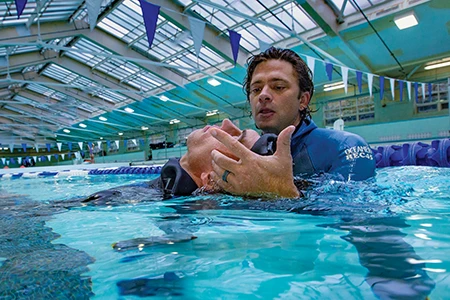
Même s’il est formidable de découvrir que je peux encore m’améliorer en apnée à un âge avancé, la leçon la plus importante que j’ai tirée est qu’il est essentiel pour tous les apnéistes de suivre une formation afin de rester à jour sur l’ensemble des protocoles de sécurité. Parmi les principes fondamentaux, il faut avoir un binôme fiable, formé au sauvetage, qui respecte la règle immuable du « un monte, un descend » et qui maîtrise les méthodes de sauvetage d’un apnéiste, la protection des voies respiratoires, la procédure « souffler, tapoter, parler » et la réanimation dans l’eau, si nécessaire.
Si vous utilisez des appareils photo, comment réglez-vous leur flottabilité ? Lorsque je plonge en profondeur avec un appareil photo, je préfère qu'il soit légèrement flottant afin de pouvoir m'en débarrasser si nécessaire.
La communauté internationale a donné lieu à la création d'organismes et de fédérations chargés de la formation et des compétitions, qui génèrent une grande quantité de connaissances qui ne cessent d'être affinées et diffusées.
Que vous soyez débutant ou plongeur expérimenté, je vous recommande vivement de suivre une formation certifiante en apnée afin de vous tenir au courant des dernières avancées en matière de protocoles de sécurité et de techniques. Il y a toujours quelque chose à apprendre sur la respiration et sur la préparation physique et mentale pour vivre des expériences d'apnée inoubliables.
© Alert Diver – Q1 2026