The Wonderful World of Octopuses
At first she is almost nothing: a slight distortion in the reef, a suggestion of movement where the reef should be still. Then an eye appears. An arm uncurls. The reef itself seems to breathe, and now the animal that had vanished into the seafloor is watching you.
For divers, finding an octopus is rarely just another sighting. Everything stops. We hover. We slow our breathing. If we are patient, she may change color, reach toward an unfamiliar object, or emerge from her den to investigate us. The encounter feels less like observing wildlife and more like meeting someone new.
That impression is not proof that an octopus thinks as we do. Her intelligence evolved along a path that diverged from our own more than half a billion years ago. She is about as close as we may ever come to meeting an alien on Earth. Yet the deeper science looks, the more wondrous and unfamiliar her experience of the world becomes.
Nearly every part of an octopus challenges our idea of how a body should work. She has three hearts: Two move blood through her gills, while the third circulates it through the rest of her body. Her copper-based blood is blue.
An octopus does not have nine separate brains, as a popular claim suggests. But she possesses something even more interesting: a mind whose control is distributed through a body capable of tasting what it touches.
Her central brain wraps around her esophagus, and much of her nervous system extends through her eight arms. Those arms are not simply waiting for instructions from the brain. Dense networks of neurons locally process touch, chemical information, and movement, giving each arm remarkable sensory and motor independence.
Her eyes offer another lesson in alternative design. Human photoreceptors face away from incoming light, and the optic nerve passes through the retina, creating a blind spot. The octopus has light-sensitive cells that face the light, and the nerve fibers run behind them, leaving no comparable blind spot.
Researchers think most octopus species are colorblind, but an octopus’ visual world is anything but simple. Her eyes detect brightness, shapes, and contrasts as well as patterns of polarized light that are invisible to humans. Her pupils shift from nearly circular in darkness to horizontal slits in bright conditions. Her skin also responds to light independently of the eyes.
Disappearance is her superpower. Her eyes, brain, and skin form an extraordinary system for reading the reef and vanishing into it.
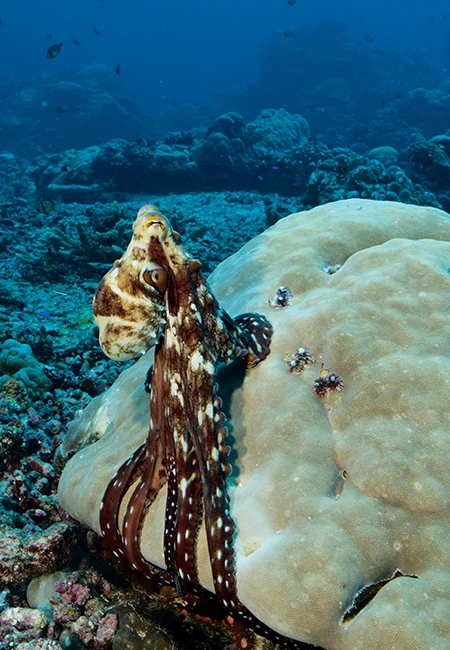
Thousands of pigment-filled organs called chromatophores expand and contract under neural control, transforming her visible pattern in an instant. Other structures reflect and scatter light. Muscular papillae raise her skin into ridges, spikes, and bumps or flatten it smooth again. Color, contrast, texture, and posture shift together until soft flesh becomes coral, rubble, algae, or sand.
She does not merely use camouflage; she transforms into it. The boundary between body and reef disappears before our eyes, and then so does she.
Octopuses can also be funny. At a crowded site in Australia, researchers recorded octopuses gathering silt, shells, and algae and then blasting the debris through the water. Some throws had force, direction, and a target. Females repeatedly aimed debris toward approaching males. One particularly persistent male was hit several times and eventually began ducking before the debris was released. It is easy to imagine the message: Not interested. Move along.
While we should be careful about assigning human motives to octopuses, the targeting, repeated exchanges, and male’s improving response reveal a flexible interaction, not a simple reflex. Never underestimate an octopus, especially one with eight arms and a gathering of projectiles.
The Life Behind the Eyes
This behavioral complexity is why octopuses occupy such a powerful place in divers’ imaginations. The documentary My Octopus Teacher introduced millions of viewers to the intimacy possible when a person patiently enters an octopus’ world. Many divers already know the feeling: the pause when an octopus looks back, the careful reach of an arm, and the unmistakable sense that the animal is assessing us too.
Research gives that intuition scientific weight. A crab sealed inside a container is not simply food out of reach. To an octopus, it is a problem waiting to be solved. In controlled experiments, octopuses have learned to open containers and manipulate puzzle boxes, pushing or pulling different parts to reach the reward inside. Individuals varied in how quickly and boldly they approached the challenge, revealing different problem-solving styles.
Octopuses have also learned routes through mazes and guided an unseen arm toward a visible food reward. Aquarists have traded stories about octopuses escaping enclosures, raiding neighboring tanks, and returning before anyone noticed. Keeping an octopus mentally and physically contained can become a battle of wits, and humans should not assume victory.
Octopuses also have unusual sleep patterns. Researchers have identified quiet sleep interrupted by brief periods of active sleep. During these episodes, an octopus twitches, moves her eyes, changes her breathing, and flashes through skin patterns also displayed while awake. Pale becomes dark. Smooth becomes mottled. Recordings reveal wake-like brain activity in regions associated with learning and memory.
Is she dreaming of stalking a crab? Is she replaying an encounter with a predator? Is she hurling imaginary debris at an irritating male? Science cannot yet tell us, but something complex is happening inside that color-shifting body, and the mystery is almost as wonderful as any answer would be.

One Life and One Final Act
For all their sophistication, most octopuses receive remarkably little time on this planet. Lifespans vary by species, but many live only a year or two. Even the giant Pacific octopus lives only three to five years. It doesn’t seem fair; an animal this fascinating should get decades.
With so little time, most octopuses reproduce only once. After a female lays her eggs, she becomes their unwavering guardian. Inside her den, she cleans them and sends water across them, keeping them oxygenated and free of debris. She rarely leaves. In many species, she drastically reduces or completely stops feeding as weeks or months pass.
This is more than starvation brought on by circumstance. A hormonally controlled transformation drives maternal care and then senescence. Her body deteriorates as the embryos develop. Around the time they hatch, her life ends.
We do not know whether she experiences maternal love in the human sense. We do know that her only reproductive effort culminates in an astonishing investment: Nearly everything remaining in her brief life is given to the generation she will never know.
From Neighbor To Food
Now imagine that same curious, solitary, responsive animal in an industrial tank instead of a den. Efforts to farm the common octopus for food have ignited an international debate.
Supporters argue that aquaculture could meet demand while reducing pressure on wild populations. But octopuses are active carnivores whose feed could shift fishing pressure onto other marine species. Their soft bodies are easily injured, and intensive systems struggle to provide the shelter, stimulation, and control they need. Crowding often-solitary animals can lead to aggression, trauma, and cannibalism. There is also no broadly accepted humane method for slaughtering them commercially.
In July 2026, Spanish seafood company Nueva Pescanova withdrew plans for what had been described as the world’s first industrial octopus farm amid scientific criticism and public opposition and following new regulatory requirements during the environmental review process. Washington and California have prohibited octopus farming, but other proposals continue to be raised. Readers can follow the debate, examine legislation, ask seafood sellers the source of their octopus, and ultimately decide whether octopus belongs on their own menus. The question is not simply whether we can farm octopuses, but whether we should.
Divers have a particular place in this conversation because we have met these animals where they live. There is an unmistakable thrill in finding an octopus underwater. We watch as she emerges from the reef, knowing that while we are studying her, she is studying us. She is wonderfully unlike us yet unmistakably aware that we are there.
The connection can be immediate.I have felt one looking at me — curious, alert, and entirely present. In that suspended moment, the distance between our worlds narrows.
We may not know exactly what she thinks or feels, but we can recognize wonder, intelligence, and a life unfolding behind her eyes. Perhaps that recognition is where love — and our responsibility — begins.
En savoir plus
Masterminds: Secrets of the Octopus
© Alert Diver – Q4 2026