IUCRR Divers Provide Support in Challenging Environments
Accidents and incidents occur worldwide that leave victims beyond the reach of standard rescue techniques. These events often happen in or near the water and may require the assistance of specially trained personnel.
Many law enforcement agencies, fire departments, and other rescue organizations have dive teams that are trained to search for and recover accident victims from underwater. These teams are generally well-trained for open-water environments within recreational diving depths, such as lakes, rivers, and coastal areas.In some cases a victim becomes lost in a location that exceeds the capabilities and training of these regional dive teams. Individuals may go missing in complex environments, such as underwater caves, abandoned mines, power plant intake pipes, storm drains, siphons, or other confined spaces, where direct ascent to the surface is not possible. These overhead environments pose unique and dangerous challenges.
In some cases a victim becomes lost in a location that exceeds the capabilities and training of these regional dive teams. Individuals may go missing in complex environments, such as underwater caves, abandoned mines, power plant intake pipes, storm drains, siphons, or other confined spaces, where direct ascent to the surface is not possible. These overhead environments pose unique and dangerous challenges.
A victim may also be lost at significant depths, requiring divers to use specialized breathing gases to safely reach them. Specific training, equipment, and procedures are essential for safe operation in such settings. Regional dive teams typically do not receive this level of advanced training.
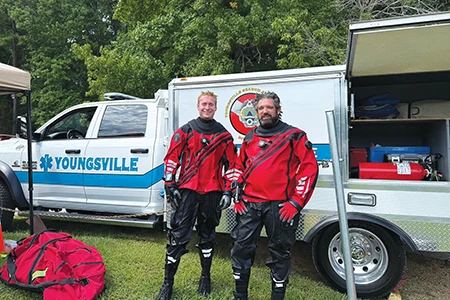

Unfortunately, some tragic cases involved regional public safety divers attempting to conduct rescues or recoveries in overhead environments or beyond recreational depths and becoming secondary victims. One particularly devastating incident occurred in Washington state, where four law enforcement divers died while trying to recover a body from a culvert.
To address these gaps in capability, Henry Nicholson and Robert Laird, along with Lamar Hires and Mark Fowler, founded the International Underwater Cave Rescue and Recovery (IUCRR) team in 1999. Rather than provide cave diving training, the IUCRR acts as a specialized response and support organization. When public safety dive teams face a situation beyond their own capabilities, particularly involving overhead environments, they can call upon the IUCRR to provide expert assistance worldwide.
While recreational activities slowed during the COVID-19 pandemic, fading the need for IUCRR’s services, people are getting back into the fresh air, and the need for specialized rescue and recovery support has increased. The IUCRR has revitalized itself in response to this need, with a focus on growing its structure and operational support capabilities. Young and motivated divers are also coming out to learn and potentially help. There is once again a growing desire to support those in need within the underwater community.
How IUCRR Works
The IUCRR is a nonprofit network of experienced volunteer cave divers based in the U.S. and abroad. It is organized through a structure of regional coordinators (RCs), who are responsible for managing operations and connecting with local law enforcement within their areas.
Whenever an appropriate authority with jurisdiction in an area requests a rescue or recovery, the area RC attempts to find vetted, local volunteers to respond. If none are available or appropriately qualified for the type of operation, divers from other regions or countries may be called upon to assist.
The IUCRR provides all operations without charge.
None of the divers, surface managers, or administrative staff receive compensation for their time or services — it is entirely volunteer-based.
The IUCRR does not self-deploy or take over a case. Its role is to act as a technical resource, offering qualified cave divers to recover victims from environments where local responders lack the necessary experience. The team’s job is to recover the victim and turn over all physical evidence, information, and written documentation to investigators. Only a designated surface operations manager speaks with law enforcement officers or the press.
IUCRR divers write detailed dive reports after each recovery and submit them to the RC and the investigators within 72 hours. Once these reports are verified and edited to remove any personal information about the victims, they may be published online to help other divers learn from the event, as long as there are no ongoing legal proceedings regarding the operation.

Types of IUCRR Dives
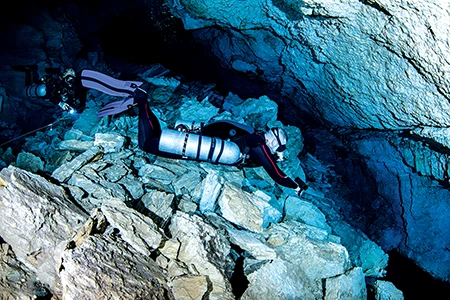
The IUCRR’s focus is on overhead environments — underwater spaces where a direct vertical ascent is impossible, including caves, mines, submerged infrastructures, and deep vertical shafts. The IUCRR also assists in virtual overhead environments, such as extremely deep dives, where decompression obligations prevent immediate ascent to the surface. The risk profiles are similar in these cases.
Even when the IUCRR is asked to help, they never require any diver to respond. Recovery dives can be stressful, complex, and emotionally challenging. The organization’s primary rule is clear: No recovery is worth a diver’s life. Every volunteer must assess their physical, emotional, and mental readiness before accepting an assignment.
Volunteer Requirements
Cave divers who want to volunteer with IUCRR must have the following minimum requirements:
- a history of safe cave diving and dive experience
- a willingness to undergo victim recovery education and training
- a willingness to complete surface operations training
- an ability to respond quickly to callouts via email or phone
- a full commitment to any recovery operation they agree to join
- a dedication to submitting a complete written report to the RC within 72 hours of any operation
The IUCRR expects all divers to maintain professionalism, discretion, and adherence to legal and operational protocols. They conduct periodic training exercises and educational programs to help divers remain proficient in techniques and team coordination. Nondivers or recreational divers can get involved with the IUCRR through surface and support operations.
Public Education
The IUCRR is also deeply invested in diver education. Their goal is not only to support public safety divers but also to prevent fatalities by helping the dive community understand and respect the risks associated with overhead environments.
Their key education services include the following:
- Incident reports: The IUCRR publishes anonymized reports from actual recoveries. These case studies are a valuable resource for cave divers and instructors, often highlighting common causes of accidents.
- Fatality trends analysis: IUCRR volunteers and leadership regularly analyze patterns in cave diving incidents, tracking trends in causes of death, changes in equipment usage, and outcomes of specific diver decisions. They publish these findings in articles and sometimes present them at dive conferences.
- Slide decks and presentations: IUCRR members have created educational slide decks for use at dive training facilities, conventions, and public forums. Topics include cave diving safety, decision-making in overhead environments, and lessons learned from past accidents. They often update these presentations based on new case data.
- Danger sign campaign: The IUCRR has helped post warning signs at cave entrances worldwide. These iconic signs read, “STOP. Prevent your death. Go no farther.” The signs are part of a global initiative to reduce preventable cave diving deaths among untrained or improperly equipped divers.
- Conference participation: IUCRR leaders and members frequently speak at major dive conventions, such as DEMA and National Speleological Society-Cave Diving Section (NSS-CDS) events, as well as training agency conferences. All presentation fees, if accepted, are donated back to IUCRR.
By combining hands-on recovery operations with public education, the IUCRR plays a unique role in responding to tragedy and working to prevent it. They have supported public safety organizations and communities during some of their most challenging moments since 1999, offering expert help when other options were unavailable.
The organization also works tirelessly to reduce the number of dive fatalities through education, outreach, and analysis. Through its dedicated volunteer base, operational excellence, and educational mission, the IUCRR remains a vital part of the global dive safety community.
© Alert Diver – Q4 2025