Blue whales (Balaenoptera musculus) are global travelers.
At up to 330,000 pounds (149,685 kilograms) and 110 feet (33.5 meters) long, they are the largest creatures to have ever lived.
Hunted remorselessly when the steam turbine and exploding harpoon were invented shortly before 1900, hundreds of thousands of these previously uncatchable animals fell prey to whalers operating primarily in Antarctic waters, driving the species to near extinction by the 1950s. The current population in the Northwest Atlantic Ocean is estimated at no more than 600, and the global population is likely less than 25,000 animals.
Everything about blue whales is colossal. They are more than 20 feet (6 m) long and weigh around 5,000 pounds (2,268 kg) at birth and grow to more than 50 feet (15 m) in their first year. During this time, each day they gain about 200 pounds (91 kg) as they consume 50 gallons (189 liters) of milk containing 30% to 50% fat.
By age five or six they are usually sexually mature and more than 70 feet (21 m) long. Females can give birth every two or three years, depending on food availability.
Blue whales strain krill from seawater after inhaling a volume of water equivalent to the average home pool and pushing it through baleen plates using a tongue that weighs as much as an elephant, forcing the krill down into their digestive tract. They have a 400-pound (181 kg) heart and the ability to dive deeper than 1,000 feet (305 m) and swim at more than 20 miles per hour (32 kilometers per hour) for short bursts.
These oceanic titans are also one of the loudest animals, capable of vocal blasts exceeding 180 decibels at incredibly low frequencies, audible over hundreds of miles underwater.
My first exposure to the blue whale was while visiting the Natural History Museum in London, England, in 1967. Picture an awestruck kid standing under a gigantic 83-foot (25-m) blue whale, a mesmerizing symbol of the ocean’s might and beauty. In later years I saw blues while driving along the northern shore of the St. Lawrence River at Les Escoumins, Québec, Canada — one of the few places you can whale watch this rare species from land.
Fast-forward 47 years to 2014, when I visited the Steele Ocean Sciences Auditorium at Dalhousie University in Halifax, Nova Scotia, where I serve as the university’s director of animal care. The auditorium has a soaring cathedral-like ambiance that reaches six stories to the skylights. This beautiful space seemingly shouted to find a way to put a blue whale in it.
I was no stranger to marine mammals or skeletons. In my class in veterinary college, I was the sole crank who dreamed of a career working with marine mammals, birds, fish, and sea turtles, while my classmates were busily preparing for more prosaic professional lives as small or large animal vets dealing with domestic animals.
Working as an anatomy technician in my summers off, I learned the osteology of many species and the painstaking work of dissection, bone preparation, and articulation on various museum specimens, from the tiniest hummingbird up to a horse skeleton. But my Mount Everest was the skeleton of a giant blue whale. It’s one thing to have a vision and another to make it happen.
Every time I walked through the oceanography building, my eyes wandered upward, envisioning a whale floating above me. I reached out to Tonya Wimmer, executive director of the Marine Animal Response Society (MARS), a nongovernmental organization that attends to strandings of whales, seals, and sea turtles in Canada’s Maritimes region. She was willing to help connect me with a whale carcass if I could find one. Over the years I helped MARS with necropsies on stranded animals and workshops, and they were great allies.
I read a research paper by Gordon Price, PhD, a scientist from Dalhousie’s agricultural campus in Truro, Nova Scotia. Price, an engineer, has published on composting carcasses of animals with pathogens transmissible to humans, pioneering a method to create conditions that would destroy those pathogens. This process solved two problems at once: breaking down the carcasses and rendering them biosecure.
I called Price in 2016 and told him I wanted to compost a whale skeleton to create a focal point on the campus of Canada’s dedicated ocean university, and we instantly hit it off. This opportunity was strategic, as seven endangered blue whales had washed up dead in coastal Newfoundland after being crushed in sea ice. They were contaminating prized swimming beaches and were too big to put back in the ocean, where they would also be a hazard to navigation. They presented a disposal nightmare and could not be buried due to the risk of contaminating groundwater.
I described for Price the process of preparing a skeleton for museum display: first carving away every bit of viscera and soft tissue you could remove and then putting the bones in a giant pot to simmer gently for a long time while periodically removing and inspecting them. When they are ready, you have to remove, curate, and assemble the skeleton, sometimes with other treatments such as defatting the bones.
Price responded with boundless enthusiasm, and we struck a deal. I would find a dead whale, and we would compost it together.
Sadly, dead whales were not hard to find in our region at that time. In Halifax Harbour in late summer, MARS found a dying minke whale, which they towed to shore after she expired. At 21 feet (6.4 m), she was an older juvenile.
We transported her 70 miles (113 km) to the composting facility in Truro, and I watched Price do his magic along with Chris Nelson, another engineering instructor who is a masterful jack of all trades, from metalwork to tractor operation to 3D printing. When I said, “Let’s get her skeleton free of soft tissue,” Price replied, “No, let’s see if we can compost her intact.”
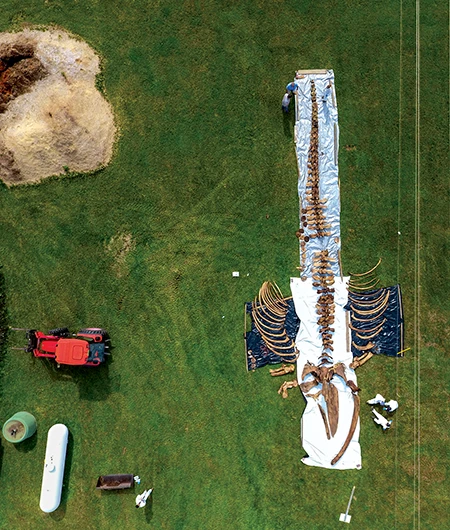
The team created a giant compost pile of sawdust and horse manure on a concrete slab, embedded continuously recording thermistor probes, and moved the whale to the compost. We had bare bones 45 days later, but the composting temperature peaked at 158°F (70°C), and the immature animal’s skeleton was not fully calcified. The ribs sagged and folded as we removed them. The bones were barely usable, but we had learned a valuable lesson: Do not let the composting process be too long and hot if you want good bones.
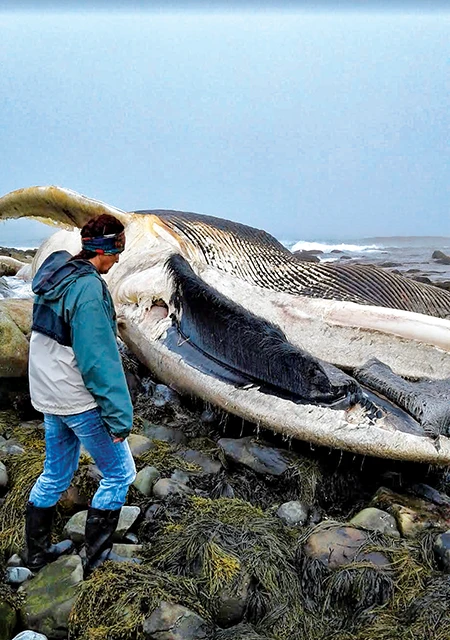
Endangered whales in the North Atlantic endured a bad year in 2017. For weeks in the spring, MARS told me a dead blue whale was washing up and down Nova Scotia’s southeast coast, but she never landed in an area where we could access her. She finally washed ashore on a rocky beach in East Berlin, Nova Scotia.
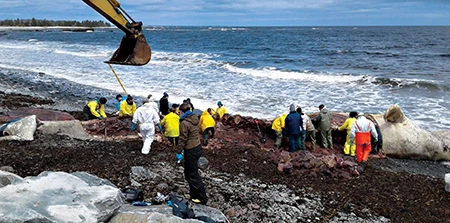
A team of 35 people, including 25 Dalhousie students and two veterinary pathologists, descended on the carcass with a giant excavator. The weather failed to cooperate, and the surf was pounding. By the end of the first day the excavator had broken when its hydraulics were overpowered by the weight of a 70-foot (21-m) blue whale.
We began recovering bones from the surf-damaged whale on the second day, and by the third we had brought in more than 95% of her bones despite being down to only a dozen people to complete the recovery. There were a few minor crises — at one point we had two giant dump trucks full of viscera, but no dump was prepared to accept them. Eventually, two more trucks departed to Truro to compost the bones.
Price and Nelson were waiting and buried the skeleton in their special mix on that mid-May morning. Over the next 18 months we periodically dug out bones to catalog, power-wash, and weigh them to check the progress of creating the skeleton. With this less-aggressive process, the skeleton gently cooked at about 86°F (30°C), and the soft tissue gradually disappeared.
As the bones emerged, a new problem did too: What do we do with the extremely fat-saturated bones? Blue whale bones contain about 40% fat, and many museums have discovered that they slowly exude stinky black liquid fat for a century after a whale goes on display. The aggressive chemical processes to defat bones had destroyed whale skeletons in the past.
Price developed a gentle process of bathing the bones in warm water and detergent, like the process used to treat birds in oil spills, to gradually remove the oil. Two years of this green process cleaned and removed the oil from the bones.
A 70-foot (21-m) blue whale skeleton is massive, and we knew it would require engineering expertise to articulate it. Peter May at Research Casting International (RCI) in Trenton, Ontario — one of the most experienced companies in curating dinosaur and whale skeletons in the museum world — provided a competitive quote. So in 2021 a team from RCI arrived and packed a 40-foot (12-m) tractor-trailer with the remains, which we had carefully curated and 3D scanned.
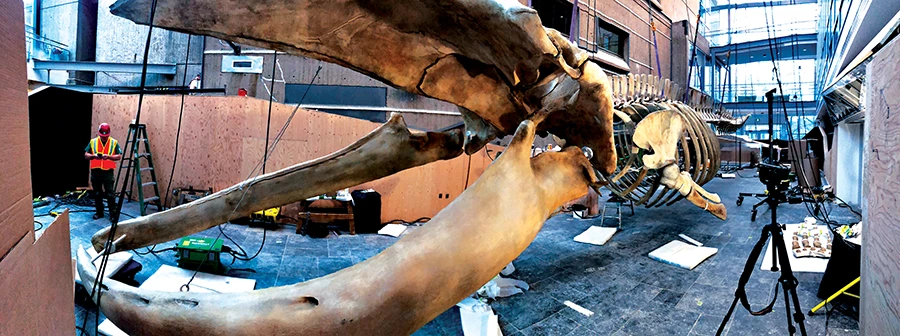
Almost four years later a truck pulled up in front of the oceanography building in Halifax on a freezing March morning. We carefully unloaded seven separate articulated segments, from the head to the tail, some of which cleared the doorway by fractions of an inch.
The six RCI craftspeople were amazingly skilled as they spent the next nine days bolting together the skeleton. They started with the spine, then the head, the ribcage, and finally the limbs, all attached by a spiderweb of cables to the ceiling 60 feet (18 m) above. As the whale was raised to her final lunge-feeding position 40 feet (12 m) up, she seemed to come alive, swinging slightly as if gently swimming.
The attention to detail these sculptors, welders, and metalworkers paid was exceptional. The massive linkages and 3-inch (7.6-centimeter) steel pipe that formed the endoskeleton were skillfully hidden with color-matched filler and paint to duplicate the cream color of the bones.
The blue whale project involved more than 100 people — including students, faculty, and tradespeople — mostly volunteers who spent thousands of hours helping make this vision a reality. It generated interest in the Beaty Centre for Marine Biodiversity, an ambitious museum and aquarium occupying the adjacent 10,000 square feet (929 square meters).
Every time I see the size and majesty of the whale, I think of all the kids who will experience it and feel the same awe I did all those years ago. People greet me in Dalhousie hallways to acknowledge the fruit of eight years of work, and I reply, “Thanks, but it took a village to raise this whale.”
Explore More
Find more about scientists preserving a blue whale skeleton in this bonus video.
© Alert Diver – Q3 2025