Descending into Lake Superior’s maritime past
Ancient beyond description and giant beyond comparison, Lake Superior’s cold and secretive depths hide a multitude of ships that prematurely ended their careers. The largest and farthest north of all the Great Lakes, Lake Superior is in a class by itself when it comes to preserving shipwrecks.
Infamous autumn storms, uncharted shoals, and blinding snowstorms have combined to wreak havoc on those who have sailed its waters. In a world where we have shaped much of the environment to our needs, the wilderness that surrounds Lake Superior is still truly wild. A witness to meteor impacts, the advance and retreat of glaciers, countless storms, and dark, freezing winter nights, the lake needs to be experienced firsthand to appreciate its power and immensity.
It is far too large to visit in one trip. By imagining this inland sea divided into four corners, we can understand how each region warrants a lifetime of diving to see even a small sample of the history that resides beneath the waves.
The Southwest: Apostle Islands National Lakeshore
The park’s 21 islands and 12 miles (19 kilometers) of shoreline feature sandstone caves, secluded beaches, and clifftop lighthouses. It is not busy or overpopulated but still feels closer to modern civilization than the rest of the lake. The dark waters here will challenge any photographer and certainly focus the mind.
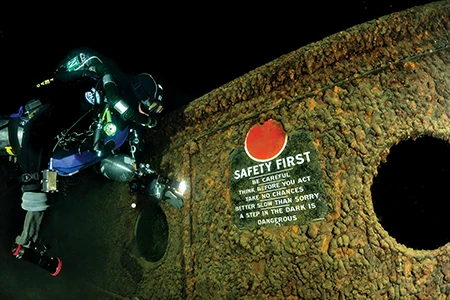
Dozens of shipwrecks litter the bottom here, but the Antelope is the highlight of this region. The former steamship sits upright with a fresh coat of green paint still adorning its railing. This 19th-century ship, which was converted into a schooner barge in the 1880s, carried passengers and delivered cargo throughout the Great Lakes for 36 years. The aging Antelope started taking on water on Oct. 7, 1897, and gently slipped beneath the waves, giving its crew time to reach safety.
The ship rests near Michigan Island in more than 300 feet (91 meters) of exceedingly dark water, with its final cargo of coal still on board. Two standing masts complete with rigging reach toward the surface, making the Antelope one of the Great Lakes’ most well-preserved shipwrecks. Stunning, bright-yellow block letters still proudly identify the vessel. Despite the poor visibility, navigation is easy with the ship so intact.
Tip: Bring a tripod to use for astrophotography, and plan to camp on one of the islands for beautiful views of the Milky Way. You will be reminded how truly amazing a night sky can be.
The Southeast: Munising to Whitefish Bay
This area hosts perhaps the highest concentration of shipwrecks in Lake Superior, as much of the early commercial traffic was concentrated here due to its connection with the lower lakes. More than 200 wrecks are in the vicinity of Whitefish Point, each with its own unique history and artifacts. So many spectacular wrecks are located along Lake Superior’s Shipwreck Coast that it is hard to select just one.
Researchers from the Great Lakes Shipwreck Historical Society discovered the wreck of the schooner barge Nelson with most of its equipment and artifacts in place 230 feet (70 m) below the surface in 2014. It sank bow-first into the bottom of the lake in 1899. Much of the ship is still in near-perfect condition. Schooners have a special place in my heart, and this one is breathtaking. Scattered dishes, the ship’s wheel, and sturdy wooden deck timbers remain on display with only a slight dusting of silt. Visiting the deck of the Nelson seemingly transports you back to life in the late 1800s.
The SS Superior City met its end in a violent collision in the summer of 1920. This enormous steamship was carrying iron ore to the steel mills on the lower lakes when the Willis L. King struck its port side, resulting in a huge explosion when cold water burst through to the boilers, killing 29 crew and leaving only four survivors. One of the more challenging dives in Whitefish Bay, the Superior City rests between 190 and 270 feet (58 and 82 m) deep and requires advanced technical diving skills. This site can be disorienting, with its partially buried, warped steel hull and scattered equipment from the massive explosion. The huge ship has so many artifacts, rooms, and machinery pieces to see that you could dedicate an entire trip to exploring this one wreck.
The remains of the SS Samuel Mather lie near the center of Whitefish Bay. Like many of these steamships from the late 19th century, sailing masts were also part of the design, making these vessels early hybrids. Being able to see the engine room, propeller, masts, and rigging on a single dive makes this ship fascinating. The massive impact damage on the starboard side is a poignant reminder of the dangers of commercial shipping. Resting upright in 180 feet (55 m), with two large masts reaching up to 75 feet (29 m), the Samuel Mather is worthy of several dives to explore and photograph.
Tip: The lower number of invasive quagga mussels in Lake Superior than in the other Great Lakes means that this lake is often not as clear, but the shipwrecks are pristine and free of marine growth. Consider close-up images rather than wide-angle photography.
The Northwest: Isle Royale National Park
When you think of islands on a lake, you may be tempted to imagine small, rocky outcrops barely large enough to stand on. This is not the case on Isle Royale. At 45 miles (72.4 km) long, it is the world’s fourth-largest lake island by area and one of the most beautiful national parks in the U.S. This remote wilderness is the final resting place of more than two dozen shipwrecks, many with tragic stories.
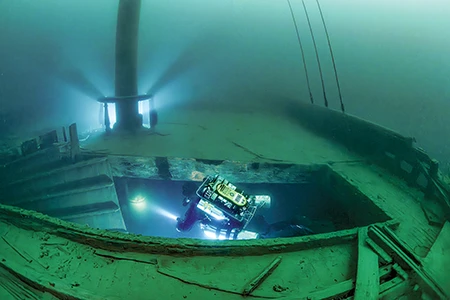
A simple navigation error led to the demise of the SS Emperor in 1947, when it ran aground on the north side of Isle Royale. Today it rests on a slope, with the bow in 25 feet (7.6 m) of water and the stern at 175 feet (53 m), allowing divers of all skill levels to witness this piece of history firsthand. The stern cabins are largely intact and contain the galley, bunks, and machinery. For advanced divers with training and equipment, the engine and boiler rooms are worth a visit.
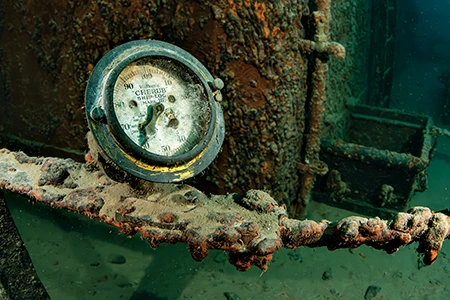
The crown jewel of Isle Royale shipwrecks is the SS Kamloops, one of the Great Lakes’ enduring mysteries. The cause of the shipwreck and how several of the crew made it ashore only to freeze to death has never been fully understood. A message in a bottle from one of the crew, found more than a year later, described freezing and starving on Isle Royale. Just off the north shore, at the bottom of an underwater cliff, the package freighter rests on its starboard side with the stern at 175 feet (53 m) and the bow at 260 feet (79 m).
Mountains of various cargo are still in the hull, even though some items have spilled out of the open hatches onto the lake floor. Crates of toothpaste, piles of boots, and rolls of wire fencing lie scattered about. Boxes of Life Savers candies are undisturbed, neatly lined up in compact rows, with the printed names and foil wrapping the same as what is available in convenience stores today.
Tip: Thermoclines can vary widely at every dive site on Lake Superior, so note the depth of the temperature drop on your descent. Returning to this depth on your ascent will provide some thermal relief during the required decompression schedule. No matter how proficient you are at technical diving, temperature is the limiting factor.
The Far North: Rossport to Marathon
The Canadian Shield, a geographic formation more than 4 billion years old, is the bedrock of this ancient region. Primordial forests and the massive granite cliffs have witnessed countless storms over millennia. Rugged and wild, the incredible North Shore scenery has inspired poets, artists, and photographers for centuries. Perhaps the two most cherished shipwrecks in all the Great Lakes reside in this area of breathtaking scenery.
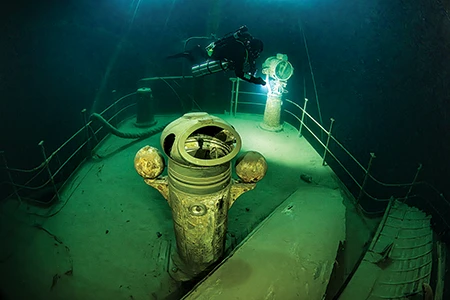
The shipwreck of the Gunilda is at the top of any technical diver’s must-see list. It was a private luxury vessel and the flagship of the New York Yacht Club when it ran aground in 1911 and then gently settled to the bottom 270 feet (82 m) below in a protected island group. An elegant, gilded bow, piano, ship’s bell, and game room are just some of the sights to see on what Jacques Cousteau declared the most beautiful shipwreck in the world.
Divers travel from around the world to spend a week diving a shipwreck that seems too good to be real. Rossport residents are justifiably proud of this story and their culturally important wreck that is now part of local lore. The Gunilda is more beautiful and captivating than any description I can provide here. It is simply magnificent.
In some ways the Judge Hart is the opposite of the Gunilda. The humble beginnings of this cargo ship, simply designed and built to be financially viable, in no way detracts from the incredible state of preservation and amazing story of its loss. A violent storm in the fall of 1942 encased the Judge Hart in ice before it sank, resulting in the entire ship becoming a time capsule that a fortunate few will experience.
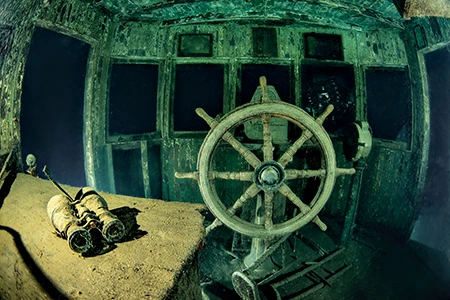
The pilot house with intact wheel, radio direction finder, binoculars, and picture frames hanging on the interior walls is a highlight of the dive. The binnacle, ship’s bell, running lights, and whistle appear ready for service. The ship is perhaps the finest example of a working freighter anywhere in the Great Lakes, so the effort required for a 170- to 195-foot (52- to 59-m) dive is justifiable. Its remote location is far from the nearest safe harbor, so any dive team embarking on an expedition to the Judge Hart needs a sense of adventure.
Tip: Ensure you are proficient with drygloves before taking a dive trip to Lake Superior. Equipment management, valve shutdowns, and camera button operations should be second nature while using drygloves.
While many shipwrecks in Lake Superior are well within recreational limits, most of the ones in this article are for technical divers. If you pursue the lure of deepwater shipwrecks, the lake will challenge you no matter your skill set.
Lake Superior remains the most formidable and rewarding location in my dive experience. It demands much from intrepid divers wishing to visit its depths, but with persistence and determination it will reveal some of the best shipwrecks anywhere on the planet.
Explore More
Find more about Echoes in the Cold in this bonus video.
© Alert Diver – Q4 2025