The Lagoon That Remembers
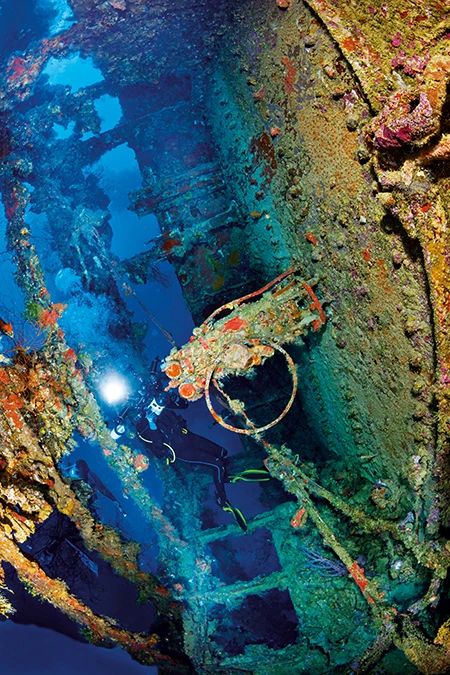
Our first dive was on the Heian Maru, an enormous Japanese passenger and cargo liner that had been converted into a submarine tender during World War II. At more than 500 feet (152 meters) long, it is one of the largest wrecks in the lagoon.
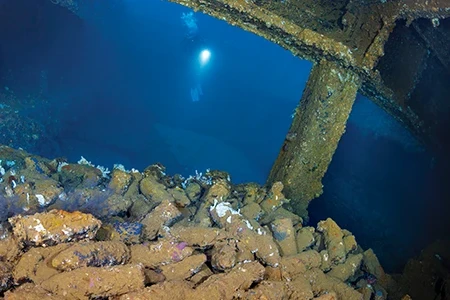
The ship lies on its port side, and that single fact changes everything. As you descend, your sense of direction slips away. Floors become walls. Hallways angle downward in ways the mind resists. Swimming through them feels like entering a place where gravity has lost its authority.
As I followed our local guide down through the blue and into the ship, I occasionally heard sounds coming from his regulator — low, steady tones that did not belong to the sea. I initially thought it was equipment noise or breath control. But the sounds continued, unbroken, through the entire dive. When we were back on our boat, I asked him about it. He smiled and said he had been singing, something he always does on wrecks as his way of acknowledging the lives lost during Operation Hailstone and of requesting acceptance as a visitor.
Most of the human remains were removed decades ago, but some are still embedded deep within the wrecks, sealed behind collapsed steel or unreachable compartments. They will never be recovered. The lagoon holds them now, and our guide believes everyone should enter the wrecks with respect.
The U.S. Navy carried out the massive Operation Hailstone assault over February 17–18, 1944. At that time, Truk Lagoon — now called Chuuk Lagoon — was Japan’s most important naval stronghold in the Central Pacific. The mission was to destroy Truk’s ability to operate as a forward base and eliminate any threat to upcoming Allied operations across the Pacific.
The attack was overwhelming, destroying hundreds of Japanese aircraft — many on the ground — and sinking more than 40 ships, including cargo vessels, tankers, destroyers, and auxiliary ships. What had been a powerful fleet was reduced to twisted steel and oil-slicked water in less than 48 hours. When the air raids ended, Truk Lagoon had become a graveyard.
I first dived these wrecks in the late 1980s, when I was younger, less patient, and focused more on penetration and discovery than observation. I have returned several times since then, drawn back by the strange combination of history and life that defines this place. Over the years I have watched coral grow where paint once shone and seen fish claim passageways that once carried men.
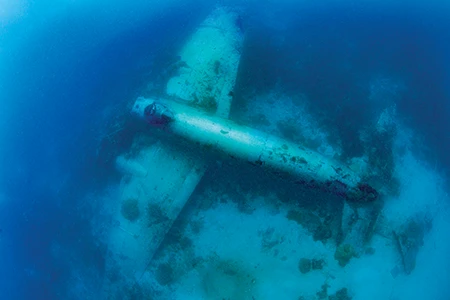
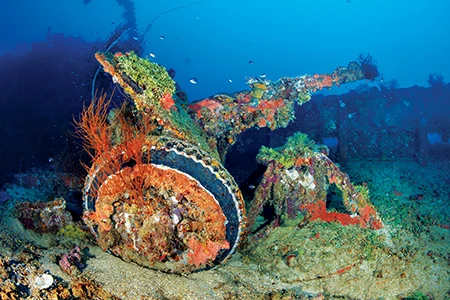
The changes were impossible to ignore on a recent expedition. Time and saltwater are relentless forces. Entire sections of wrecks have collapsed, and decks that once supported sailors now crumble at a touch. Steel beams thick as trees have thinned and weakened. Some wrecks have been deemed too dangerous to enter — their interiors unstable and threatening imminent collapse. What war did not finish, the sea continues, patiently and without pause.
Thousands of divers visit the lagoon each year, many of whom are returning visitors. Some come to explore wrecks they missed before. Others come to test new technology, such as rebreathers, mixed gases, and other equipment that allows access to depths beyond what traditional scuba tanks permit. Regardless of experience or gear, each diver enters the same quiet world below the surface.
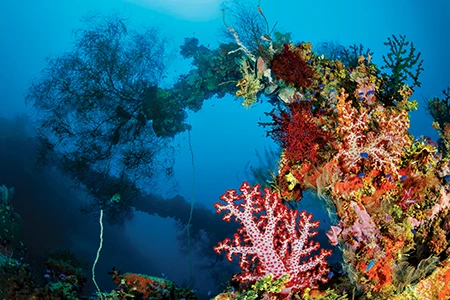
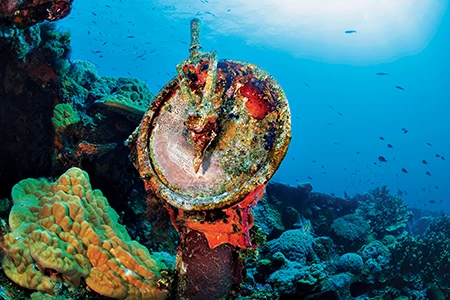
We also explored the I-169 submarine on our first day. It’s the only known submarine wreck in the lagoon and rests upright at a depth of 98 to 138 feet (30 to 42 m). As we descended, its dark shape slowly emerged from the water below, long and unmistakable. The submarine stretches more than 300 feet (91 m), and its form is intact, severe, and imposing.
We passed through drifting jellyfish as we dropped toward the stern, where the enormous starboard propeller hovers just above the bottom. The I-169 was not sunk during Operation Hailstone but weeks later, when an air-raid siren sounded while the submarine was in the lagoon. The captain ordered an immediate dive, and in the haste not all hatches were sealed. Water rushed in, and the submarine settled to the bottom, full of air, steel, and silence.
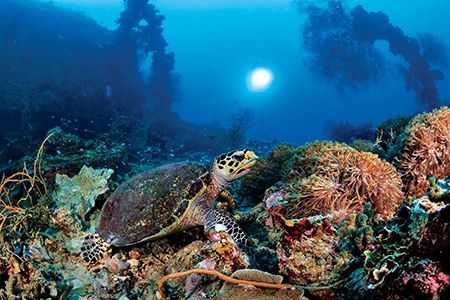
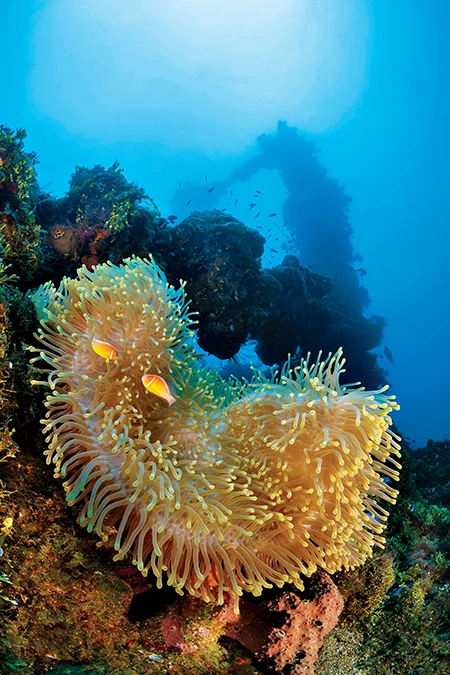
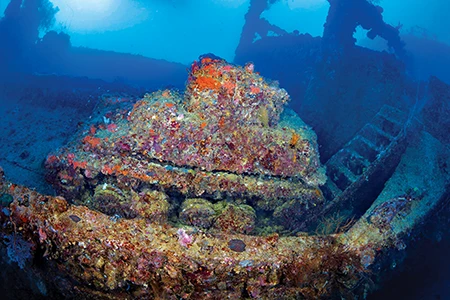
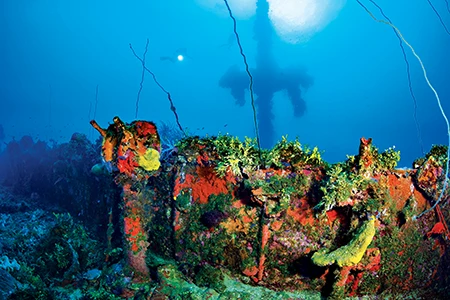
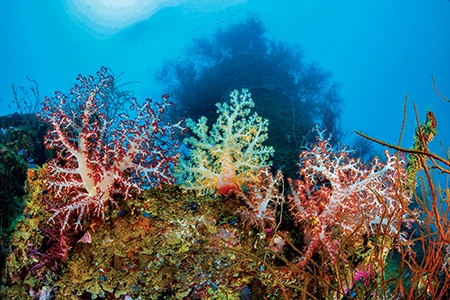
We made three or four dives a day for a week and still visited only a dozen wrecks — each different and claimed by the sea in its own way. Huge gorgonian fans spread wide along railings and gun mounts. Forests of soft corals cover masts and cargo holds in red, pink, yellow, and lavender. Life here is selective. Different schools of fish occupy different wrecks, as if each ship carries its own identity, even in death.
Twice, spinner dolphins passed nearby. Their sharp clicks cut through the water, alerting us to their presence long before we saw them. They circled once, curious, and then disappeared into the blue.
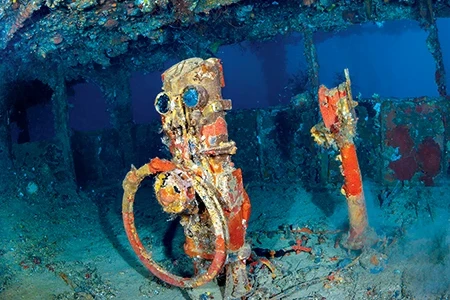
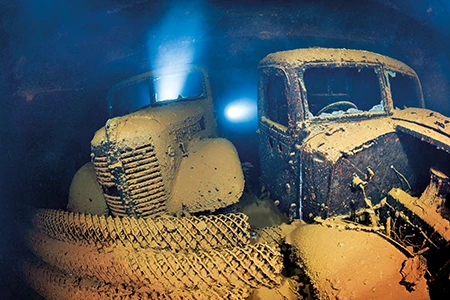
The wrecks and aircraft in the lagoon are protected as a historic site. It is illegal to disturb them or remove artifacts. This protection is taken seriously. Some items recovered long ago were returned to the wrecks and arranged so divers can easily see them. These displays give parts of the lagoon the feeling of an underwater museum. Sake and beer bottles sit upright on steel shelves, and gas masks rest beside ceramic water jars. Plates, cups, bullets, and shells remain where they were left decades ago. Everything feels paused.
In September 2025, oil began leaking from the Rio de Janeiro Maru, one of the lagoon’s more popular wrecks due to its shallow depth — some areas lie in as little as 30 feet (9 m) of water. Heavy fuel oil reached the surface, forming a visible slick that threatened nearby reefs and shorelines. The leak was eventually contained, but operators avoided the area out of caution.
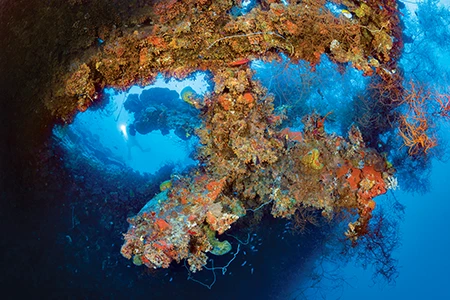
Our alternative dive on the Hanakawa Maru was one of my favorites. The wreck is quieter and less famous but deeply rewarding for its atmosphere and structure. It feels discovered rather than visited.
A descent line with a float had been secured to the deck. As we descended, a few jellyfish drifted past in a light current, and then more appeared. When we reached the wreck, a wave of thousands of jellyfish came rising over the gunwale from below. It was more than I had ever seen at once, and they pulsed and drifted together, filling the water around us.
Our guide began singing again. The sound carried softly through the water as the jellyfish engulfed the ship like spirits rising from the steel. The mass continued to pass for nearly 10 minutes, and then thinned and vanished as suddenly as it had appeared.
The masts of the Hanakawa tower toward the surface, covered in bright soft corals in red, pink, and yellow. This alien forest rivals the imagination of the Avatar films.
Over the following days we dived wrecks with names such as Kiyosumi, Heian, Shinkoku, Fumitzuki, Yamagiri, and Nippo. Each name ends with the same word: maru, meaning “circle” or “complete.” Bestowing that name upon a ship was meant to protect it and ensure a safe voyage and return. When you read a name such as Fujikawa Maru or Seiko Maru, you are reading a wish and a hope that the ship would come home whole. That meaning feels heavy and quietly heartbreaking now as we hovered above the wrecks, knowing they never did.
Chuuk is a place where history and nature coexist. Nearly 290 islands make up the state, with five or six core islands surrounding the lagoon and housing most of the population. Life here moves at the pace of tides and daylight. Hospitality is warm. The sea is respected.
Chuuk feels remote, resilient, and soulful. It is a place where time slows, steel becomes reef, and the ocean remembers everything, shaped by wind, war, water, memory, survival, and spirit.
How To Dive It
Chuuk, formerly known as Truk, is one of the four Federated States of Micronesia in the western Pacific Ocean. It lies a little more than 600 miles (966 kilometers) southeast of Guam and is part of the Caroline Islands.
Dive operations: You can dive Chuuk from a land-based resort or on a liveaboard. Blue Lagoon Resort, in conjunction with the Blue Lagoon Dive Shop, is the primary option for land-based diving. The accommodations are basic to mid-range, with a strong emphasis on diving rather than luxury, and Wi-Fi can be intermittent. There are three primary liveaboard operations:
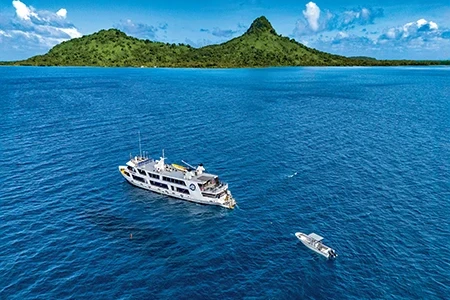
- Odyssey: This 132-foot (40-m) steel liveaboard purpose-built for Chuuk accommodates a maximum of 16 divers in small, controlled groups. The vessel moors directly to the wrecks, allowing divers to enter the water from the boat, which is equipped with an in-water elevator.
- Pacific Master (formerly Taka): This liveaboard is part of the Master Liveaboards fleet and offers 12 cabins, accommodating up to 20 guests.
- S.S. Thorfinn: Functioning more as a floating hotel than a roaming liveaboard, this vessel remains moored within the lagoon, with diving conducted from small boats. Capacity is approximately 20 guests.
Conditions: Chuuk’s tropical location ensures consistently warm water, typically ranging from 82°F to 86°F (28°C to 29.5°C) year-round, with minimal seasonal variation and little to no thermocline. A 3mm wetsuit is generally sufficient, and a full suit is recommended for repetitive wreck diving. Chuuk is diveable year-round. The wet season (May to December) brings slightly warmer water and reduced visibility, while the dry season (December to April) offers clearer conditions and more stable weather.
Wreck depths: Chuuk’s wrecks span a wide range of depths. The shallowest structures are at 15 to 30 feet (5 to 9 m), but the most common depths are 60 to 130 feet (18 to 40 m). The deepest sections are more than 200 feet (61 m) deep. Many wrecks are multilevel, allowing for multiple dives at varying depths on the same site. Most operators offer nitrox and adjust blends based on the planned depth of each dive. Dive profiles are typically tailored to the group’s skill level.
Technical diving: Some operators accommodate technical diving groups with advance notice. Oxygen for rebreathers and helium for trimix may be available upon request, but you should make arrangements before arriving.
Decompression considerations: Dives are planned according to the divers’ experience. Advanced certification is generally required, and nitrox is strongly recommended. Most dives are conducted within no-decompression limits, with three- to five-minute safety stops encouraged. Many operations provide additional cylinders at 15 feet (5 m) as a precaution.
Chuuk is medically remote. Weno Island has a privately operated recompression chamber with basic equipment. Staff must be called in, which can affect response time. A more reliable facility is 633 miles (1,019 km) away at U.S. Naval Base Guam, where serious decompression illness cases are typically treated. Medical evacuation is costly, so dive conservatively, use nitrox appropriately, allow for adequate surface intervals, and maintain your DAN dive accident insurance.
Explore More
See more of Chuuk Lagoon’s wrecks in this video.
© Alert Diver – Q3 2026