The mesmerizing movements of schooling silversides
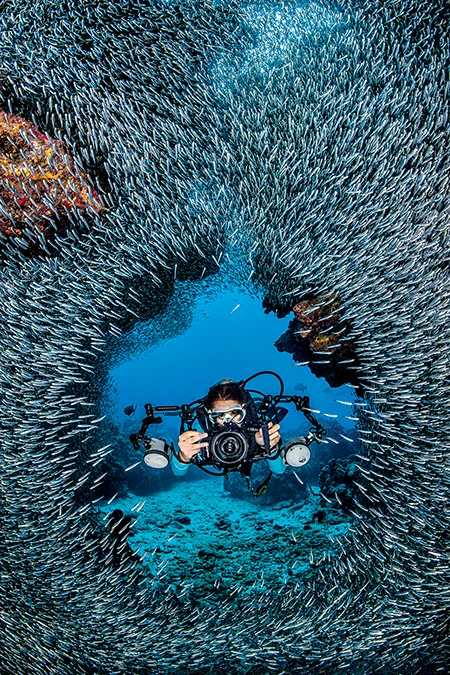
Fish completely enclose me. Their tiny, silvery bodies twinkle in the half-light as I float suspended in the center of a sphere of clear, warm water. I feel like I am inside a disco glitter ball.
Whichever way I swim, I can’t get closer to the fish. The countless silversides react as one, as if I am emitting a force field. The silversides are on defensive duty, seemingly aware that their astronomic numbers will be irresistible to predators.
The school moves with such synchronicity to maintain its personal space that it is hard not to perceive it as a single animal rather than a gathering of individuals. This all-encompassing spectacle is mesmerizing, hypnotic even, especially in the darkness.
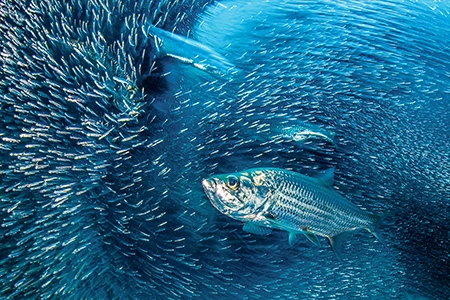
The school is crammed into a cavern close to shore in George Town, the capital of Grand Cayman. The schooling silversides are so thick that I can’t see the walls of the coral cave, but suddenly I am spat back out into the bright blue world as the fish flee to another chamber to escape a marauding tarpon.
The predator looms into view. Tarpon here are monstrous, swollen by tasty handouts from local restaurants. This one is almost as long as me, and her large, polished silver scales glint like medieval armor. My heart thumps in shock and excitement.
Perhaps the greatest addiction in scuba diving is that the underwater world is filled with a diversity of spectacular marine life. It seems trite to attempt to rank such varied experiences, but my mind can’t avoid speculating that nobody across the globe has had as amazing underwater experiences as I am having right now.
I fin deeper into the cavern and am once again engulfed in the synchronized school. Just as they entrance me, the moving mass of silversides confuses potential predators, making it hard for them to pick a target.
They are equally difficult to identify. We call them silversides or glass minnows, and most divers recognize their massed ranks, silvery flanks, and synchronized movements. But look closer, and you’ll spot that the schools can be formed of a mix of similar fish — either different age groups or species that can’t be identified outside of a laboratory.
Silversides is a catchall label rather than a species. The name is used for small fish with elongated bodies covered in shiny, reflective scales that create a shimmering effect as they swim. Their characteristic silver sheen is not just for show: It is camouflage that helps them blend into the water’s surface and enhances their ability to confuse predators as fish after fish glints as the school rolls past.
Schooling has other benefits. Swimming in a group reduces individual energy expenditure, as each fish benefits from the school’s hydrodynamic efficiency, and more eyes are looking out for danger. Recent studies show that vision is the dominant sense in maintaining synchronized schools, although the pressure-sensitive lateral line also plays a role. Fish that school typically have eyes mounted on the sides of their head, and the exact spacing of individuals and the precise and unified movement is controlled mainly by eye contact.
We may use the words shoal and school interchangeably when talking about fish aggregations, but marine scientists distinguish between the two based on behavior and structure. A shoal is a loose gathering of fish, often consisting of a mixture of species and sizes where the fish don’t necessarily move in unison. A shoal is like a group of friends hanging out in a bar. Shoaling is very common — about 50% of all fish species do it at some point in their lives.
A school is far more organized, like a sports team lined up for play. Fish in a school swim in tight, synchronized formations, moving at the same speed and simultaneously changing direction. Typically made up of a single species, schooling fish are usually silvery. All schools can be classified as shoals, but not all shoals are schools.
Interestingly, most protective shoals, like those of silversides and grunts, disperse at night to allow the fish to feed for several reasons. They cannot see to coordinate their tight schooling in the dark, and many predators are not active at night. Also, when looking for food it is better to be on your own, away from competition.
Silversides typically return to the same cavern before dawn, but sometimes a proportion or even the whole gathering will suddenly relocate. It is common when diving around silverside schools for their numbers to fluctuate a lot from day to day.
Other factors influencing the size of silverside aggregations are these short-lived schools’ gathering and predation processes. When the school starts to grow, it often does so rapidly, with their numbers jumping each day as the gathering attracts more fish. Within a few weeks, the numbers fall away.
I am unsure if this decline is simply predation hoovering up all the fish or if silversides are naturally leaving these aggregations. I have often wondered if the gatherings are also linked to spawning, as so many fish together seems like too good an opportunity to miss. Perhaps they disperse after spawning, but I am not aware of any studies regarding this.
Silverside blooms are typically a summer event across the Caribbean, but the location and timing vary. In Cayman they will occur for several summers in a row and then be absent for years before reappearing in the same cavern. Your best chance for catching them is in July and August, but it takes some luck to see the spectacular peak of the bloom, which is part of what makes witnessing it feel so special.
Another major attraction of these dives is the predators drawn irresistibly to the banquet. Tarpon are large, powerful fish that divers admire and sport fishers respect for their impressive size, fight, and acrobatic displays. They are often found in shallow water and specialize in smaller prey, despite growing to more than 6 feet (1.8 meters).
Their hunting strategy is characterized by stealth and sudden bursts of speed, allowing them to ambush their prey with precision. Tarpon have a special ability to gulp air from the surface and absorb the oxygen through their swim bladder, which provides them with an additional oxygen supply and enables them to hunt sluggish prey in low-oxygen environments. You can even see them belch the air back out again underwater.
Watching tarpon hunting silversides is one of the great ocean spectacles. The silverside school dances like a giant phantom, engulfing the tarpon like the school is the predator. The tarpon strike back as they move through the water, creating a vortex that disorients the silversides, helping separate small groups from the school to make them easy pickings. The tarpon don’t spend their entire day in the schools of silversides and seem to purposely move in and out of the caverns.
Their arrival certainly turns up the tempo of life. Their hunt starts with patrolling runs through the school. I watch these metallic predators slicing through the water with effortless power, their large eyes scanning the surroundings for potential prey. They arrive as a team, and while their attack isn’t coordinated, the combined chaos seems to increase their success.
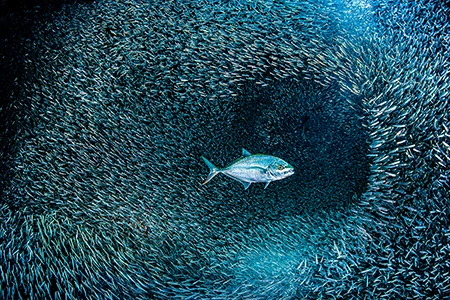
Tarpon are not the only predators drawn to the schools; while they are usually the instigators, many other species benefit. Bar jacks seem addicted to the schooling fish and sweep back and forth through the silversides, waiting for their chance. The bar jacks are fast and nimble, but their odds of success jump when the larger tarpon splinter the ranks. The black jack is the other species of trevally irresistibly drawn to the silversides.
Curiously, I don’t usually see black jacks at Grand Cayman. I have often used the fact that I’ve spotted one as a first clue that the silversides are in residence. Not just a Caribbean species, black jacks are found around the world, typically in open water beyond a drop-off. I can only conclude they can sense when the silversides gather, which draws them in. I don’t know if the school’s smell or sound gives them away, but schooling ironically is a form of protection that clearly draws in additional predators.
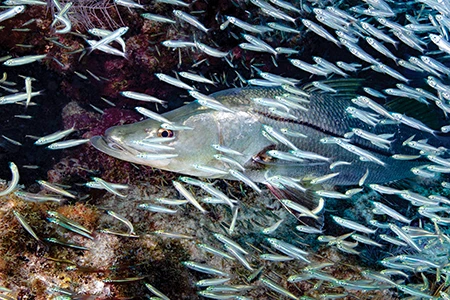
The silversides are not just prey for fast-swimming hunters; they also attract a selection of predatory reef fish that lurk in the shadows, waiting for the school to move close enough for an ambush. The silversides are clearly aware of the threats and always maintain a safe distance from the cavern walls. Prime predators include schoolmaster snappers, black groupers, Nassau groupers, and scorpionfish, all waiting for their moment.
While Cayman is intrinsically linked in my mind with silverside schools, you can see them around the world. Typically, these clouds of baitfish gather in the shallows, especially under and around jetties or in mangroves. But there is something special when you encounter them in the caverns.
The large caverns aren’t immediately obvious on many of Cayman’s reefs, as their entrances look like any other overhang. The first time you swim in it is like discovering a secret world. When that world is crammed with a school where you can completely disappear and see large predators in action, you have something truly special.
As with all good things in life, there is a but. The frustration with silversides is that their blooms are not reliable or predictable. Some years there are blooms in multiple locations around Grand Cayman, and other years there isn’t a single one. The gatherings do not occur at a particular state of the tide or phase of the moon; they just suddenly appear.
George Town harbor is one of the hottest spots for silversides, but this dive site is under threat from a port expansion proposal to allow cruise ships to dock directly against the small island. Fortunately, a national referendum this year came out strongly against the port development, and for now we hope this special dive site remains safe.
If you are on the island when the silversides bloom, it is easy to learn about it. Everyone knows they will be around for only a few weeks, and divers share the news so you won’t miss it. Hearing the news is easier than ever, thanks to social media and people wanting to share spectacular photos and videos from these amazing dives.
A lot of what we see in the ocean is incredibly reliable: You book the trip and see the critters. The mesmerizing dance of silverside schools and tarpon is an incredible ocean sight, but it rises to the top of my list because it isn’t easy to witness. You have to visit in the right window, but you still need a big slice of luck for the event to kick off while you are there.
The good news is that if you hear the silversides are in town, you can go directly to the right spot and see them. The all-consuming experience of diving into a cavern and swimming completely inside a school of fish never disappoints.
Explore More
Find more about the silversides in these bonus videos.
© Alert Diver – Q3 2025