From ornamental aquaculture to resilient reef restoration – MEMBER PROFILE
Hometown: Zenia, Ohio
Age: 69
Years Diving: 55
Why I’m a DAN Member: I love the community of divers and learn so much from the magazine.
Ken Nedimyer’s connection to the sea began early. He put himself through college by collecting tropical fish and diving for lobster in the Florida Keys. He spent summers working at Sea Camp, and he eventually transitioned to breeding saltwater tropical fish and invertebrates at a fish farm — a career that spanned more than 30 years and helped support his family.
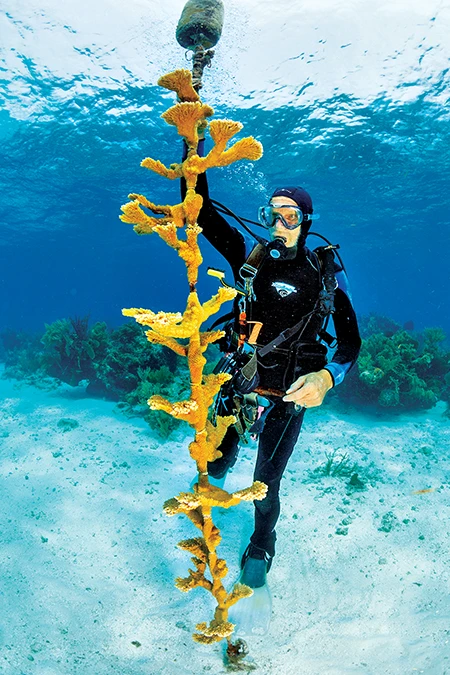
Living in the Upper Keys for most of his life, Nedimyer began collecting live rock for the aquarium trade. In 1996 he noticed staghorn coral naturally settling on some of this rock. Amazingly, those corals survived hurricanes and bleaching events for six years. When pieces broke off, Nedimyer would reattach them — an act that sparked a bigger idea: What if corals could be grown and sold in the aquarium trade?
Nedimyer partnered with his daughter, an enthusiastic 4-H member, to launch an ocean-based coral farm in 2001. Living in the Florida Keys, they knew raising cows or horses wasn’t in the cards and thought corals would be more fitting. It was a father–daughter project born from curiosity and a shared love for the sea.
Their goal was simple: to grow corals for the aquarium trade. But as they spent time together underwater, watching the corals grow and thrive, Nedimyer felt something shift. He began to wonder if the corals could do more than decorate tanks. Could they help bring damaged reefs back to life? That question changed everything.
When he brought their homegrown corals to the Florida Keys National Marine Sanctuary, officials were amazed but had no mechanism to issue permits for restoration. They found a workaround, however, allowing Nedimyer to place his corals where a ship had run aground on Molasses Reef, creating a blank slate on the seafloor.
The corals thrived. Broken fragments were reattached, and a flourishing reef eventually emerged. Though Nedimyer never sold a single coral, his work helped birth an entire industry.
He persisted for six years without receiving a proper permit, growing more than 5,000 corals. Frustrated, he finally told regulators to approve coral restoration or else he would have to sell the corals. He got the permit — and national attention. Partnerships soon followed with The Nature Conservancy, the University of Miami, and the Florida Fish and Wildlife Conservation Commission.
By 2007 Nedimyer saw the need for something bigger. He founded the Coral Restoration Foundation (CRF), and in 2009 he secured a major grant in collaboration with leading institutions. Coral restoration was officially on the map.

While researchers advanced genetic and reproductive knowledge, Nedimyer offered a visionary, scalable model. His aim was never fame — it was action. After several years at CRF’s helm, he stepped away, choosing to focus on what he did best: growing and planting corals.
This change led to his next venture, Reef Renewal USA (reefrenewalusa.org). With a major initiative funded by the National Oceanic and Atmospheric Administration (NOAA) underway — a $17 million collaboration uniting agencies, universities, and nonprofits — he felt the collective drive to solve reef degradation was truly unified for the first time.
The team’s mission was to identify resilient corals. They scoured the Florida Keys, from Key Largo to the Dry Tortugas, collecting hardy survivors from diverse environments and then propagating and planting these corals as hopeful champions for restoration.
Tragedy struck in 2023, when a historic marine heatwave hit the Keys. Water temperatures soared to 94°F (34.4°C) and even hotter in shallower waters without current flow, killing nearly all elkhorn and staghorn corals — both wild and restored. Centuries of reef growth and decades of restoration were gone in a few weeks. It was devastating.
Amid the destruction, a few survivors stood out: corals that had been planted in the Lower Keys and were already acclimated to higher temperatures. Brain and star corals bleached but held on, refusing to die. These resilient corals offered a glimmer of hope, proving that genetic hardiness and heat tolerance could make a difference.

While delicate branching coral species were lost, robust boulder corals endured. For Nedimyer, this was a turning point — evidence that reef survival was possible and a clear signal to chart a new course forward.
In the wake of the unprecedented coral die-off, Nedimyer knew he needed to rethink his approach. With his offshore nursery in the Florida Keys increasingly vulnerable to climate extremes, the risk of losing everything in another catastrophic event was too great.
Drawing on his aquaculture roots, he partnered with fish farmers and a major inland facility in Ruskin, Florida, to establish a temperature-controlled coral nursery and gene bank. His mission was clear: grow bigger, faster, and more cost-effective corals while engaging fish farmers and nondivers in the effort. “If you want to grow coral successfully,” Nedimyer said, “you get a farmer to do it.”
His team has now cultivated more than 1,000 genetically resilient brain and star coral strains, selecting for heat and disease tolerance much like traditional farmers breed for hardy crops. They use both asexual and sexual reproduction techniques to scale up restoration-ready corals built for the future.
Nedimyer believes that the future of reef restoration lies in innovation and collaboration. One promising tool is a specially formulated gel used to enhance coral larvae settlement. This gel mimics the chemical cues of crustose coralline algae — the natural substrate coral larvae are drawn to — by replicating its taste and smell.
Similarly, fish larvae have been shown to detect and prefer live coral, swimming toward it over dead reefs. These discoveries, rooted in the sensory biology and behavior of marine organisms, offer powerful new strategies for accelerating reef recovery at the ecosystem level.
As Nedimyer looks ahead, he remains optimistic. With more than 30,000 dives and a lifetime beneath the surface, he has witnessed the ocean’s beauty and fragility. Now he is driven to share a powerful message: All is not lost.
He offers this advice to those inspired to follow in his fin strokes: Don’t be afraid to fail. Every setback is a lesson, and every success is a step forward.
“Just keep trying,” he said. “This work matters more than ever because the future of our planet depends on it.”
Explore More
Find more about Ken Nedimyer in this bonus video.
© Alert Diver – Q3 2025