Diving in California’s Mendocino and Sonoma Counties
My introduction to Northern California began with trees. As a little boy on family camping trips near Mendocino, I stared up in amazement at the towering redwoods. When we came out from under the green canopy to drive along the equally famous coastline, I stared down steep cliffs at crashing waves and the fathomless expanse of the mighty Pacific. And I wondered about the world beneath the waves.


Expanding My Horizons
Only recently did I finally start exploring NorCal underwater, at least areas north of San Francisco. I had logged hundreds of dives around the Monterey Peninsula over the decades but never a single tank in the Golden State’s more remote region that I remember so fondly from those childhood tree-hugging adventures. I don’t know why.
During the pandemic, when so many people were sheltering in place, I awoke to realize that my omission offered an opportunity. It was past time I pushed beyond the boundaries of my usual dive site stomping grounds into uncharted — at least for me — territory.
My first dive in the Mendocino area was at Russian Gulch. Conditions were far from stellar — only an arm’s length of visibility and surgy from a big northwest swell — and I mostly wandered around lost. Even so, I was undeterred.
I tried again the next day and fared considerably better, thanks to a friend from the Bay Area who drove up to show me around. He knew all about diving this site and many others along a nearly 100-mile (161-kilometer) stretch from Fort Bragg in Mendocino County south to Jenner in Sonoma County.
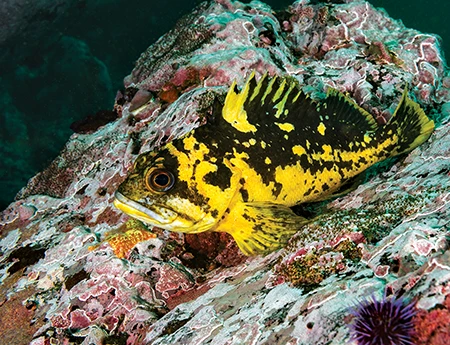
We began with a long surface swim — approximately 1,500 feet (457 meters), according to Google Earth — to save gas and maximize our bottom time exploring outside the northern point of Russian Gulch’s cove. Large boulders and slabs defined the seascape at 30 to 55 feet (9 to 17 m) deep, with coralline algae painting most rock surfaces coral and pink. Rockfish captivated us for the 75-minute dive. Gopher, vermilion, China, and black-and-yellow varieties lounged in the open and lurked in recesses.
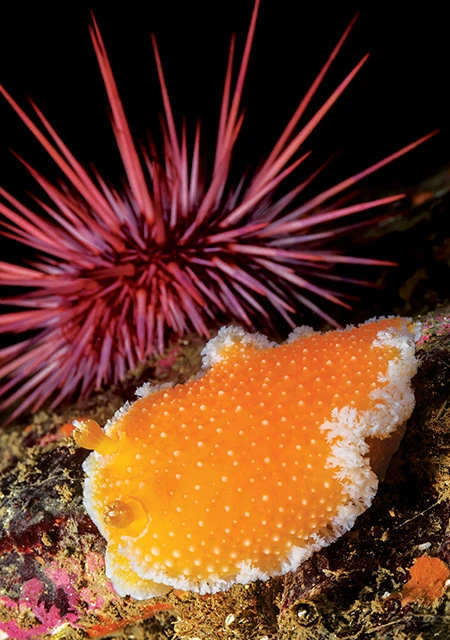
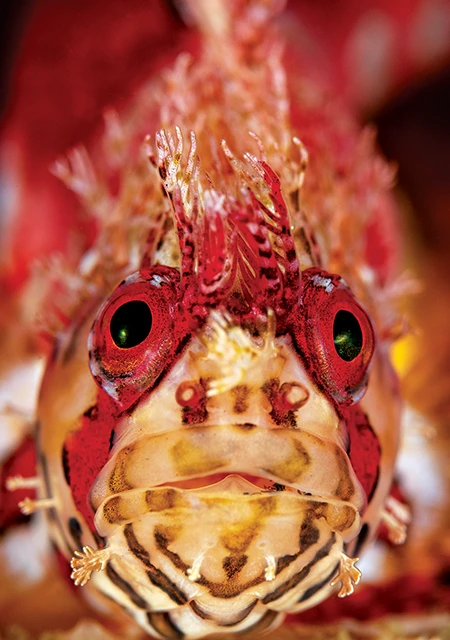
On our second tank, we started at roughly the same location but then navigated adroitly southward across the cove. This time we focused on smaller subjects, including lemon and opalescent nudibranchs, chitons, crabs, and a mosshead warbonnet — a fish more abundant in my home state waters of Washington than here in California. Its pleading gaze and fantastic, spiky pompadour demanded a portrait session.

Access and Fitness
Russian Gulch is a good place for scuba baptism in Mendocino County, as it offers one of the easiest entries. Simply gear up in the parking lot, walk under the oft-Instagrammed bridge, and step into the sea. The entry point enjoys considerable protection from prevailing swells and wind. Other sites are much more challenging due to exposure to the elements and the level of exertion required to reach, enter, and exit the water.
Headlands, for example, could challenge an amphibious mountain goat. On the first day I scoped out this site, it was a fairly average North Coast day with 15 knots of wind and a 6-foot (1.8-m) swell. I swore it would be impossible to make the steep descent to the ocean’s edge and survive a dive in the tempestuous waters. Waves pummeled the jagged rocks; spume and spray geysered to the heavens.
A couple of days later, minus Neptune’s wrath and with guidance from an experienced local, I carefully made my way down the escarpment at Headlands, slipped into the jade-blue Pacific, and enjoyed a dive over dramatic terrain, basalt ridges, and pinnacles decorated with tapestries of large green sea anemones, red and purple sea urchins, orange sea cucumbers, and orange ochre sea stars.
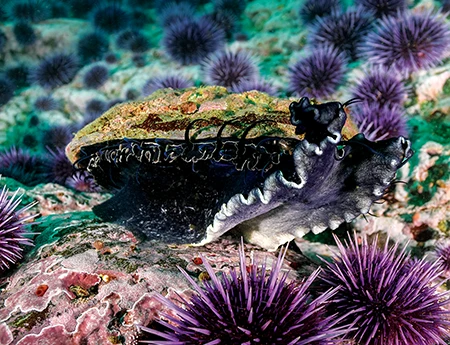
I also saw kelp greenlings, sculpins, and a handful of red abalone. Once the mollusk magnet pulling thousands of hungry freedivers to Mendo each year, the prized red abalone is now fully protected statewide, with no harvest allowed.
At the end of the dive, a detour into a surge channel that led to a small beach provided a safer, easier exit point than where I had submerged. Overall, I rate this site as demanding. But with mellow conditions, some physical effort, and careful planning of your entry and exit points, Headlands is far from impossible.
Van Damme State Park receives significantly more fin traffic than Headlands. It is the most popular dive spot in Mendocino County and perhaps in all of the North Coast. I have dived Van Damme using three modes of propulsion: with my legs (shore entries and long, long surface swims), from a kayak launched on the crescent-shaped beach, and via my 15-foot (4.5-m) Zodiac launched at the Albion River Campground and Marina, a few miles down the coast.
The conventional, fin-powered approach is enviable for its simplicity, but unless you are willing and able to kick on your back for 45 minutes to an hour or more, exploring Van Damme by some kind of boat is definitely the way to go. Watercraft comfortably opens access to more distant, deeper reefs a half-mile to one mile (805 to 1,610 meters) or farther from the beach. These seascapes at 50 to 90 feet (15 to 27 m) are home to noticeably more marine life and often better visibility.
Lingcod and cabezon — gamefish that are few and far between in shallow water inside the bay because they are spearfisher favorites — are still seen outside on the shelving sandstone walls that step down into the deep. There are also white-tentacled, red-stalked, fish-eating anemones larger than dinner plates and fuzzy carpets of dime-sized strawberry anemones. Purple-ringed topsnails sparkle among these colonies of club-tipped anemones. Puget Sound king crabs in brightly hued suits of armor clamber over granite boulders.
My wife and I encountered a male wolf-eel about 5 feet (1.5 m) long in a fissure at 60 feet (18 m) west of the cluster of frothy wash rocks called Keyhole. On another dive we dropped our boat’s anchor in a kelp bed northwest of the main bay, where we backrolled into the bull kelp. While collecting our bearings beneath the canopy, an ocean sunfish materialized from the teal-colored haze and swam curiously up to us. Holy mola, we had not been expecting such an odd-looking, pleasant surprise.


Twilight of the Kelp Forests
I wish I could say the majestic forests onshore have company offshore — that the redwoods and other conifers on land are mirrored by dense, extensive stands of amber giants in the sea. That was true when I was a child first visiting this stunning coastline and for a few decades after, but no longer.
Most of the underwater forests of bull kelp — and, to a lesser extent, giant kelp — that used to flourish in Mendocino and Sonoma counties have disappeared in recent years, grazed down to nothing by too many purple sea urchins. An exponential explosion in urchin numbers started in 2013, coinciding with the rapid loss of billions of sunflower sea stars. A concurrent, extended marine heatwave did not help matters either.
This sea star species, the main predator of urchins in the balanced coastal marine ecosystem of pre-urchingeddon times, was decimated and made functionally extinct by a lethal tissue-wasting disease caused by the Vibrio pectenicida bacteria. The same grim story played out in varying degrees south through central California as well as north through Oregon and into Washington.
Today, kelp forests in NorCal are the exception rather than the norm. Divers can still find patches here and there around Mendo, such as at Van Damme and Portuguese Bay. There is hope that things will improve. Some kelp restoration efforts are bearing fruit.
A research program, for example, in the Big River area during 2024 and 2025 involving large-scale urchin removal by commercial divers followed by planting lab-grown bull kelp sprouts into the wild in areas of the seabed cleared of urchins has resulted in robust kelp recovery in a 5-acre (2-hectare) area. This success could provide a blueprint for other help-the-kelp projects in California and beyond.
Sonoma Sites
Sonoma County is more easily managed as a there-and-back day trip from San Francisco, the Greater Bay Area, and even Sacramento. For someone like me, who will drive a thousand miles to get their frontier scuba fix, the dive sites along this section of twisty, terrific Pacific Coast Highway 1 are worth a few days in a weeklong North Coast expedition. The top two Sonoma sites of the five I have sampled so far are Gerstle Cove and Stillwater Cove.
Taking any fish or invertebrate is prohibited inside the marine reserve at Gerstle Cove,whichlies within Salt Point State Park. I found rock scallops, abalone, lings, cabs, and a few rockfish species in water less than 40 feet (12 m) deep.
One beautiful, bold vermilion rockfish flaunted its immunity, flaring its fins while I harmlessly shot away with my 35mm macro lens. Poking around Gerstle’s boulder piles and swimming along sharp-edged rocks thrusting up from sandy patches proved quite productive for photos.
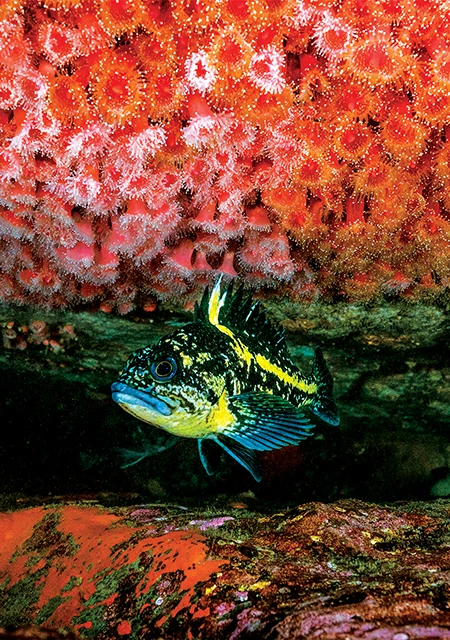
Another photographer suggested nearby Stillwater Cove.It took me a while, but I eventually located his secret spot in 70 feet (22 m), where a school of blue rockfish orbited huge granite blocks covered in white plumose anemones.
Cyan water and 30-foot (9-m) visibility were replaced with pea soup murk on another day when gelatinous drifters came to town: moon jellies, sea nettles, and spiraling chains of salps. When the wind and swell later picked up, I dived inside the cove and watched demersal dwellers such as painted greenlings, brittle stars, and multicolored dendronotid sea slugs go about their daily lives.
When the weather deteriorated further, I packed up my scuba gear and went back in time. Camping in the redwoods, I stared up in amazement at the trees and wondered how soon I could return to continue exploring NorCal’s temperamental, terrific seas.
How To Dive It
Conditions: Diving this rugged, remote coast is at the mercy of Mother Nature. Weather and sea conditions change quickly and can be extremely dangerous. Some days the only smart and safe dive plan is to stay on shore, relaxing in a campground or hiking in the woods. There is no predictable best dive season. It’s whenever, wherever conditions allow safe diving for those whose training and fitness are up to the task.
Summer and fall usually offer the most days with manageable swell and wind. Lulls between wintertime storms can be good. Spring tends to be windiest. The ocean is coldest in spring and warmest in fall, with temperatures about 48°F to58°F (9°C to 14°C). Visibility averages 5 to 20 feet (1.5 to 6 m) but can be twice that.
Currents sweep some exposed sites (e.g., points and offshore pinnacles). Wind and swell are usually present. It’s often simply too rough to dive outside the most sheltered coves. A few sites are suitable for beginners, but most require more experience.
Tips: Buddy up with people who have dived here before. The nearest dive shop is a 1.5- to 2-hour drive away in Santa Rosa, so unless you have a portable compressor, plan to rent or borrow extra tanks to maximize diving before returning to the city for fills.
Before you dive, share your dive plan (where, when, how, etc.) with someone staying on shore. Carry a compass, a surface marker buoy (SMB), and ideally a mini emergency position-indicating radio beacon (EPIRB), personal locator beacon (PLB), or similar emergency device in a waterproof container.
© Alert Diver – Q3 2026