Zachary Schlader studies the effects of environmental stressors on health.
With a foundation in community-focused research and a dedication to developing the next generation of researchers, Zachary Schlader, PhD, has developed his career into an impactful model of scholarship, mentorship, and meaningful advancement.
Schlader is an associate professor in the kinesiology department at Indiana University School of Public Health–Bloomington, where he codirects the Thermal Extremes Laboratory alongside Blair Johnson, PhD. Their team specializes in integrative physiology in extreme environmental conditions.
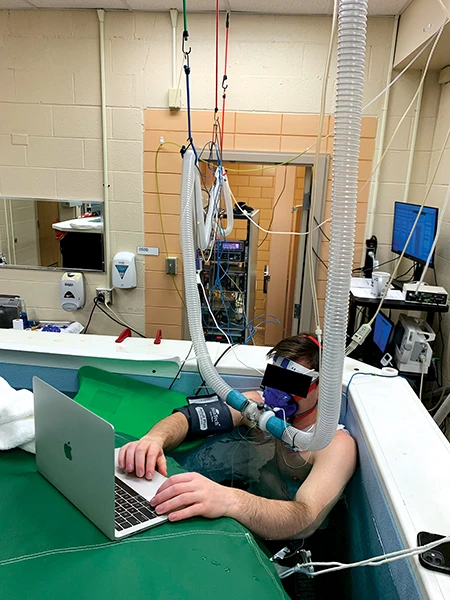
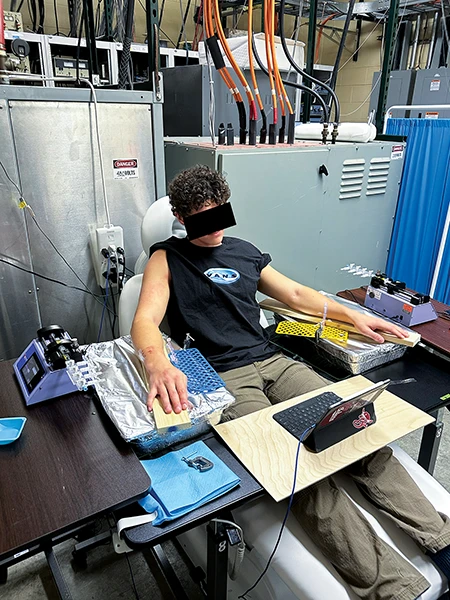
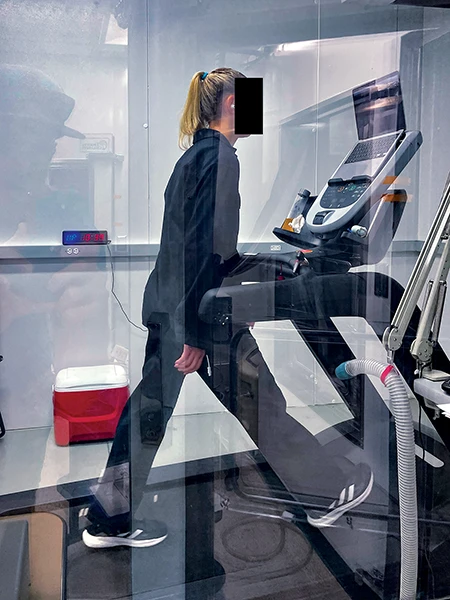
The lab is equipped with two chambers that can create environments from –40°F to 122°F (–40°C to 50°C) and simulate altitude. It also has a temperature-controlled immersion pool and swimming flume. The team’s work advances our understanding of physiological thermoregulation and the effects of environmental stressors in divers, occupational and military communities, and during public health crises such as heat waves.
How did your research journey begin?
It’s never a straight path. I did my undergraduate work at Austin Peay State University in Clarksville, Tennessee. I went there on a basketball scholarship and initially majored in biology, but all the labs for biology, chemistry, and physics conflicted with basketball practice.
“You are a student first,” my coach told me. At that time, however, I was more dedicated to basketball, so I switched my major to health, which turned out well as I got interested in exercise physiology.
I started my master’s degree in exercise physiology at Indiana University, not really knowing what I wanted to do. I thought I might go to medical school or physical therapy school, but I ended up getting involved in research. I spent one summer working on a study and making virtually no money, but it was the best summer. We lived in the lab, collected data, and learned to analyze blood samples. After that, I knew I was going to pursue a PhD and primarily do research in physiology.
My long-term goal was to work somewhere like the Gatorade Sports Science Institute. They had amazing commercials with athletes, and I thought it would be awesome to do something like that.
Along the way I became interested in the environmental physiology of how the body regulates temperature and copes with environments such as extreme heat, cold, altitude, and related stressors. My master’s thesis focused on how the body regulates temperature. I did my PhD at Massey University in New Zealand, working with Toby Mundel, PhD, on thermoregulation during exercise in heat.
I went there on a scholarship from the New Zealand government — and a blind leap. I had just gotten married the previous year, and my wonderful wife responded, “It looks like we’re moving to New Zealand!”
After that, I did postdoctoral research at the Institute for Exercise and Environmental Medicine at the University of Texas Southwestern in Dallas. Working with Craig Crandall, PhD, I studied integrative physiology with a focus on heat stress and cardiovascular control. This experience also introduced me to military-focused research.
When did your research start to involve divers?
When Dave Hostler, PhD, was appointed chair at the University at Buffalo in New York, he asked my postdoc mentor to recommend people for a couple of positions. Late one night I got a text from my postdoc mentor asking, “What do you think about Buffalo?” One thing led to another, and I got hired there. It was a great spot.
My first funded project with the U.S. Navy involved studying thermoregulation during scenarios with disabled pressurized rescue modules (PRMs). If a submarine is disabled, these PRMs go to rescue sailors. We were tasked with understanding what happens from a thermoregulation standpoint if a PRM becomes disabled in warm water. We also modeled these responses to estimate survival times and water needs.
So my introduction to diving was through thermoregulation and undersea rescue rather than open water training. If I had stayed in Buffalo longer, I probably would have become a diver. Since then, the U.S. Department of Defense undersea medicine community has been one of the communities we’ve been involved with.
How do you simulate extreme environments in your laboratory?
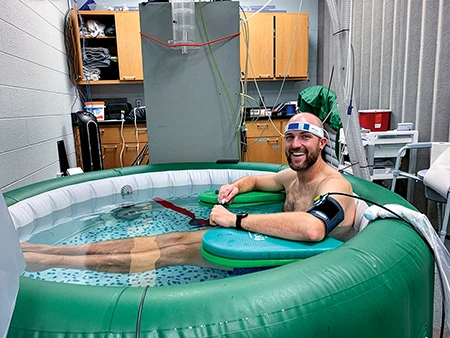
We have two chambers that can create extreme temperature environments, and they enable us to simulate almost any normobaric (normal atmospheric pressure) environment on air, including hypoxic environments. Our two immersion pools allow us to simulate swimming and conduct temperature-controlled studies of water immersion and open water swimming environments.
What are some interesting or innovative projects you’ve recently been involved with?
One thing I appreciate about the undersea medicine community is that we build new ideas based on what others in the field have identified.
One of the first projects we did at Indiana University built on the work of Melissa Ilardo, PhD, who found that Indonesia’s Bajau divers had relatively large spleens. During lunch at a program review, I asked her if she thought the response could be trained. Will my spleen get bigger, for example, if I go diving in cold water or just expose myself to cold water and hold my breath a bunch of times? She didn’t know, so we did the study.
We are working on the main papers now, but the initial observations are that you can get an enlarged spleen by two weeks of breath-hold dive training while sitting in cold water. You don’t get that adaptation unless you are cold.
We also incorporated work on whether the spleen is involved in the removal of microparticles from circulation and some inflammatory responses. It is exciting when you can connect the dots and come up with novel ways to look at a problem.
Research doesn’t necessarily lead to answers, but continuing to collect bits of information can ultimately help improve our understanding.
What impact do you want your research to have?
I think we all do this primarily because we think it’s going to make a difference. One paper probably won’t move the needle, but a volume of studies could ultimately impact clinical practice, public health practice, or military guidelines.
What guides our work is that everything has a purpose. We consistently work to know more than we did before and hope that it will help someone who has to operate in contaminated water or an extreme environment.
The other important part that we don’t always think about is that most researchers are academics who teach and mentor students. A significant part of our job is training the next generation of scientists and researchers and helping them develop new, fresh ideas. We devote a lot of our time and effort to amplifying and raising up trainees around us so they can go on to bigger and better things.
How do you see your research evolving over the next 10 years?
Many people in public health are conducting community-based research around the world. Here in Indiana, for example, there’s a big focus on rural health.
Many of these public health researchers work directly with communities to help create the next study that will help those people. I view undersea medicine as our community. I can’t predict what the next problem or question will be, but I can guarantee it will happen, and what will follow will be a community-based next step.
What sparks joy and curiosity in your life outside of the lab?
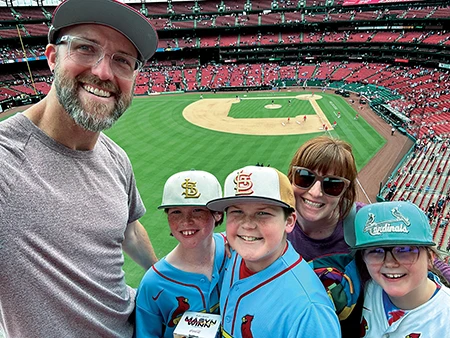
The first thing that comes to mind is my kids. Seeing the world through their eyes is amazing. Our 12-year-old is starting to show signs of becoming a teenager, but he still has moments of innocence and wonder. Our two 10-year-olds are soaking in as much information as possible, and so many things are novel and interesting for them.
They have so many random questions, which reminds me to be open-minded. They don’t have any preconceptions, and you never know what might happen. If we go down to a creek and skip rocks, they think they might find something special. That may be unlikely, but they start searching – and sometimes they find cool geodes.
We can learn from that approach in the lab and think about our work with the same curiosity and open-mindedness.
Explore More
Watch this video to learn more about the physiology studies in Zachary Schlader’s lab.
© Alert Diver – Q3 2026