Coral reefs are facing many environmental challenges, and cruise ships are a major contributor. One of these ships’ greatest impacts is starting to muddy the water.
The cruise industry is booming again after taking a hit during the COVID-19 pandemic, with more than 37 million cruise passengers estimated for 2025. The ships carry about 3,000 people on average, but some now hold more than 6,500 passengers. That many people on board creates a massive amount of waste — from sewage and gray water (wastewater from showers, sinks, and laundry) to the oily bilge water — which affects seawater quality.
Air pollution from the ships’ diesel engines and solid waste such as food, plastic, cans, and glass add to the environmental effects. A medium-sized cruise ship’s carbon footprint is greater than that of 12,000 cars. And ballast water — seawater brought into a ship’s hull to ensure stability — can transfer invasive species and diseases. (Read “Blame the Ballast” in the Fourth Quarter 2023 issue of Alert Diver for more information.)
Impact on Corals
Fragile coral reefs are especially susceptible to these types of environmental impacts. The Caribbean, home to nearly 10% of the world’s coral reefs, is the lead cruise ship destination.
Healthy coral reefs rely on a stable environment. Compromised water quality — such as by sewage, marine debris, invasive species, disease, and increased atmospheric carbon — negatively affects coral reefs and the millions of species that live there.
Sediment
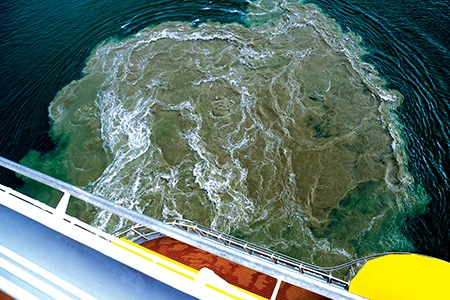
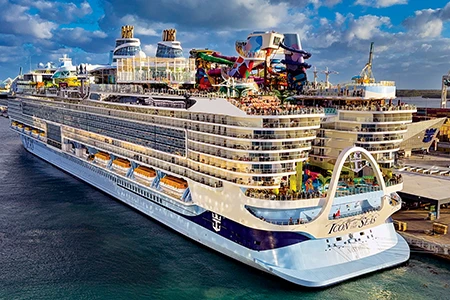
Cruise ships are large and getting larger. Most ports in the small island nations where cruises typically stop were not built to accommodate these enormous ships. As a result, ports are increasing the frequency and depth of dredge projects. They dig channels and ports deeper to accommodate larger vessels that require greater depth. Dredging destroys local habitats and adds to the sediment in the water column.
Moreover, the sediment on the bottom gets stirred up into the shallow water every time a large ship comes to port. A recent study conducted in Key West, Florida, found that it was common for cruise ships coming into port to cause turbidity levels exceeding Environmental Protection Agency limits, sometimes with levels as high as those caused by hurricanes.
Turbidity is especially problematic in habitats that generally thrive in crystal-clear water, such as what you would expect in the Caribbean, because it affects sunlight penetration. Corals are not photosynthetic, but they rely on an algal symbiont, zooxanthellae, for survival. Zooxanthellae need sunlight to photosynthesize, and they share the sugars resulting from this process with corals, providing necessary energy for coral survival.
The stirred-up sediment — containing contaminants, pathogens, and microbes reintroduced from layers of the buried seabed — can smother the coral. Some species are more susceptible to sediment accumulation, depending on their shape.
Increased sedimentation affects the early life stages of corals. If sediment is covering the substrate, coral larvae have difficulty settling. A recent study showed that sediment specifically from a port — as opposed to an offshore reef site — significantly impacted not only larvae settlement success but also the overall coral larvae survival rate. Researchers suggest the specific microbial community found within the port sediment, which in this study contained bacteria associated with coral disease, is likely a contributing factor.
Solutions
Changing the massive cruise industry is not simple, but they could make some adjustments to decrease their environmental impacts while still allowing plenty of onboard fun.
• Ships can decrease speed when coming into port to reduce sedimentation.
• The cruise industry can increase enforcement of waste-handling regulations.
• Technological advances can improve cruise ship sustainability by utilizing alternative fuels, energy-efficient LED lighting, more efficient hull designs, onboard recycling and composting programs, solar panels, and wind-powered systems.
If you plan to go on a cruise, choose a ship that has fewer environmental impacts than others. Friends of the Earth releases an annual Cruise Ship Report Card that grades 15 different cruise lines on criteria such as sewage treatment, water-quality compliance, and overall environmental footprint.
If you prefer a more sustainable vacation choice, consider an all-inclusive resort or a sailboat cruise. Even a land cruise (bus tour) would be more environmentally friendly. These options offer a lower carbon footprint, less pollution, and reduced harm to marine ecosystems — all of which add up to some serious luxury.
© Alert Diver – Q3 2025