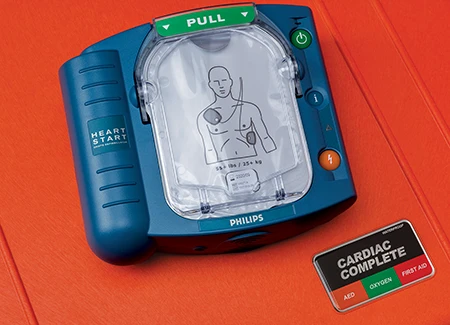
The automated external defibrillator (AED) was developed as a portable medical device and released for public use in the 1960s. The operation of AEDs has gotten simpler over the years, and the devices are now widely available for use by lay providers with basic training.
The benefits of quick application of an AED are undeniable. In many reviews of cases involving a lay provider, we see a survival rate of around 5% to 9% of cases involving CPR without an AED. With the timely application of an AED, the survival rates leap to 30% to 40%.
The use of an AED is invaluable in cases of sudden cardiac issues. Some common misconceptions, however, make many laypeople hesitant to use one. We hope discussing these fallacies will help lay providers be more confident using an AED.
Misconception: An AED restarts a flatlined heart. An AED will recommend a shock only when it detects certain (shockable) dangerous heart rhythms that cannot effectively pump the blood. An AED will not deliver a shock to a fully stopped heart with no detectable electrical activity.
Misconception: I cannot use an AED on a wet floor or in the rain. Studies show that being in a wet environment is not a concern if the pads are well-adhered to the chest.Drying the chest before applying the pads results in better adhesion.
Misconception: Do not use an AED if the injured person is on snow or ice. Snow and ice are not good conductors, so you can use an AED on someone lying on snow or ice.
Misconception: I cannot use an AED on a metal dock or boat. You can use an AED when the injured person is on a dock or boat if you make sure the pads are not touching the metal when delivering a shock. The electrical shock can move further across the body rather than just across the chest, so be especially careful that no one is touching the injured person. The current travels between the pads along the path of least resistance, however, not to the ground.
Misconception: Do not use an AED on a pregnant person. You should still use an AED. It will not recommend a shock unless the heart is in a shockable rhythm that needs to be addressed for the potential survival of the person and the baby.

Misconception: An AED will fry a pacemaker. If the pacemaker is not maintaining an appropriate rhythm in the heart, you should still use an AED. Avoid placing the pads within 1 inch (2.5 centimeters) of the pacemaker, which you can identify by a small scar and slight bump.
Misconception: I can put the pads on top of any medication patches on the chest. Never place the AED pads directly on top of a medication patch. Avoid or remove such patches, and wear gloves to avoid dosing yourself.
Misconception: I cannot use an AED on a child or infant. Some AEDs have a button or special pads on the unit to set the shock level for a child or infant. If pads for a child are unavailable, you could still use the adult pads and settings on a child. Ensure the pads are not touching. Place the pads on the front and back of an infant if needed.
Misconception: It is easy for me or another rescuer to receive a deadly shock. The electrical shock is designed to go from one pad to the other, so proper pad placement is essential. A rescuer touching the person may experience a tingling sensation. The rescuer may have an undiagnosed heart issue, so they should avoid any provocation. Touching the patient may also reduce the AED’s ability to correctly analyze the patient’s heart rhythm. Using surgical gloves will reduce the chance of shock to the rescuer.
Misconception: I must remove any jewelry on the chest before using an AED. Jewelry will not interfere with the AED, but a rescuer should not place the pad directly over any jewelry.
Using an AED can dramatically improve the likelihood of survival for someone suffering from certain dangerous heart rhythms. Lay providers should have the confidence to use this basic device without fear of harming the victim or themselves. Everyone should obtain this relatively easy training that can save a life.
Time is always critical; the faster you can respond, the greater the chance of recovery. Using an AED is only one step in the chain of survival, so don’t delay the call to emergency services for professional care.
© Alert Diver – Q3 2025