The Center for Research and Education in Special Environments (CRESE) at the University at Buffalo in New York is at the forefront of environmental physiology research, investigating how various environmental stressors impact human health and performance. Led by a dedicated team, including principal investigator Hayden Hess, PhD, CRESE’s work is integral to understanding dive pathologies, heat stress, and other occupational hazards that affect vulnerable populations, including military personnel and first responders. CRESE has a rich history and unique research facilities that combine cutting-edge science with practical applications, particularly for divers and workers exposed to extreme environmental conditions.
Hess’ journey to CRESE is a testament to the intersection of passion and purpose in scientific discovery. With a background in sports medicine and strength conditioning, his interest in diving led him to a career focused on environmental physiology. From his early experiences in sports medicine to his exploration of hyperbaric medicine and diving in Honduras, his career trajectory has been shaped by his curiosity and commitment to improving health outcomes in challenging environments. His primary research interests include thermal physiology, renal physiology, dehydration, and the effects of hyperbaric and hypobaric exposure in diving and at altitude. Hess and the CRESE researchers are not only investigating the impacts of environmental stressors on the human body but also fostering the next generation of scientists who will continue this important work.
What is your background?
My background is in sports medicine and strength and conditioning. I went to Washington State University for undergrad and completed the athletic training program. I then pursued a master’s degree in kinesiology at Boise State University. My master’s advisor was a diver, and he hosted a hyperbaric physiology course with a study-abroad trip to Roatan, Honduras. I first experienced hyperbaric medicine there and did some reef restoration. I fell in love with the underwater environment.
As I was looking for PhD programs, I stumbled upon CRESE and met Dave Hostler, who mentored me. I went on to Indiana University for a postdoctoral position to conduct comprehensive environmental physiology research. Eventually, I found myself back here as a principal investigator, doing dive and hyperbaric research and looking at the impact of heat stress in occupational settings.
Why does this kind of research excite you?
I love to ask questions and identify knowledge gaps. There are problems in the military and occupational settings related to health, safety, and performance. I get to study those problems in the lab and look for answers to drive policy change or provide information these populations can use to improve their health, safety, and performance.
How much of your work specifically relates to diving?
CRESE is a comprehensive environmental suite, and about half of our work is related to diving or hyperbaric exposure. The other half leans toward thermal stress and the impact of heat stress in hot environments, cold stress in cold environments, and hypobaric or altitude exposure.
What does the University at Buffalo, specifically the CRESE program, offer that other places do not?
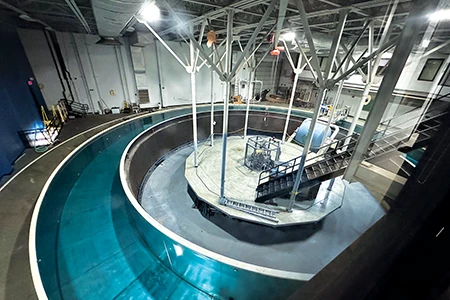
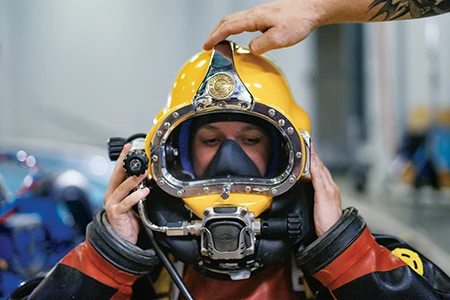
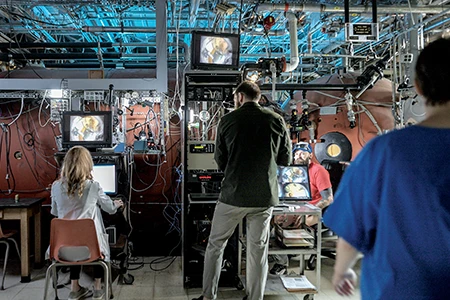
There is a large environmental suite that has two unique components. The university cleverly used water instead of concrete for a retaining wall next to the human centrifuge, which was completed in the 1970s, and quickly converted that wall into a circular pool. A lot of our initial work in CRESE was developing scuba and thermal protection equipment. We also have a hyperbaric chamber that we can fill with water on one side, allowing us to have a diver in hyperbaria with more laboratory control and experimental control over our dive exposures.
Where do you see your research being applied?
Funding from the Office of Naval Research is integral to CRESE, and much of our research enhances the performance and capabilities of soldiers and U.S. Navy divers. It also informs dive pathophysiology on a broader scale.
What do you and your team do to train hyperbaric researchers?
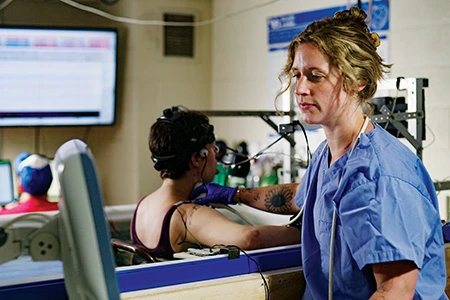
It is our responsibility as investigators and faculty at the University at Buffalo to train the next generation of scientists. Some of them are divers and have dive-related research questions, but that’s not necessary. Our studies accommodate everything from dry hyperbaric environments to partial submersion near the surface to the bottom of our pool for divers and nondivers alike. We bring in motivated and curious researchers and train them in all aspects of our studies: recruitment, retention, data collection and analysis, and how to utilize that analysis and share it in impactful ways.
Our trainees are typically here for two to five years. The cohorts tend to become tight-knit and form lasting friendships with staff that often last beyond their time here. We see each other at conferences as trainees move on to their careers. The faculty facilitates an environment that makes people feel welcome and is engaging and fun, especially when doing laborious work.
One of our primary goals with our staff is to keep the work fun, so we stoke their enthusiasm for being researchers.
The Center for Research and Education in Special Environments (CRESE) at the University at Buffalo combines diving research with environmental science. The center studies how hyperbaric exposure, thermal stress, and altitude affect human health and performance. CRESE conducts research that directly impacts diver safety and performance while training the next generation of diving and undersea medicine researchers.
© Alert Diver – Q4 2025