Citizen Science in Turks and Caicos
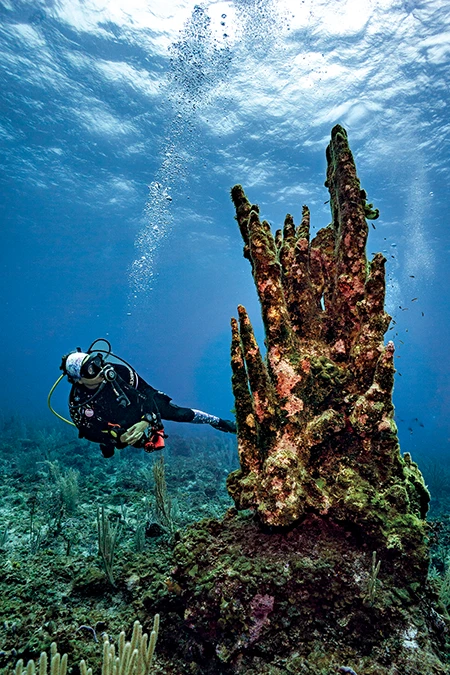
One of the Atlantic’s last truly wild places is offshore along the wave-exposed northern coast of East Caicos in the Turks and Caicos Islands (TCI).
The island is large, uninhabited, difficult to access, and lined with a reef system that has escaped the pressures of growing human activity for decades. For marine scientists, East Caicos has become something rare in the modern Caribbean: a natural laboratory. Since 2018 that laboratory has come alive through a unique collaboration between the Turks and Caicos Reef Fund (TCRF), volunteer citizen scientists, and the liveaboard Turks and Caicos Explorer II.
Expeditions sailing under the banner of RumPowered Research — a TCRF fundraising initiative blending rigorous science with hands-on public participation and with support from major rum labels — have produced the most comprehensive dataset ever collected on these remote reefs before and after the arrival of stony coral tissue loss disease (SCTLD).
Across five expeditions — with a sixth planned for 2026 — TCRF has turned a weeklong liveaboard trip into an engine of coral reef monitoring and collaborative research.
Why East Caicos?
Getting to East Caicos is neither simple nor inexpensive. The reefs lie far beyond daily dive boat range, the seas are often rough, and the island’s isolation means no shelter or services. But that remoteness is precisely why these reefs matter.
Funded by a grant from the European Commission’s Biodiversity and Ecosystem Services in Territories of European Overseas (BEST 2.0) program, TCRF surveyed 16 sites along East Caicos’ northern shore in 2018, establishing a rare predisease ecological baseline. Those early assessments revealed some of the highest coral cover recorded in TCI.
When SCTLD reached the archipelago in 2019, the need to revisit those same reefs became urgent. The original baseline provided a scientific anchor point against which change could be measured.
Due to COVID-19, we couldn’t return in 2020, but a disease survey conducted in March 2021 in collaboration with TCI’s Department of Environment and Coastal Resources confirmed the presence of SCTLD on the reefs of East Caicos. The pressure was on to go back and assess the impact. That summer RumPowered Research was born from urgency, creativity, and, of course, rum.
Mount Gay, Bambarra, and Woody Creek Distillers were our first rum sponsors, and a partnership with Explorer Ventures and the Turks and Caicos Explorer II made it possible to return to those same sites. The platform allowed researchers, students, and trained volunteers to live offshore for a week at a time, making repeated dives at historically surveyed sites.
Collaborating with other research projects looking at seabirds and turtle nesting adds another layer of resolution to a still-unfolding story of ecological change, resilience, and recovery potential.
Citizen Science as a Force Multiplier
RumPowered Research trips are built on the belief that conservation is strongest when people are actively involved. Participants do far more than observe; they contribute meaningful labor, data, and logistical capacity.
In 2025 six visitors with no scientific experience joined our team, including a family with their 16-year-old daughter. The response from that group was overwhelmingly positive: “A once-in-a-lifetime experience that we hope to repeat again and again!” was one of the comments left in the guest book.
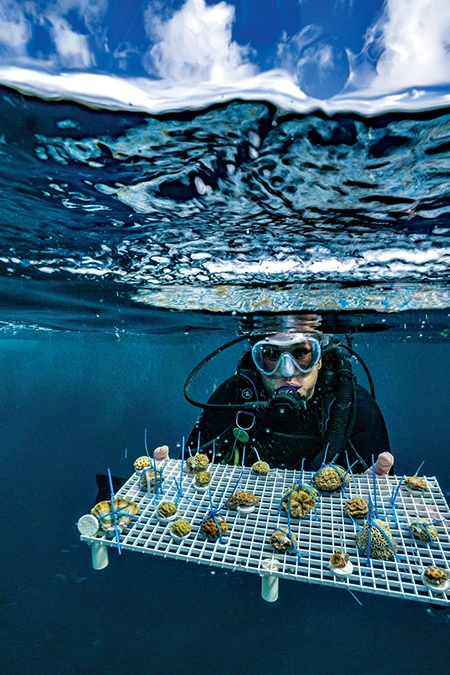
We try to make the week as interactive as possible, giving guests the opportunity to get training in coral and fish identification, disease recognition, and even data collection using standardized monitoring protocols. In the evenings we have roundtable discussions, games, and movies. Each night one of our core team members or visiting researchers presents on their work, creating a wonderful platform for brainstorming and collaboration. By the end of the week many of our guests are actively involved in laying out transects and setting up plots, directly participating in the research.
This collaborative structure dramatically increases our capacity. During the 2023 expedition, for example, seven citizen scientists worked alongside 10 researchers and seven crew members to accomplish what would be impossible for a small nongovernmental organization operating alone. The result is a dataset proportional in scale to major regional monitoring programs yet achieved with a grassroots model that brings new people into the world of reef science every year.
Seeing Change Through Time
The ability to track patterns across years is one of the RumPowered Research program’s most valuable outcomes. With consistent monitoring of repeat sites, the dataset gets more robust every year. In 2025 we set up three photomosaic plots, each measuring 82 by 82 feet (25 by 25 meters). More than 5,000 photographs per plot will be stitched together using specialized software to create a high-definition digital twin of those plots. Although data are still being analyzed, several themes have emerged.
Being remote isn’t guaranteed protection. East Caicos shows that isolation alone can’t protect marine ecosystems in an interconnected ocean. This finding highlights the need for global climate action and cutting carbon emissions.
East Caicos may hold critical genetic and ecological refugia. Although less anthropogenically impacted reefs are not immune to the effects of sea surface temperature rise and waterborne pathogens, our research still shows that these reefs may have a higher capacity for resilience and recovery in the face of modern challenges.
Combining people and computing power is best. Advances in 3D modeling and large-scale imagery now allow high-resolution data collection at unprecedented scales, but people-powered surveys remain essential for interpreting ecological context and validating digital outputs.
Collaboration at Sea
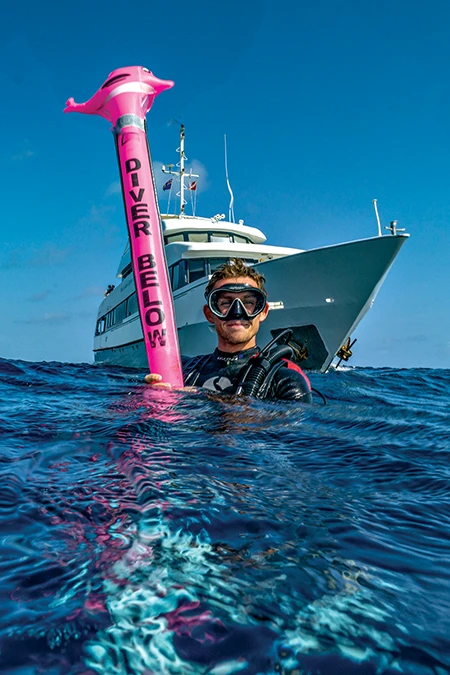
Although RumPowered Research is a TCRF-led initiative, it is fundamentally collaborative. Support from Explorer Ventures Fleet and the Turks and Caicos Explorer II crew members plays an essential role: maintaining safe diving operations, supporting scientific schedules, and adjusting routes and logistics to meet research priorities. The vessel itself is stable, spacious, and capable of reaching East Caicos comfortably and functioning as a floating field station.
Researchers from partner institutions — including the Turks and Caicos National Trust, the School for Field Studies, Royal Society for the Protection of Birds, and other regional groups — routinely join the expedition. These cross-institutional exchanges strengthen the scientific value of the trip and ensure that data contribute to shared regional goals.
The model also minimizes the environmental and financial costs of accessing remote reefs, allowing the team to simultaneously address multiple research questions.
Why It Matters
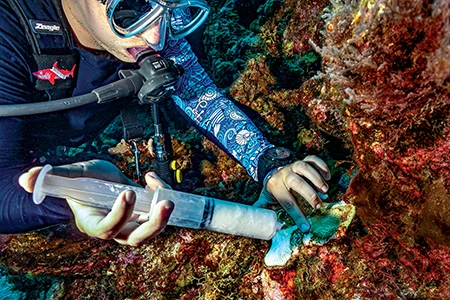
Coral reefs worldwide, including those in the Caribbean, are in rapid decline. For small island states like TCI, reefs are not only ecological treasures but also economic lifelines. Monitoring, treatment, restoration, and genetic safeguarding are urgent priorities. These efforts require time, expertise, and presence in places that are often difficult to reach.
Citizen science liveaboards bridge that gap. They provide the field capacity that small conservation organizations need while giving divers the chance to deepen their connection with the ocean in a meaningful way. Volunteers do not just witness change; they participate in understanding and addressing it.
As RumPowered Research moves toward becoming a scheduled annual charter, its long-term dataset will become increasingly valuable. Each year adds another frame to the time-lapse of East Caicos — a reef system that continues to show resilience worth fighting for. AD
Alizée Zimmermann is TCRF’s executive director.
© Alert Diver – Q1 2026